
Parent Checklist: Picking the Right Math Tool for Your Teen
Math Education
Feb 14, 2026
Feb 14, 2026
Checklist to choose middle-school math tools that match standards, use gamified learning, support varied styles, track progress, and reduce math anxiety.

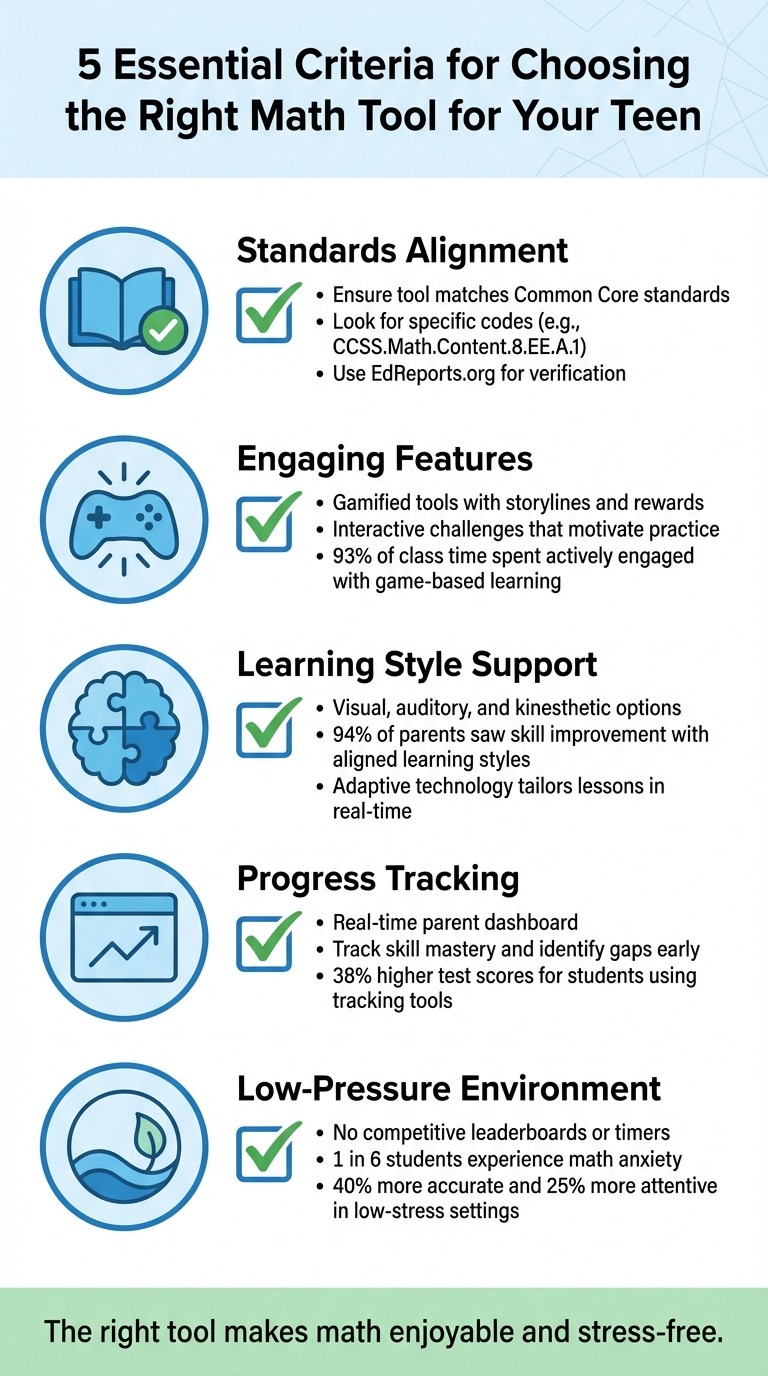
Finding the right math tool for your teen can feel overwhelming, but focusing on a few key factors can make the decision easier. The best tools align with school standards, keep teens engaged through gamified learning, cater to different learning styles, allow parents to track progress, and create a stress-free environment for learning. Here's what to look for:
Standards Alignment: Ensure the tool matches Common Core standards so your teen practices what they learn in class. Look for specific codes (e.g., "CCSS.Math.Content.8.EE.A.1") on the tool's website or use trusted review sites like EdReports.org.
Engaging Features: Gamified tools make math fun by incorporating storylines, rewards, and interactive challenges that motivate teens to keep practicing.
Learning Style Support: Whether your teen learns visually, audibly, or through hands-on activities, choose a platform that adapts to their preferred method of learning.
Progress Tracking: A good parent dashboard provides real-time insights into your teen's performance, helping you identify areas needing extra support.
Low-Pressure Environment: Avoid tools with competitive leaderboards or timers. Instead, choose platforms that encourage learning through trial and error without added stress.
One option to consider is Infinilearn, a platform designed for grades 6–8. It combines math practice with a fantasy storyline, adaptive problem difficulty, and a parent dashboard for tracking progress. A free version is available, with a premium plan at $9.99/month offering expanded features.
The right tool not only helps your teen stay on track academically but also makes math enjoyable and stress-free.
5 Essential Criteria for Choosing the Right Math Tool for Teens
Criterion 1: Common Core Standards Alignment
Why Common Core Alignment Matters
Using a math tool aligned with Common Core State Standards ensures your teen is practicing the same concepts taught in class. This is especially important in middle school, where subjects like Expressions and Equations, Functions, and Ratios and Proportional Relationships build on one another year after year.
These tools also help prepare students for standardized tests based on Common Core. For instance, if the class is working on "CCSS.Math.Content.8.EE.A.1" (which focuses on radicals and integer exponents), an aligned tool will include exercises tailored to this specific standard. This kind of targeted practice reinforces what they’re learning in school.
Additionally, Common Core alignment lays out grade-level skills clearly, helping students stay on track. It ensures they progress from mastering foundational topics like the Number System in 6th grade to more advanced areas like Geometry and Statistics by 8th grade.
Next, let's look at how you can confirm a tool's alignment with Common Core standards.
How to Check for Common Core Alignment
Follow these steps to verify whether a math tool aligns with Common Core standards:
Visit the tool’s website. Look for a "Standards" or "Alignment" section, often found in the footer or About page. High-quality tools will list alphanumeric codes (e.g., "9-12.HSN-RN.A.1") alongside exercises, showing which standards each lesson addresses .
Use independent resources. Websites like EdReports.org evaluate math tools using a detailed three-gateway system: focus and coherence, rigor and mathematical practices, and teacher/student supports. Tools with "all-green" ratings meet expectations across these areas. You can also check Common Sense Media, where educators review digital tools and confirm their alignment with Common Core standards.
Look for state-specific filters. Many tools allow you to select your state and grade level, showing topics that match your teen's curriculum. Some even offer previews - hover over a skill name to see a sample question, which can help confirm the difficulty aligns with the standard's goals.
Criterion 2: Gamified Features That Keep Teens Engaged
How Gamification Improves Learning
Gamified features can transform math practice into an engaging experience for teens. By weaving math challenges into captivating storylines, these tools tap into three essential psychological needs: autonomy (freedom to choose one’s path), competence (the satisfaction of success), and relatedness (building connections with others). This approach creates a "dopamine learning loop", where small, frequent wins release dopamine, reinforcing memory and keeping students motivated.
The effectiveness of this method is backed by research. For instance, 93% of class time is spent actively engaged when game-based learning is used, compared to traditional methods. Additionally, students in grades 3–8 using gamified math tools achieved twice the average growth on benchmark assessments. At a Title 1 school, students using such tools saw an average growth of +8.2 compared to +4.5 without them. Some platforms even incorporate video game-style mechanics, like solving equations to power hoverboards or navigate obstacles, making math practice as engaging as popular games.
"A game can draw somebody in - the same ideas may be laid out on a piece of paper or in a textbook, but they don't draw you in in the same way. You get instant feedback from a game... You can fail, and you instantly find out what happens. Then you try again, and it's not discouraging."
– Ted Stanford, Associate Professor, New Mexico State University
Gamified Features to Look For
The best tools seamlessly integrate learning into gameplay, avoiding the feel of traditional worksheets. Look for platforms with immersive storylines that place teens in adventurous roles, like battling monsters or completing missions, giving math problems a meaningful and exciting context.
Reward systems play a big role in keeping teens motivated. Whether it’s earning points, badges, virtual currency, or personalizing avatars, these features encourage consistent engagement. For example, a study of 5th-graders showed that earning "stickers" for solving problems, paired with a progress meter tracking completion from 0% to 100%, significantly boosted both their effort and focus. The meter’s design - requiring accurate, sequential answers to reach 100% - discouraged random guessing and promoted thoughtful problem-solving.
Another key feature is immediate, detailed feedback. Instead of just marking answers as right or wrong, effective platforms explain the outcomes of each action right away, helping students adjust their strategies in real time. This approach not only enhances understanding but also reduces math anxiety by framing mistakes as opportunities to learn.
The Best Maths Apps for Home Educated Children
Criterion 3: Support for Different Learning Styles
Teens approach math in unique ways. Some pick up concepts quickly with visual aids like diagrams, while others need to talk through problems or physically interact with objects to fully grasp the material. Finding a math tool that caters to these different learning styles can make a huge difference. In fact, 94% of parents noted their child's math skills improved when instruction aligned with their learning style, and 93% observed a more positive attitude toward math under these conditions.
Identifying Your Teen's Learning Style
Pay attention to how your teen tackles homework to get a sense of their learning style:
Visual learners: These teens benefit from diagrams, color-coded instructions, and neatly organized layouts. They often prefer seeing a concept modeled rather than hearing it explained.
Auditory learners: These students process information by talking through steps, explaining concepts aloud, or listening to word problems being read. This approach helps them better understand the material.
Kinesthetic learners: Hands-on activities are key for these learners. They might use their fingers or objects to solve problems and thrive with tools that let them physically interact with concepts. Long periods of sitting can be challenging for them.
"A simple understanding of how a student learns can take a dreaded subject and turn it into a success." – Rebecca, The Well Planned Gal
If you're unsure, formal tools like the VARK questionnaire (Visual, Aural, Read/Write, Kinesthetic) can help pinpoint your teen's dominant learning style. While these styles are not rigid, they offer valuable insights into how your teen learns and builds skills.
Understanding their learning style helps you choose tools that align with their strengths and address their challenges.
Tools with Personalized Learning Paths
Top-notch math tools leverage adaptive technology to tailor lessons in real time based on your teen's performance. These platforms identify areas where your teen struggles and provide targeted practice to address those gaps, creating a learning path that matches their pace.
For visual learners, look for tools with features like arrays, number lines, and 10-frames that simplify complex ideas. Auditory learners benefit from read-aloud options for word problems and voice-guided feedback that explains errors step-by-step. Kinesthetic learners thrive on interactive elements, like digital manipulatives, that allow them to engage directly with the material.
Many platforms also begin with diagnostic assessments to gauge your teen's current level and adjust content as they progress. For example, research shows that students using an adaptive program improved their RIT scores by an average of 82% more than those who didn’t. This approach not only keeps learning engaging but also reduces stress, turning math into a rewarding challenge.
These adaptive tools lay a strong foundation for the parental involvement strategies discussed in the next section.
Criterion 4: Progress Tracking for Parents
Tracking your teen's progress in math goes hand-in-hand with adaptive learning and personalized study paths. It gives you the tools to actively support their learning journey and connect the dots between at-home efforts and classroom achievements.
The Importance of Progress Tracking
Why wait for quarterly report cards to find out how your teen is doing in math? Real-time dashboards let you see what they’re learning, where they’re excelling, and where they might need extra help - before small gaps turn into big hurdles.
"One of the biggest problems of traditional report cards is that they only come out a few times a year... you might only find out about it long after the teacher had finished teaching it." – Ryan Stanley, Parent Resources Writer, Prodigy Education
These tools break down performance by specific skills, like algebra or geometry, making it easier to spot learning gaps. With this clarity, you can step in with targeted support - whether it’s helping with practice problems or reviewing tricky concepts together. Studies even show that students from disadvantaged backgrounds using these platforms score 38% higher on STAAR tests.
This ability to track progress in detail makes choosing a dashboard with actionable, easy-to-read data a priority.
What to Look for in a Parent Dashboard
A good parent dashboard strikes the right balance - it gives you useful insights without overwhelming you with too much data. Features to look for include:
Real-time activity tracking: See which skills your teen practiced, how many questions they answered, and their accuracy rates.
Curriculum mastery tracking: Visualize progress through grade-level standards. Many platforms define mastery as getting seven questions correct in a row for a given skill.
Usage metrics: Check how much time your teen spends on lessons and how many they complete, ensuring they stay on track.
Some advanced dashboards go even further. For instance, question logs let you review the exact problems your teen struggled with, helping you pinpoint where they’re stuck. Frustration detection features can alert you when repeated mistakes signal a bigger issue, so you can step in right away. For added convenience, weekly email summaries keep you updated without needing to log in daily.
Criterion 5: Low-Pressure Learning Environment
Did you know that about 1 in 6 students experience math anxiety? Many times, this anxiety stems from things like timed tests and competitive settings. That’s why the right math tool should foster a relaxed space where teens can experiment, make mistakes, and learn without the fear of rankings or high-stakes pressure.
Reducing Math Anxiety
In a low-pressure environment, mistakes aren’t failures - they’re stepping stones. Research shows that low-stakes, engaging math practice not only lowers anxiety but also improves retention. In fact, students using such methods can be 40% more accurate and 25% more attentive compared to those using traditional approaches.
"Making a mistake isn't 'wrong'; it's just a data point to adjust the slider." – Screenwise Parent Guide
Look for tools that provide immediate, non-punitive feedback. Features like step-by-step hints can turn errors into valuable learning moments. Some tools even let you hide grade-level labels, which can prevent teens from feeling embarrassed about revisiting earlier concepts.
Beyond constructive feedback, it’s equally important to steer clear of features that might add unnecessary pressure, like public competition.
Avoiding High-Stakes Competition
Competitive elements, such as public leaderboards or rankings, can often do more harm than good. Instead of motivating, these features can amplify stress and anxiety. The best tools focus on individual progress rather than comparing students to their peers.
"Without timers, leaderboards, or life counters, the tool eliminates stress-inducing competition." – Screenwise Guide on Mathigon
Opt for platforms that celebrate effort and persistence over speed or high scores. For example, some tools reward users with coins for customizing avatars - encouraging engagement in a fun, pressure-free way. Also, make sure the platform offers a solo experience without chat rooms or public profiles, which can detract from focus.
Adaptive difficulty is another key feature to look for. By tailoring problems to your teen’s skill level, these tools help maintain a "flow state", where tasks are challenging yet manageable. This keeps boredom and frustration at bay, allowing students to build confidence and truly grasp the material - all without the added stress of competition.
How Infinilearn Meets These Criteria
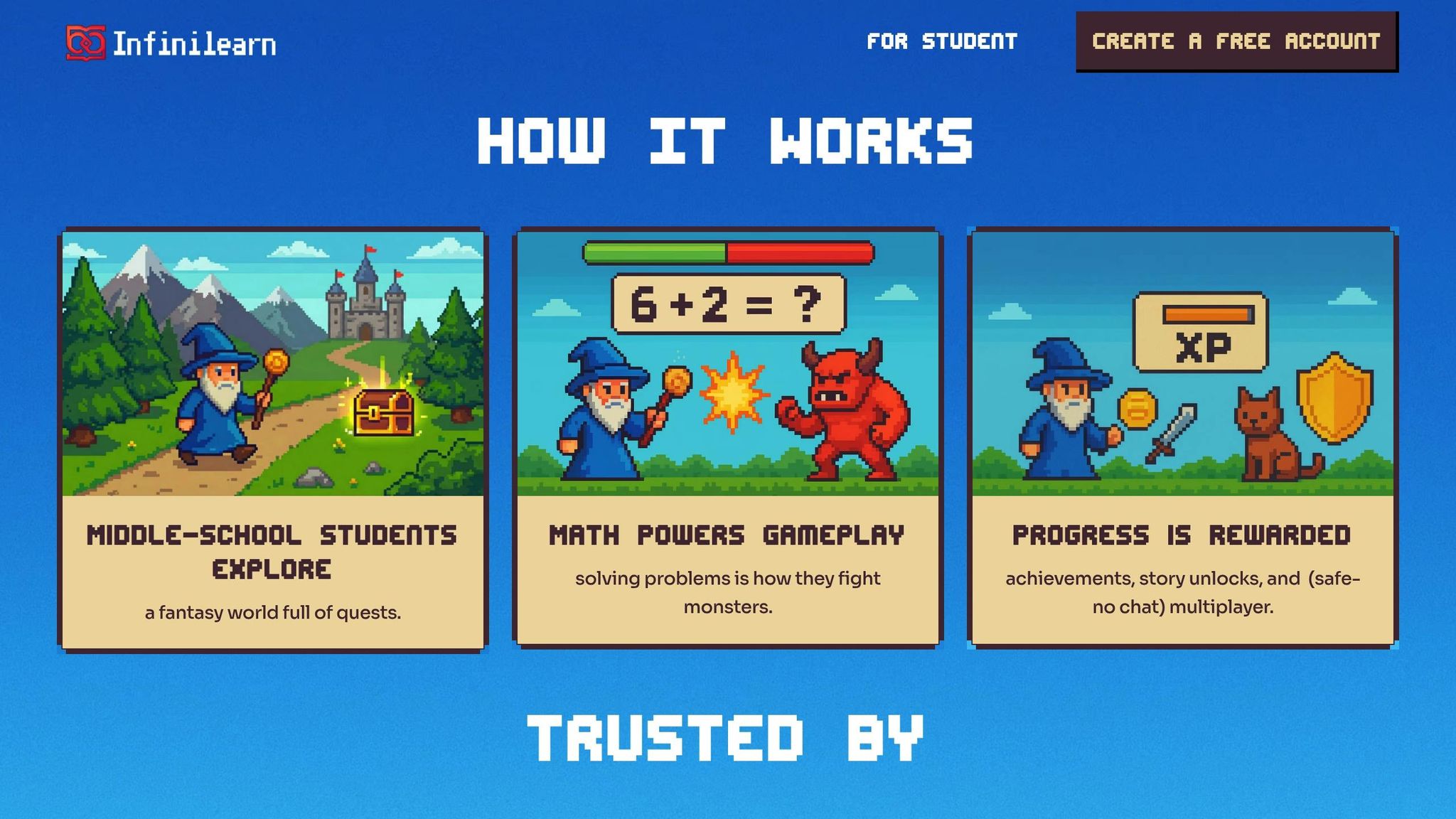
Infinilearn ticks all the boxes for an effective and engaging learning platform. Designed for grades 6–8, it blends rigorous academic alignment with interactive gameplay. The result? A tool that eases math anxiety while keeping parents in the loop.
RPG Storyline in Numeria
Through gamification, Infinilearn introduces students to Numeria, a captivating fantasy world in need of restoration. Teens take on the role of Academy apprentices, embarking on quests to recover Seal Fragments using math-powered combat. Each battle and mission is driven by solving math problems, with a system that adapts dynamically to ensure the difficulty stays balanced - challenging but never overwhelming. Along the way, students unlock achievements, progress through story chapters, and collect fun rewards like unique outfits and pets, all while practicing essential algebra and geometry skills.
Grade-Specific Math Problems
The platform ensures students tackle math problems tailored to their grade level, aligning with core standards for 6th, 7th, and 8th grades. This targeted approach helps students engage with material that matches their current abilities while exploring advanced topics like algebra and geometry. Whether your teen is just starting middle school or preparing for high school, they’ll find problems designed specifically for their learning level.
Parent Dashboard for Tracking Progress
Infinilearn’s parent dashboard provides a clear view of progress with metrics like Experience Points (XP), skill mastery, and practice time. This real-time feedback helps identify and address learning gaps without creating pressure. Parents can see which skills their teens have mastered through gameplay achievements. The free version offers basic tracking, while the premium membership ($9.99/month) unlocks in-depth reporting and exclusive in-game perks. To get the best results, Infinilearn suggests 20–30 minutes of daily practice - enough to build skills without causing burnout. Plus, the platform ensures a safe environment with no chat features or public profiles.
Conclusion
Picking the right math tool boils down to five key factors: aligning with educational standards, incorporating game-like elements, accommodating various learning styles, tracking progress, and creating a low-pressure environment. As Screenwise highlights, "Kids who are afraid of getting it wrong will never take risks in math".
Middle school often marks the peak of math anxiety, a challenge that can undermine confidence and growth. Modern algorithms are now better than ever at adapting to individual needs, helping students build resilience instead of frustration. By combining challenge with support, the right tools can ease anxiety and spark a lasting love for problem-solving.
An effective math tool doesn’t just teach - it transforms learning into an engaging, stress-free adventure. Infinilearn checks all the boxes, offering a platform tailored for grades 6–8. It provides detailed skill mastery insights for parents through its dashboard while eliminating stressors like public leaderboards or harsh grading systems.
For $9.99/month, Infinilearn’s premium plan delivers a practical and low-pressure solution. There’s also a free version so you can see if your teen connects with the gameplay before subscribing. Research supports this approach, noting that game-based learning uses the "universal language of play" to motivate students, even when tackling tough concepts.
At the end of the day, the best math tool is the one your teen will actually use. If Infinilearn’s blend of rigorous standards and engaging gameplay feels like the right fit, just 20–30 minutes a day could make a world of difference in your teen’s math journey.
FAQs
How do I match a math tool to my teen’s exact class standards?
To make sure a math tool matches your teen’s class standards, focus on those built to align with educational guidelines, such as the Common Core. Many tools highlight their standards alignment or offer resources to confirm it. Choose tools that clearly state they work with your teen’s curriculum to better support their learning journey.
What gamified features actually improve learning (not just screen time)?
Gamified features in education can transform learning into a more engaging and interactive experience. Instead of simply adding to screen time, these features actively involve students in meaningful ways. Key elements include adjustable difficulty levels that match a student's progress, instant feedback to reinforce learning, and challenges that connect math concepts to everyday situations. Games that set clear goals tied to educational standards and use visual models to simplify abstract ideas help students grasp concepts more effectively. This approach not only boosts understanding and memory but also eases math anxiety, making the learning process both productive and enjoyable.
How can I tell if a math app is helping without stressing my teen out?
To figure out if a math app works well without stressing your teen out, focus on whether it feels calm, straightforward, and visually easy to navigate. Steer clear of apps loaded with timers, excessive visuals, or overwhelming elements. Instead, opt for ones that include visual models, short, manageable challenges, and structured rewards - these features help make learning both enjoyable and stress-free.