
Top 7 Benefits of Storytelling in Math Games
Game-Based Learning
Feb 15, 2026
Feb 15, 2026
Narrative math games make problems meaningful, increasing engagement and memory while reducing anxiety and improving problem-solving and communication.
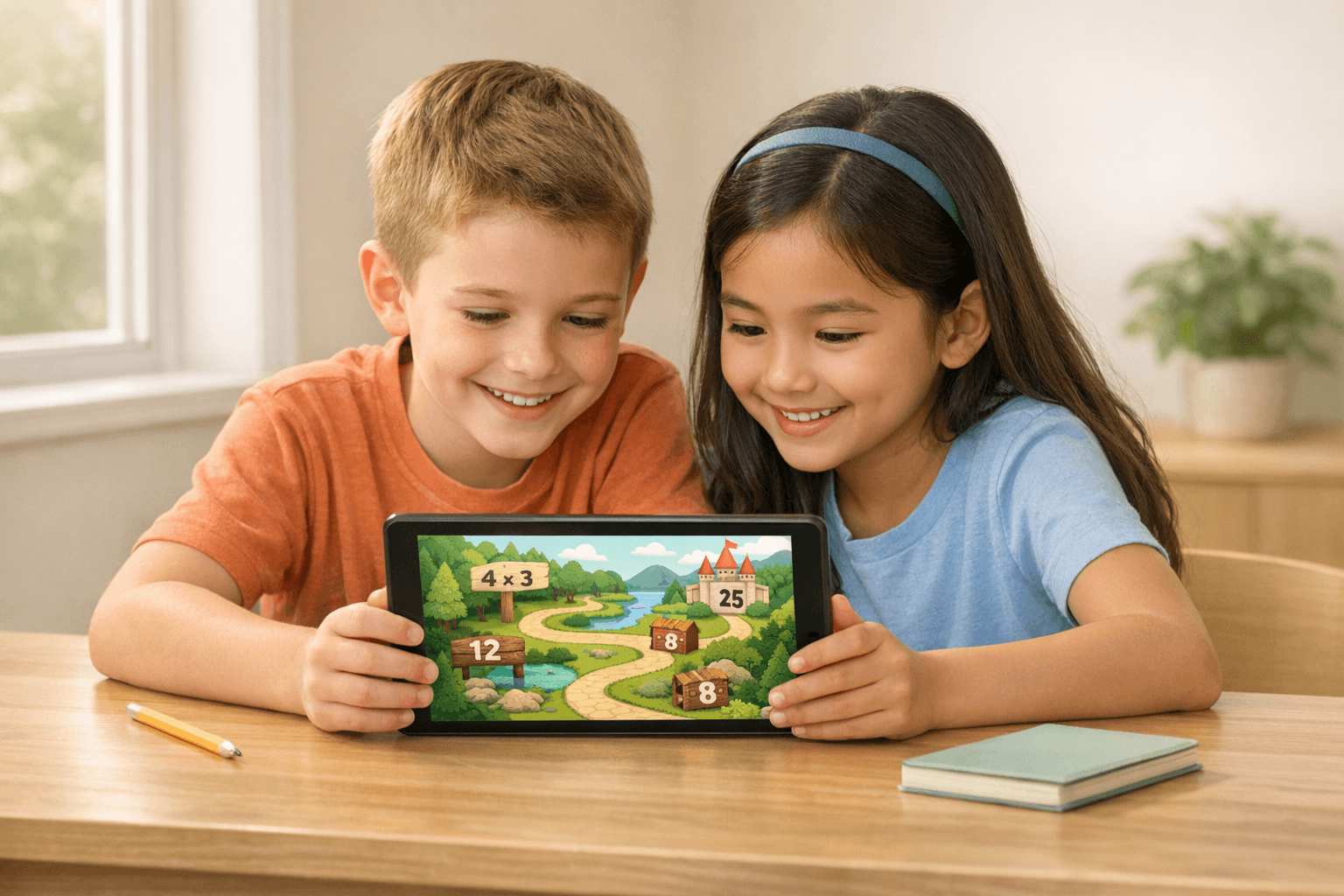
Storytelling in math games transforms how students engage with math by embedding challenges into narratives. Instead of isolated problems, students solve equations to progress in a story, making math feel purposeful and engaging. Research shows this method can improve performance, reduce anxiety, and enhance memory. Here’s why storytelling works:
Boosts Engagement: Students stay motivated by advancing the story through problem-solving.
Improves Memory: Narratives make abstract concepts easier to recall.
Reduces Anxiety: A low-pressure, story-driven environment minimizes fear of mistakes.
Activates Imagination: Combines logical and creative thinking for better understanding.
Encourages Problem-Solving: Students apply math in meaningful scenarios.
Develops Communication: Explaining math strategies becomes part of the story.
Builds Motivation: Progressing in the story becomes a rewarding experience.
For example, games like Infinilearn integrate math into battles and quests, turning learning into an adventure. This approach not only engages students but also helps them connect emotionally with math, leading to better outcomes and a more positive attitude toward the subject.
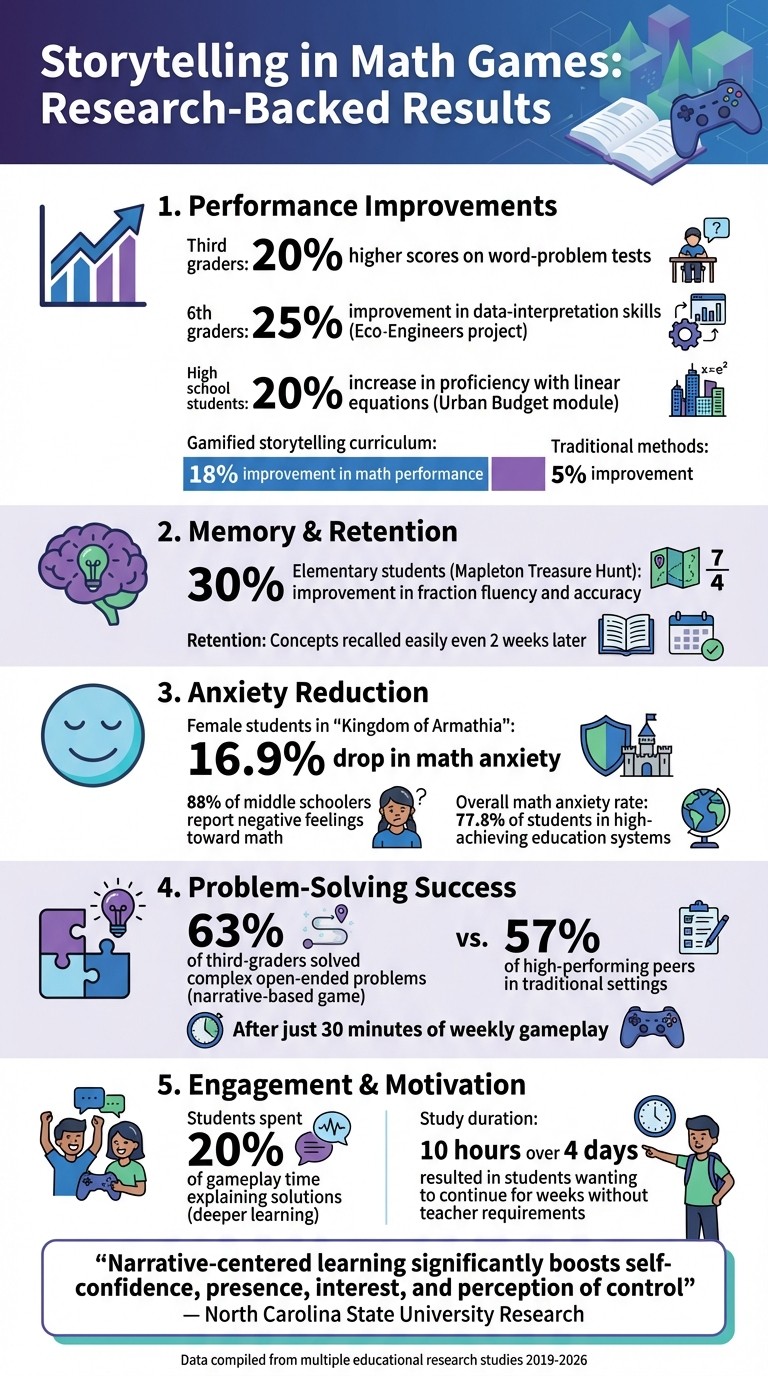
Research-Backed Benefits of Storytelling in Math Education: Key Statistics
Re-imagining Storytelling to Connect Math, Games and History
This approach is central to the Infinilearn math game, which uses a narrative-driven world to help students master complex concepts.
How Storytelling Improves Math Learning
Storytelling brings math to life by turning abstract numbers and equations into scenarios students can visualize and connect with emotionally. For example, solving an equation might help a character escape danger or manage resources in a village, giving math a clear purpose within a relatable context.
The results speak for themselves. Third graders using math-based stories scored 20% higher on word-problem tests, while 6th graders in an "Eco-Engineers" project improved their data-interpretation skills by 25%. High school students working with an "Urban Budget" module saw a 20% increase in proficiency with systems of linear equations. These examples show how blending narratives with math can deepen understanding and boost performance.
At the heart of this success is a concept called "intrinsic integration" - where math isn't just an add-on but an essential part of the story. In Infinilearn's curriculum, for instance, solving math problems drives the plot forward. Students battle monsters or repair the Arcane Seal by completing calculations, making math an indispensable part of their progress. This approach also leverages dual-coding theory, which suggests that combining verbal storytelling with visual imagery strengthens memory. When students imagine a character navigating a map using fractions or calculate a bakery’s profit margins with percentages, they’re processing information through multiple channels.
The emotional connection to the story is just as important as the intellectual engagement. When students care about the protagonist’s journey, they tackle complex math problems out of curiosity rather than obligation. This narrative-driven method enhances engagement on three levels: behavioral (active involvement), emotional (interest and enjoyment), and cognitive (strategic thinking and effort). For instance, a gamified math curriculum using storytelling led to an 18% improvement in math performance, compared to just 5% for traditional methods.
1. Increases Student Engagement and Motivation
Storytelling in math games has a unique way of drawing students in, boosting both their engagement and motivation. By embedding math challenges within a narrative, students stop wondering, "Why do we need to learn this?" and instead focus on advancing the story. Educator Alice Keeler captured this perfectly:
"When I used a story-based math game to teach my students about x intercepts in math, not one student asked me, 'Why do we need to learn this?'"
The narrative gives students a reason to engage with math - not out of obligation, but because solving problems moves the story forward.
This method transforms students from passive learners into active participants. For example, when teachers assign roles like "Agent" or "Commander" and turn worksheets into "missions" - such as solving 30 problems to unlock a secret gate - it changes the way students approach the task. Suddenly, math becomes part of an adventure, giving their work immediate purpose.
Characters and storylines also create emotional connections that drive persistence. Students become invested in characters like "Dennis the halfling" or "dwarven shieldmaidens", solving problems because they care about what happens next, not just because they have to.
Take Infinilearn, for example. It integrates math into combat scenarios, where students solve problems to defeat monsters and restore the Arcane Seal. Every calculation pushes the story forward, merging math and narrative into one engaging experience.
This approach is especially impactful for middle schoolers, 88% of whom report negative feelings toward math due to past experiences. By wrapping math in a fantasy adventure, where mistakes are just part of the game, students feel less pressure and are more likely to stick with it - not because they have to, but because they want to see what happens next. And this emotional connection doesn't just improve engagement - it also strengthens memory and recall of the math concepts they’re learning.
2. Improves Memory and Recall of Math Concepts
Using stories to teach math makes it easier for students to remember concepts. Our brains naturally latch onto vivid images from narratives - like characters, challenges, and resolutions - making abstract ideas stick.
Research backs this up. For example, elementary students who learned fractions through a story called "Mapleton Treasure Hunt" saw a 30% improvement in their fluency and accuracy with fractions. The story featured Captain Riley navigating map segments represented by fractions like 1/4, 1/3, and 1/2. Even two weeks later, students could recall these concepts more easily because the narrative gave them a concrete, memorable reference. By tying math to relatable stories, students not only understand the material better but also encode it into their memory more effectively.
This approach also benefits from the dual-coding effect, where verbal and visual cues work together to enhance memory. For instance, when students hear about a baker dividing ingredients or an architect calculating dimensions, they’re not just crunching numbers - they’re picturing the scenario. These mental images make abstract ideas more tangible. As TeachMaverick puts it:
"Mathematical storytelling transforms abstract concepts into vivid narratives that students can visualize and emotionally connect with, bridging the gap between symbols and real-world relevance."
Metaphors and personification can also make a big difference. Teachers have used "Positive and Negative Ninjas" to explain integer addition, helping students picture "zero pairs" as ninjas of equal strength canceling each other out. Another creative example involved a "love story" between a Rhombus and a Rectangle to illustrate the unique properties of a Square. These imaginative tools turn dry math concepts into lessons that students won’t forget.
In Infinilearn, math takes on a whole new life. Students aren’t just solving equations - they’re battling monsters in Numeria or completing quests to restore the Arcane Seal. These adventures weave math into the storyline, so learning becomes part of an exciting journey. Instead of rote memorization, students apply math concepts in meaningful ways, ensuring the lessons stay with them long after the adventure ends.
3. Reduces Math Anxiety in a Low-Pressure Setting
Math anxiety is a genuine challenge for middle schoolers, and it’s often triggered more by the environment than by actual ability. Studies show that anxious learners make nearly twice as many mistakes on complex tasks. Traditional classrooms, with their emphasis on grades and public performance, can worsen this anxiety. In contrast, story-driven math games flip the script, treating mistakes as natural and necessary steps in solving puzzles.
When students immerse themselves in a story, they often lose track of the fact that they’re doing math. Instead, their focus shifts to moving their character forward in the narrative. Take "The Kingdom of Armathia", for example. During the 2024/2025 school year, researchers from the University of Applied Sciences and Arts of Southern Switzerland (SUPSI) ran this experiment with 16 middle schoolers. The students became "apprentice heroes", solving fraction problems to uncover secret messages. The results were striking - female participants saw a 16.9% drop in math anxiety. Masiar Babazadeh, one of the researchers, explained:
"The gamified context motivates students... to engage with complex challenges that students with low self-efficacy might be reluctant to tackle under conventional pressure and performance evaluation conditions."
This kind of narrative-driven approach creates a safe, low-pressure environment where errors are not only accepted but expected. Researchers call this a "psychologically safe error climate". Without public scoreboards or the fear of being judged by peers, students can focus on learning rather than worrying about how they compare to others.
4. Activates Imagination and Both Sides of the Brain
Storytelling in math education does more than reduce anxiety - it fires up both creative and logical thinking. While traditional math lessons often stick to formulas and procedures, weaving a narrative into math problems flips the approach. Students find themselves moving between visualizing a story and applying logic, creating a dynamic learning experience that blends creativity with analytical reasoning.
Research backs this up. A study at Big Dipper Academy in Sequoia, California, led by Stanford University researchers Holly Pope and Charmaine Mangram, tested a game called Wuzzit Trouble. In this game, players solve puzzles to free creatures by hitting target numbers through gear turns. Edmund L. Andrews from the Stanford Graduate School of Education noted:
"The Wuzzit experiment... shows that a math game can strengthen a deeper understanding of mathematics as well as the kind of creative and flexible thinking essential for math proficiency".
This approach doesn’t just teach math - it encourages flexible thinking. Students constantly shift between the story and the math, which helps them develop adaptive reasoning and strategic problem-solving skills. They learn to conceptualize problems, explore alternative solutions, and adjust their thinking based on the narrative’s framework.
The results are promising. In one study, 63% of third-graders who played a narrative-based math game successfully solved a complex, open-ended problem, compared to 57% of high-performing peers in traditional settings - all after just 30 minutes of weekly gameplay.
Games like Infinilearn take this concept further by embedding math challenges into turn-based battles. These battles demand both imagination and logic, seamlessly blending storytelling with problem-solving.
5. Develops Critical Thinking and Problem-Solving Skills
Narrative-driven math games don’t just boost engagement and memory - they also push students to think critically and solve problems creatively. These games require players to analyze situations, plan strategies, and adapt to changing scenarios. By embedding math problems into a story, students use mathematical reasoning as a tool to tackle real-world challenges, like managing resources, trading items, or crafting strategies. This seamless blend of math and storytelling encourages deeper thinking about how to approach and solve each problem.
The benefits of this approach are backed by research. A 2019 study by Pires et al. observed 28 fifth-grade students, splitting them into two groups. Those using a gamified curriculum with narrative-based challenges improved their mathematical performance by 18%, compared to just 5% in the group following traditional instruction.
Another study, conducted in January 2026, followed 33 fifth-grade students at an urban elementary school in the Northeastern U.S. using the "First in Math" digital platform. With over 250 gamified activities, students solved problems to earn rewards. Teachers noted that the platform’s narrative and reward-based challenges significantly boosted both behavioral and cognitive engagement compared to pre-intervention levels.
Games like Infinilearn take this concept further by incorporating turn-based battles where solving math problems determines success. Students can’t rely on rote memorization or skip the math altogether - they must critically evaluate which strategies will help them succeed. This kind of problem-solving trains students for real-life scenarios where adaptability and context are key.
6. Encourages Communication of Math Thinking
Narrative-driven math games push students to articulate their reasoning as part of the story progression. This process of explaining their thought process plays a key role in deeper learning. Some games even include teachable agents that prompt students to explain their solutions, adding another layer to their understanding. Research indicates that students spend about 20% of their gameplay time explaining their solutions, which helps reinforce and deepen their math skills.
This method has been shown to improve learning outcomes. For example, in April 2024, Wei-Cheng Lee and Chiu-Lin Lai from the National Taipei University of Education conducted a study involving 52 fifth-grade students. Over four weeks, the experimental group engaged in a Gamified Collaborative Argumentation (GCA) approach for 560 minutes across two weeks. This approach tracked both individual and group performance to enhance the quality of mathematical arguments. The results? The gamified method significantly boosted learning achievement, math motivation, and collaboration skills compared to traditional methods.
"Students often focus on the efficiency of solving problems and neglect the importance of expressing statements and reasoning in the collaborative argumentation process."
– Wei-Cheng Lee and Chiu-Lin Lai, Researchers, National Taipei University of Education
In games like Infinilearn, where turn-based battles are driven by narrative, students are encouraged to internalize and communicate their math strategies. While they may not need to write out explanations, the story-driven context pushes them to understand why a particular math approach works. This mental connection between abstract math and the narrative's challenges teaches students how to translate mathematical notation into real-world problem-solving - a critical skill for effectively communicating math thinking.
7. Builds Internal Motivation Through Progress and Achievement
Tapping into increased engagement and clearer understanding of math strategies, narrative progression becomes a powerful way to spark internal motivation.
By solving math problems to unlock story chapters, students actively push the narrative forward. This turns math from an abstract exercise into a meaningful adventure, where every solved problem becomes a stepping stone toward a larger mission.
Research backs this up. For instance, a study involving eighth-grade students highlighted that narrative-centered learning significantly boosted their self-confidence and sense of control over their education. In another study with 58 middle-school students who played narrative-based math games for 10 hours over four days, researchers found that these students were eager to continue playing for weeks - without any teacher requirements.
"The motivational benefits of narrative-centered learning with regard to self-efficacy, presence, interest, and perception of control are substantial." – Scott W. McQuiggan et al., North Carolina State University
These findings show how narrative progress directly fuels self-confidence. Take Infinilearn, for example: students step into the role of Academy apprentices on a mission to save Numeria by recovering Seal Fragments. Each math-powered challenge they overcome moves them closer to restoring the world. This setup turns everyday problem-solving into a journey marked by clear, motivating milestones.
Conclusion
Storytelling has the power to turn math from a source of stress into an exciting journey. When middle schoolers dive into narrative-driven math games, they’re not just crunching numbers - they’re unlocking new storylines, building confidence, and making progress in a way that feels meaningful. Research even highlights that narrative-based approaches can help reduce math anxiety, which impacts around 77.8% of students in high-achieving Asian education systems, while also improving memory and recall.
This approach doesn’t just entertain; it hones critical thinking skills by encouraging students to see mistakes as part of the learning process in a low-pressure environment. For instance, one study involving middle schoolers found that using an RPG-based math program led to significant improvements in both their attitudes toward math and their anxiety levels.
"Storytelling has proven to be an effective tool for motivating students in mathematics by making the subject more comprehensible and enjoyable." – European Journal of Psychology of Education
For educators and parents, the key to success lies in choosing platforms where the story is deeply woven into the math content, rather than acting as a superficial backdrop. Take Infinilearn as an example: students solve math problems embedded directly into turn-based battles in the fictional world of Numeria. Here, they play as academy apprentices on a mission to recover Seal Fragments, ensuring that every solved problem moves the story - and their learning - forward.
When students become invested in a story’s outcome, they’re motivated to tackle even the toughest calculations out of curiosity rather than obligation. This shift - from resistance to engagement - brings benefits like better memory, reduced anxiety, and stronger critical thinking skills. It’s a compelling reason why storytelling has the potential to reshape how middle schoolers experience math.
FAQs
How can you tell if a math game's story effectively teaches math?
To figure out if a math game's story helps teach math effectively, see if the narrative promotes meaningful problem-solving and gets students involved in mathematical reasoning. Check for supporting evidence, like research that connects storytelling with better math skills, to confirm the game contributes to learning.
What math topics work best with storytelling for grades 6–8?
Storytelling pairs exceptionally well with math topics such as number concepts, operations, patterns, and solving problems tied to everyday life. By weaving abstract ideas into relatable narratives, it transforms learning into a more engaging and meaningful experience for students.
How much weekly play time is enough to see results?
Playing educational math games for just 10–20 minutes per session, three times a week, can make a big difference in math skills. Studies have found that consistent play leads to noticeable progress in just a few weeks. These short, regular sessions not only strengthen learning but also keep the experience fun and easy to stick with.