
Study: Gamified Learning Reduces Math Anxiety
Game-Based Learning
Feb 17, 2026
Feb 17, 2026
Research shows gamified math lessons reduce anxiety and boost engagement and confidence with adaptive difficulty, instant feedback and progress tracking.
Gamified learning makes math less stressful and more engaging by turning lessons into games with points, levels, and storylines. This approach helps students overcome math anxiety, a common issue that affects their confidence and performance. Research shows gamified tools can reduce anxiety by 16.9% in some cases, improve math attitudes, and boost engagement by over 30%.
Key Takeaways:
Gamified learning integrates math into games, making it feel like an adventure rather than a chore.
Features like adaptive difficulty, instant feedback, and interactive gameplay help students stay motivated and reduce fear of failure.
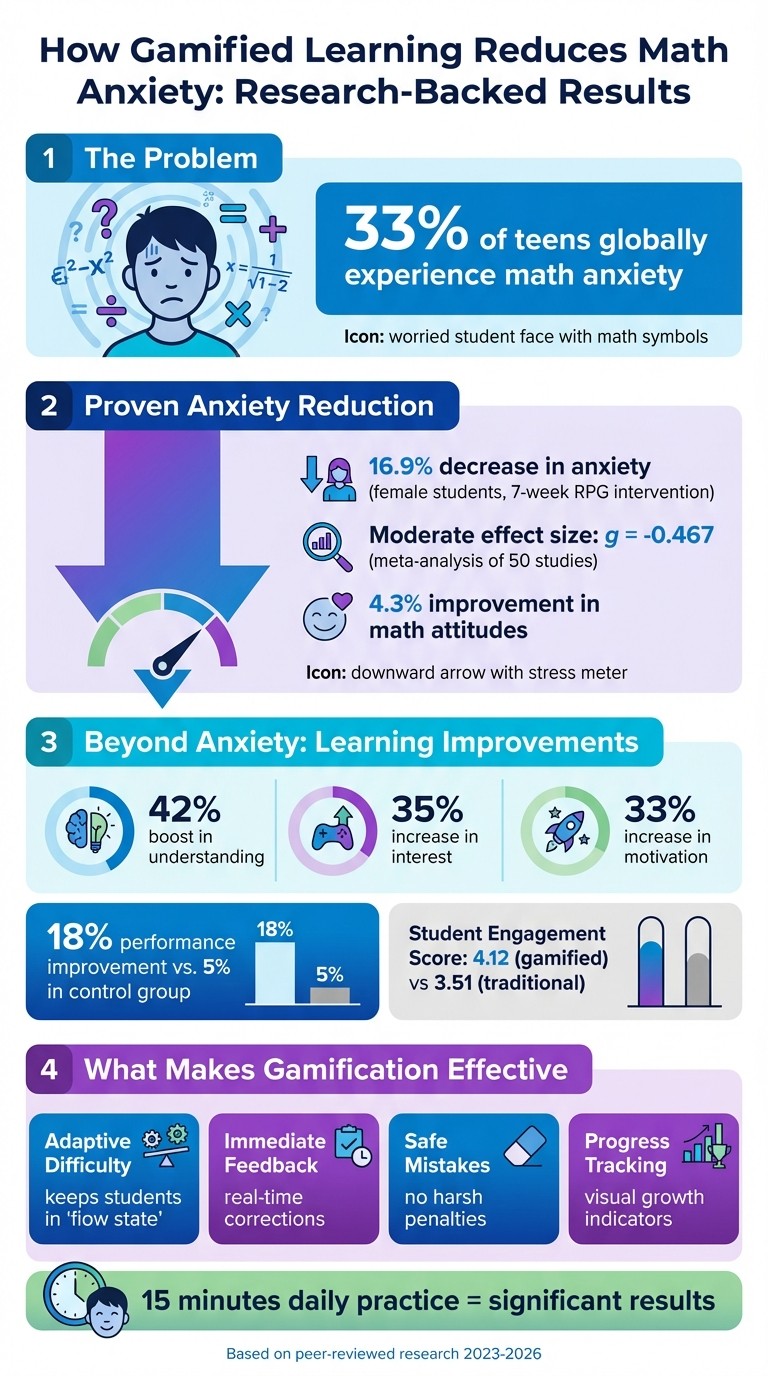
Math anxiety impacts 33% of teens globally, but safe, supportive tools can help break this cycle.
Platforms like Infinilearn and First in Math use private progress tracking and low-pressure challenges to build skills and confidence.
Gamified learning isn’t about replacing traditional teaching but creating a safe, fun space where students can practice, make mistakes, and grow at their own pace.
Gamified Learning Impact on Math Anxiety: Key Statistics and Benefits
What Research Shows About Gamified Learning and Math Anxiety
How Gamification Affects Student Psychology
Gamification taps into two critical psychological factors: perceived control and perceived value. When students feel they have control over their learning - through experiences that allow them to build skills and tackle challenges at their own pace - and see math as engaging rather than intimidating, their anxiety levels naturally decrease. This idea is rooted in the Control-Value Theory, which shifts students from feeling powerless to feeling capable.
One of the most impactful aspects of gamification is its ability to create a "psychologically safe" learning space. Instead of penalizing mistakes with harsh consequences like lost points or public ranking drops, well-designed games treat errors as a normal part of learning. This approach lessens the fear of failure, a key driver of math anxiety, and encourages students to experiment, make mistakes, and try again without the emotional weight of traditional assessments.
"Games provide mastery experiences through progressive challenges, immediate feedback, and opportunities for repeated success, thereby strengthening learners' sense of competence and control."
Ljerka Jukić Matić, School of Applied Mathematics and Informatics, University of Osijek
Data on Anxiety Reduction
The numbers back up gamified learning's potential to ease math anxiety. A 2023 meta-analysis of 50 studies reported a moderate reduction in math anxiety (g = -0.467). Similarly, a seven-week role-playing game (RPG) intervention in Ticino led to a 16.9% drop in anxiety among female students and improved overall math attitudes by 4.3% (p = 0.045 and p = 0.014, respectively). However, not all studies show equally strong effects. A separate meta-analysis of 16 studies found smaller impacts (ES = -0.32, with digital games at ES = -0.13), highlighting the importance of thoughtful game design.
"The weak results obtained indicated the need to develop and test games explicitly designed for math anxious students."
Pierpaolo Dondio, Technological University Dublin
How Gamified Learning Works
Certain design elements make gamified learning particularly effective at reducing anxiety. One key feature is adaptive difficulty, which dynamically adjusts challenges to a student’s skill level. This keeps learners in a "flow" state - engaged but not overwhelmed - making it easier to build confidence. Another is immediate feedback, which provides students with real-time corrections, helping them adjust and learn on the spot. This boosts their sense of mastery and reduces anxiety.
Interactivity also plays a major role. Features like manipulating digital objects can reduce the impact of anxiety on performance. By engaging working memory, these interactive elements help block out the intrusive thoughts that often accompany math anxiety. Research shows that math anxiety has a much smaller effect on performance in high-interactivity settings compared to low-interactivity ones.
Social aspects further reinforce the benefits of gamified learning. Collaborative gameplay offers peer support, which eases individual performance pressure and lowers anxiety. Interestingly, non-digital games often show stronger anxiety-reducing effects than purely digital ones, likely because they naturally incorporate social interaction.
Modern gamified platforms are already applying these principles. For instance, Infinilearn combines adaptive difficulty, instant feedback, and collaborative gameplay in a 2D role-playing adventure. This creates a supportive environment where middle school students can not only improve their math skills but also build confidence. Together, these insights show how well-crafted gamified learning tools can make math less daunting and more accessible.
Other Benefits of Gamified Learning
Increasing Engagement and Motivation
Gamified learning does more than just ease anxiety - it captures students' interest in math in a way traditional methods often can't. Research highlights that gamification engages students on multiple levels: behaviorally, emotionally, and cognitively. This comprehensive engagement keeps students involved longer and encourages greater effort compared to standard teaching methods.
For instance, studies show that gamified approaches can lead to a 42% boost in understanding, along with increases in interest (35%) and motivation (33%). Middle school students using a gamified curriculum scored 4.12 on the Student Engagement Scale, significantly higher than the 3.51 scored by students in traditional classrooms. Performance improvements also stand out - students in gamified math programs saw an 18% improvement, compared to just 5% in the control group.
This heightened engagement fulfills students' need to feel competent while striking a balance between challenge and skill. By keeping students actively involved, gamified learning not only sparks interest but also helps reduce math anxiety, making the learning process more immersive and less intimidating.
Take the "First in Math" platform as an example. In January 2026, a study involving 33 fifth-grade students at an urban Northeastern U.S. school explored how this tool integrates gamification into math practice. Over 250 gamified activities were used during daily 15-minute sessions. One activity, "Equivalents", tasked students with solving fraction and decimal problems to fill a strength meter. This format discouraged random guessing and encouraged strategic problem-solving.
These engagement benefits naturally lead to another key outcome: improved student confidence, as discussed next.
Building Confidence Through Progress Tracking
When students are more engaged, progress tracking becomes a powerful tool for boosting confidence. Gamified learning often uses visual tools like dashboards and strength meters to show students their growth in real time. Unlike traditional tests, which can feel like a one-time judgment, gamified feedback focuses on incremental improvement. It encourages students to view mistakes as part of the learning process rather than as failures. By turning assessments into visual markers of progress, gamified systems help reduce both anxiety and self-doubt.
The "First in Math" platform illustrates this well. Its strength meter tracks progress from 0% to 100%, requiring students to solve problems accurately and in sequence. Incorrect answers result in small setbacks - about one-twelfth of the progress bar - which discourages random guessing while keeping the focus on steady improvement. When progress tracking emphasizes individual growth rather than public competition, it also helps minimize the stress often tied to math performance. For example, students using a Scratch-based gamified assessment felt less pressure from evaluations, leading to lower levels of teacher-related anxiety and social stress.
Infinilearn adopts a similar approach by providing private progress dashboards accessible to both parents and teachers. As students navigate Numeria and participate in math-based challenges, they build their skills in a low-pressure environment without the stress of competing against peers. This system transforms math practice into a series of manageable goals, fostering a mastery-driven mindset and helping students grow their confidence step by step.
How Parents and Teachers Can Use Gamified Learning
Using Gamified Learning at Home
Parents can tackle math anxiety by setting up a simple, 15-minute daily routine that incorporates gamified math activities. This consistent habit not only builds confidence but also encourages strategic problem-solving, or what experts call metacognitive awareness.
Take advice from Kelly Sheen, a fourth-grade teacher at Wilcox-Hildreth Elementary in Nebraska. By the end of the 2024–2025 school year, she reduced the number of students needing extra math help from eight to just two. Her secret? She played the games herself first.
"By experiencing the games myself, I learned how to implement them... I could see firsthand how to weave them into lessons, when to use them for review versus pre-teaching, and how to keep the fun from becoming a distraction."
Kelly Sheen, fourth-grade teacher at Wilcox-Hildreth Elementary
When parents understand how the games work, they can celebrate their child's achievements - like beating a boss or earning a badge - and encourage their child to explain the steps they took to solve problems. This not only deepens understanding but also helps combat the summer learning slump, when 70% to 78% of students lose math skills. Tools like Infinilearn’s private progress dashboard can be a game-changer, offering parents a clear view of their child's progress through Numeria. It highlights areas needing reinforcement without adding the stress of competition.
These small, consistent actions at home lay the groundwork for even greater success in the classroom.
Using Gamification in the Classroom
While gamified learning at home builds personal accountability, its impact grows exponentially in a classroom setting. Teachers who use gamified platforms effectively can identify struggling students in real-time and provide tailored support. For example, in January 2026, a group of fifth-grade teachers in the Northeastern U.S. introduced a 15-minute daily gamified math program immediately after core lessons. The results? Students showed higher engagement and persistence, especially with challenging topics like fractions and decimals.
The timing and purpose of gamified activities are key. Using specific game modules for low-pressure test prep or as warm-up exercises to revisit earlier lessons can help prevent skill loss over summer and improve knowledge retention. Instead of treating these games as mere rewards, teachers can assign them with clear weekly goals. This approach not only reinforces learning but also helps ease the anxiety many students feel about math.
Creating a safe environment for mistakes is just as important. Avoid platforms with public leaderboards or penalties like losing "lives" for wrong answers, as these can heighten emotional stress. Instead, choose tools that treat mistakes as part of the learning journey. For instance, Infinilearn incorporates math problems into turn-based battles where errors don’t lead to public embarrassment or rank drops. Students simply continue their adventure in Numeria, learning at their own pace.
"Game-based learning isn't about replacing rigor. It's about sparking curiosity, reducing fear and fostering a genuine love of learning."
Kelly Sheen, fourth-grade teacher at Wilcox-Hildreth Elementary
Teachers, Try This: Gamify Instruction to Reduce Math Anxiety and Improve Test Scores
Conclusion: What's Next for Gamified Math Learning
Research highlights that gamified learning tools can help break the cycle of math anxiety - when they are designed with psychological safety in mind. Studies show that combining skill-building with techniques to regulate anxiety can lead to significant improvements, with effect sizes reaching g = -1.09. However, many current digital tools fall short, as a 2023 meta-analysis revealed a much smaller impact (ES = -0.13). These findings pave the way for a new generation of solutions in math education.
Future math tools need to go beyond basic quiz formats. Designs that are sensitive to anxiety should include real-time adjustments based on student stress levels. Instead of competitive leaderboards, collaborative modes can reduce social pressure and encourage teamwork. For example, Infinilearn already incorporates features like adaptive difficulty, turn-based battles to handle mistakes safely, and private progress tracking.
"Addressing MA effectively requires integrated approaches that simultaneously provide cognitive support, foster emotional regulation, and promote positive attitudes toward math."
Ljerka Jukić Matić, University of Osijek
Looking ahead, mastery-based tracking and distributed practice will be key. Short, consistent practice sessions over weeks - not high-stakes tests - help build both skill and confidence. With 33% of 15-year-olds across 65 countries reporting feelings of helplessness when solving math problems, the need for tools grounded in research has never been more pressing.
When gamified learning prioritizes psychological safety and steady progress, students can not only overcome math anxiety but also gain skills that last a lifetime. Tools that treat mistakes as opportunities, offer challenges tailored to individual needs, and provide a safe space for practice can transform how students engage with math. By fostering resilience and strategic thinking, these tools can empower students to succeed in math - and beyond.
FAQs
How can I tell if my child has math anxiety?
When it comes to math tasks, watch for physical signs such as a racing heart, sweating, or even an upset stomach. These can be subtle indicators of stress. On the behavioral side, you might notice things like fidgeting, avoiding math activities altogether, taking frequent bathroom breaks, or expressing negative thoughts - statements like "I’m bad at math" often reveal deeper anxiety.
If these behaviors go unnoticed, they can contribute to skill gaps over time. Spotting them early is crucial for tackling math anxiety and helping individuals build confidence in their abilities.
What game features help reduce math anxiety?
Gamified learning tools offer several features that can ease math anxiety by making the subject feel more approachable and enjoyable. Techniques like storytelling, role-playing, and collaborative tasks transform math into an engaging experience, helping learners feel less overwhelmed.
Key components such as adaptive difficulty, which adjusts to a learner's skill level, and immediate feedback provide a supportive environment for growth. Low-stakes practice further boosts confidence by allowing learners to make mistakes without fear of judgment.
Interactive elements like explorable worlds, problem-solving challenges, and multiplayer modes foster active participation. These features not only tackle the logical side of math but also address emotional barriers by building a sense of community and support among learners.
How can we use gamified math for just 15 minutes a day?
To make the most of gamified math in just 15 minutes a day, focus on short, interactive sessions that emphasize fun and learning. Studies suggest that even quick, focused activities can help ease math anxiety and improve confidence. Dedicate a specific time each day to tackle activities like puzzles, level-based challenges, or interactive problem-solving. Keeping the sessions consistent and enjoyable not only builds confidence but also ensures the practice remains stress-free and effective.