5 Benefits of Real-Time Feedback in Math Games
Game-Based Learning
Feb 16, 2026
Feb 16, 2026
Instant feedback in math games boosts engagement, speeds skill growth, personalizes practice, improves problem-solving, and gives teachers real-time insights.
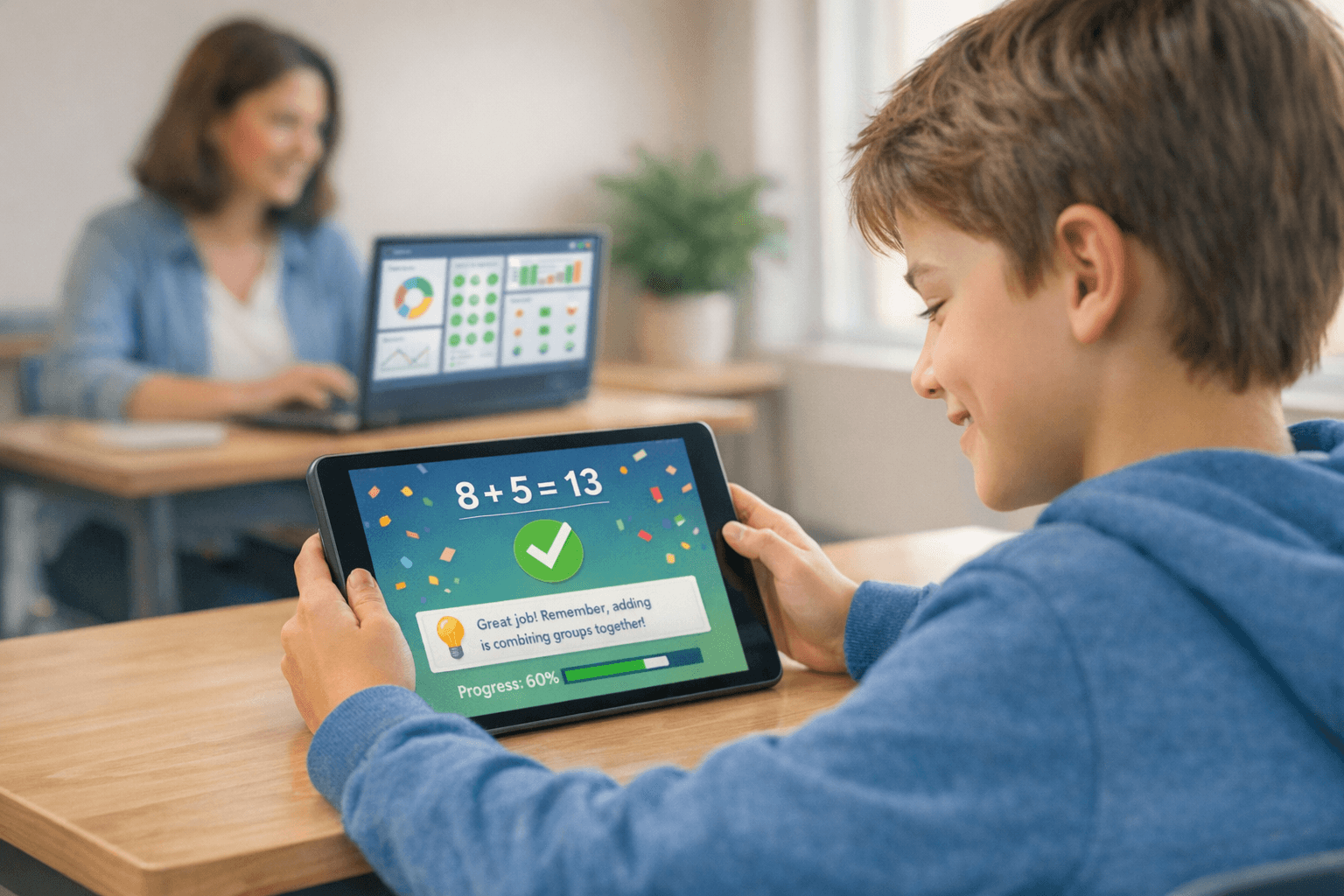
Real-time feedback in math games offers immediate responses to student actions, helping them learn faster and more effectively. It keeps students engaged, improves problem-solving, and provides personalized learning experiences. Teachers also gain insights to address learning gaps. Here's what makes it impactful:
Instant Error Correction: Students correct mistakes immediately, avoiding bad habits.
Boosts Engagement: Rewards and progress tracking make learning enjoyable.
Improves Problem-Solving: Students refine strategies in real time.
Customizes Learning: Challenges adjust to individual skill levels.
Supports Teachers: Data helps identify and address student needs.
Real-time feedback turns math practice into an interactive, supportive, and effective experience.
1. Instant Error Correction and Learning Reinforcement
When students make mistakes, real-time feedback steps in immediately, identifying the error, comparing it to the correct answer, and providing an instant response. This quick cycle keeps frustration at bay and helps maintain focus. By addressing errors while they’re still fresh, students avoid reinforcing incorrect methods, laying the groundwork for meaningful skill development.
Research backs this up: real-time feedback can accelerate math skill development by up to 3× faster. Studies also reveal that students perform better in problem-solving when engaging with online games that offer feedback, as opposed to traditional paper-based methods without it. This instant feedback transforms mistakes into valuable "learning moments", helping students grasp what went wrong before bad habits take root.
Advanced systems go a step further, offering scaffolded hints and guiding questions to promote independent thinking. Take Infinilearn, for example: when a 7th grader struggles with an algebra problem during a monster battle, the game provides targeted hints instead of simply giving away the answer. This approach encourages students to solve problems on their own, boosting their confidence along the way.
"Every game has a positive effect and gives me confidence." – PSTASHIO, Funexpected App User
Confidence-building is essential, especially since early math skills are a stronger predictor of academic success than reading skills. Just two 15-minute practice sessions per week in a feedback-rich environment can lead to noticeable improvements in math, logic, and spatial reasoning. The timing of feedback is key - it arrives the moment students encounter a challenge, maximizing both engagement and learning. This process showcases how real-time feedback turns mistakes into stepping stones, highlighting the strategic benefits of multiplayer math games.
2. Higher Engagement and Motivation
Real-time feedback transforms math practice into an interactive and rewarding experience. When students receive instant recognition - like points, badges, or progress bars - for solving problems correctly, they feel a sense of achievement that keeps them engaged. Research indicates that 73% of students are more motivated when they get direct feedback on their understanding, and 80% feel more connected to content when gamification elements are paired with real-time evaluations. This immediate acknowledgment not only boosts motivation but also encourages strategic learning, as demonstrated in various classroom scenarios.
The benefits go beyond just creating a positive feeling. Instant feedback helps prevent misunderstandings and enables students to adjust their approach right away. By seeing their progress in real time, learners take control of their educational journey, making quick adjustments to improve their performance.
Take Infinilearn as an example: the platform uses a progress meter that tracks students' advancement from 0% to 100%. Correct answers move the meter forward, while incorrect ones subtract a small portion, discouraging random guesses. This design has been shown to enhance both focus and cognitive engagement. On top of that, students earn digital rewards - like stickers for mastering fractions, decimals, or percentages - which further encourages thoughtful problem-solving.
"Rewards were not viewed merely as incentives but as feedback mechanisms that validated student effort and signaled progression." - Dele-Ajayi et al., Researchers
This kind of validation is crucial because it fosters a safe environment for failure, allowing students to experiment and learn without the usual academic pressures. For instance, in Infinilearn, when a 6th grader solves an equation to defeat a virtual monster, they’re rewarded immediately with experience points and loot. What might have been a nerve-wracking test question becomes an exciting win. These rewards unlock harder challenges, encouraging students to push themselves further. The results speak for themselves: gamified math platforms have shown a 35% rise in student interest and a 33% boost in motivation.
3. Better Problem-Solving and Critical Thinking
Math games with real-time feedback transform learning into a hands-on, interactive experience. They create a safe space for students to experiment, make mistakes, and refine their strategies on the spot. When students attempt a problem and get immediate feedback, they engage in a dynamic process: testing ideas, observing outcomes, and adjusting their thinking as needed. This builds critical thinking skills that go far beyond simply memorizing formulas.
The shift from traditional methods is striking. Research by Angeliki Kolovou and Marja Van Den Heuvel-Panhuizen at Utrecht University shows that students using online games with feedback are better at solving non-routine problems compared to those learning through conventional approaches. The constant feedback loop encourages students to identify and correct their errors, fostering independence and prompting them to check their work more frequently. Additionally, the speed of feedback plays a key role in sharpening critical thinking.
Timing also matters. Melissa Sommerfeld Gresalfi and Jacqueline Barnes highlight that well-timed feedback boosts engagement and enhances the learning process. When students receive feedback immediately after making a choice, it promotes metacognitive awareness, helping them analyze their approach and make adjustments on the fly.
Infinilearn integrates these principles seamlessly into its gameplay. For instance, imagine a 7th grader miscalculating an algebraic expression during a boss battle. The consequence - like losing health points or missing a turn - becomes a teaching moment. The student can quickly try a new approach, figuring out whether the mistake was due to a simple miscalculation or a deeper misunderstanding. As Alter Learning Games puts it:
"In game-based learning, failure isn't the end - it's a clue".
This approach encourages active problem-solving rather than passive task completion. It's especially effective for tackling complex, non-routine problems - those that involve multiple interconnected variables and lack a clear formula. These challenges mirror the kind of adaptive thinking and problem-solving students will need in real-world math scenarios. The real-time feedback loop in multiplayer math games makes this process even more engaging and impactful.
4. Personalized Learning Through Adaptive Feedback
Adaptive feedback customizes challenges to match each student's learning pace. Instead of applying a uniform approach, these systems analyze factors like success rates, time spent on tasks, and recurring mistakes to adjust the difficulty level in real time. This method helps keep learners in their Zone of Proximal Development (ZPD) - the sweet spot where tasks are challenging enough to encourage growth but not so difficult that they become overwhelming.
Research backs this up. In a study involving nearly 1,000 young students, significant learning improvements were observed when games were tailored to individual skill levels. The most notable gains were seen in students who began with lower math proficiency. Another large-scale study by WestEd, which included over 14,500 students, revealed that those who played 50 or more curriculum-aligned games saw a 25 percentile point boost in their annual exam scores. The adaptive system pinpointed specific knowledge gaps and provided targeted exercises to address them. These insights directly influence Infinilearn’s adaptive design, ensuring each math challenge is perfectly aligned with a student’s current abilities.
In practice, Infinilearn applies these principles by adjusting problem difficulty based on grade level and performance. For instance, if a 6th grader encounters difficulty with fractions during a Numeria battle, the game offers scaffolded support like hints or simplified tasks, helping the student learn from their errors right away. On the other hand, if an 8th grader excels at algebraic expressions, the game increases complexity to maintain their engagement. This mastery-based progression ensures students thoroughly understand a concept before moving on to more advanced material.
5. Teacher Insights and Data-Driven Instruction
Real-time feedback doesn’t just benefit students - it’s a game-changer for teachers, too, giving them the tools to identify and address learning gaps with precision.
Digital math tools automatically collect performance data, making it easier for teachers to see which concepts students have mastered and where they might be struggling. This streamlined approach helps educators make informed decisions about their instruction. In fact, a survey of elementary educators in the U.S. and Canada revealed that 91% found it easy to monitor progress using visual tools, and 70% noticed improvements in math fluency during class.
By using this data, teachers can create small, targeted groups to address specific learning needs. For instance, a WestEd study involving over 14,500 students showed that 5th and 8th graders who used game-based tools twice a week scored up to 23 percentile points higher on standardized tests. Teachers achieved these results by using real-time reports to track mastery levels and time spent on key standards, which allowed them to adapt their teaching strategies effectively.
In platforms like Infinilearn, educators have access to progress tracking dashboards that show student performance on grade-specific math concepts. For example, if multiple 7th graders are struggling with algebra during their Numeria battles, the teacher can quickly form a small group to provide focused support. Meanwhile, other students can continue progressing independently. This real-time data allows teachers to address learning gaps as they arise, ensuring timely interventions that benefit both individual students and the entire class.
Comparison Table
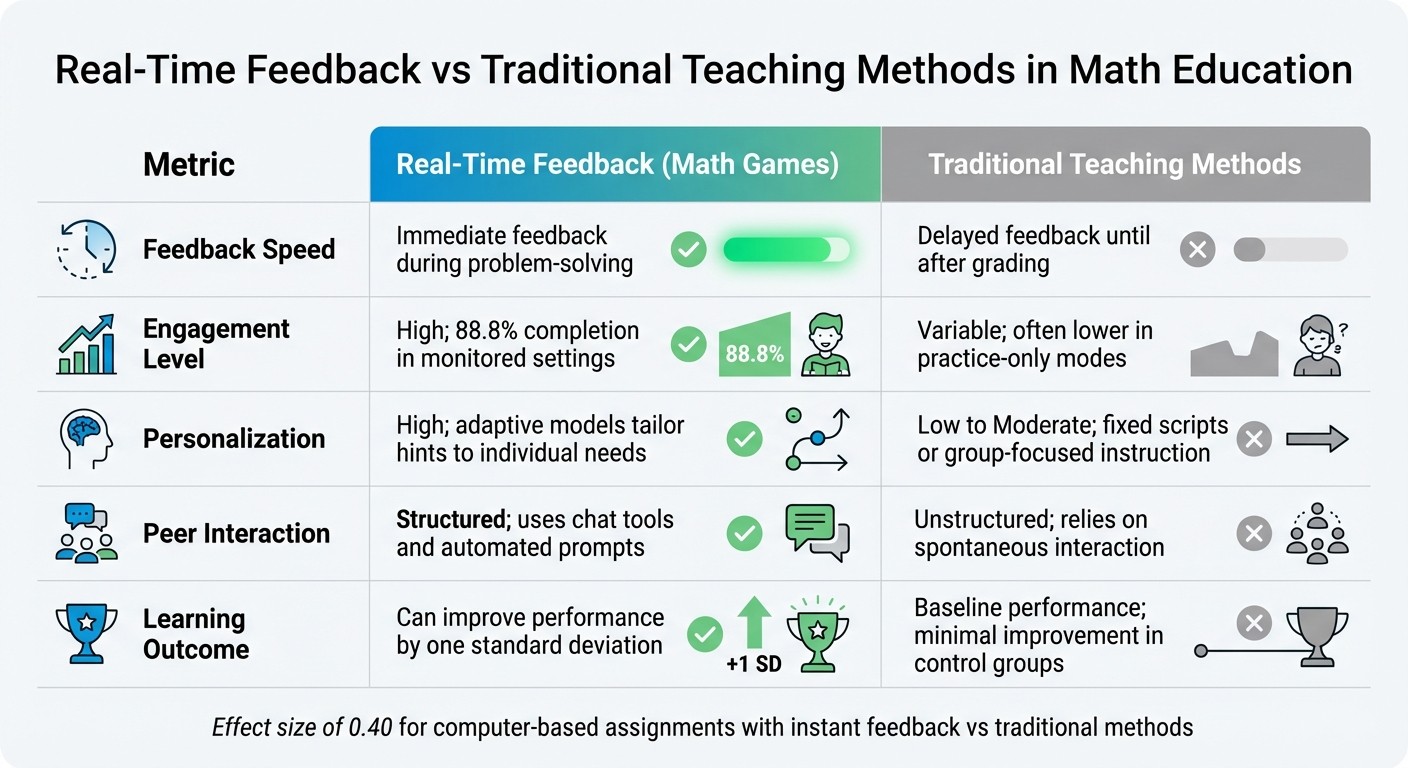
Real-Time Feedback vs Traditional Teaching Methods in Math Education
Real-time feedback in multiplayer math games offers a distinct advantage over traditional teaching methods. Unlike traditional approaches, where corrections are often delayed, digital platforms provide immediate feedback. This timing difference is crucial - studies show that students working on computer-based assignments with instant feedback achieve significantly better results, with an effect size of 0.40, compared to those using traditional paper-and-pencil methods.
Below is a comparison of real-time feedback in math games versus traditional teaching methods across key metrics:
Metric | Real-Time Feedback (Math Games) | Traditional Teaching Methods |
|---|---|---|
Feedback Speed | Immediate feedback during problem-solving | Delayed feedback until after grading |
Engagement Level | High; 88.8% completion in monitored settings | Variable; often lower in practice-only modes |
Personalization | High; adaptive models tailor hints to individual needs | Low to Moderate; fixed scripts or group-focused instruction |
Peer Interaction | Structured; uses chat tools and automated prompts | Unstructured; relies on spontaneous interaction |
Learning Outcome | Can improve performance by one standard deviation | Baseline performance; minimal improvement in control groups |
Real-time feedback systems excel in personalization. They adapt to each student’s pace and needs, offering tailored hints and problem selection. As noted in the International Journal of Artificial Intelligence in Education:
"In intelligent tutoring systems (ITSs), the system develops a model of student knowledge by comparing students' problem-solving steps to ideal performance, and then uses that model to give students individualized support such as hints, feedback, and problem selection".
This level of individual attention is rarely achievable in traditional classrooms, which often rely on group instruction rather than one-on-one support.
Another key advantage is structured peer interaction. Unlike traditional methods that depend on spontaneous student engagement, real-time systems guide discussions. For instance, during the 2007–2008 school year, researchers Jeremy Roschelle and William Penuel evaluated TechPALS, a wireless group feedback tool, in three elementary schools. Students using real-time feedback for group discussions on fractions experienced learning gains with effect sizes ranging from 0.14 to 0.44 compared to individual learning on desktops.
Immediate feedback also proves especially beneficial for students with lower prior knowledge. It allows them to correct errors on the spot instead of reinforcing mistakes - an issue common with delayed feedback. For example, in Infinilearn’s Numeria game, a 6th grader struggling with fractions receives instant hints during gameplay, enabling them to fix misconceptions immediately. This prevents the repetitive practice of incorrect methods, a common drawback of traditional homework.
These advantages highlight how immediate feedback can significantly enhance both student engagement and learning outcomes.
Conclusion
Real-time feedback transforms math learning by addressing mistakes as they happen and guiding students through challenging problems. By correcting errors instantly, students avoid developing misunderstandings, while personalized systems ensure they tackle problems at the right difficulty. Features designed to engage students make problem-solving enjoyable, and detailed teacher insights allow timely interventions. Together, these elements create an effective and interactive learning environment.
The impact of these tools is clear: studies show they can accelerate math skill development up to three times faster, with detailed feedback producing a learning effect size of 0.49 compared to just 0.05 for basic responses. These aren’t small improvements - they represent a fundamental shift in how students grasp and retain mathematical concepts.
Perhaps most importantly, this approach reframes how students perceive mistakes. Errors become opportunities for growth rather than signs of failure. This mindset shift is crucial, especially since early math skills have been shown to be twice as predictive of long-term academic success as reading skills.
Educational tools that combine instant feedback, tailored challenges, engaging features, and data insights don’t just simplify math - they redefine how it’s taught and learned. When students receive immediate guidance to correct mistakes, they experience a powerful blend of support and challenge. This isn’t just better teaching; it’s a new pathway to math mastery.
The research is clear: real-time feedback works. The next step is ensuring these tools are available to every student.
FAQs
How does real-time feedback prevent math misconceptions?
Real-time feedback plays a key role in preventing math misconceptions. By addressing errors as they happen, students can immediately identify and correct mistakes, reinforcing their understanding. This approach not only stops incorrect ideas from taking root but also helps students develop a solid grasp of math concepts. The instant support keeps learners engaged and boosts their confidence, making the learning process smoother and more effective.
Can real-time feedback help students who hate math?
Real-time feedback can be a game-changer for students who struggle with or dislike math. By delivering instant responses to their work, it helps build confidence, provides tailored support, and makes the learning process more interactive. This method can shift their perception of math, making it feel less overwhelming and even enjoyable.
What student data can teachers see in real time?
Teachers have the ability to monitor students' responses, progress, and task performance in real time. They can see details like scores, how accurate their answers are, and even their engagement levels. This insight allows educators to adjust their teaching strategies and make decisions that better support each student's learning needs.