
Why Your Child Hates Math: 5 Solutions That Actually Work
Math Education
Jan 16, 2026
Jan 16, 2026
Why middle-schoolers hate math and five proven fixes: gamified practice, quests, group activities, progress tracking, and private feedback.
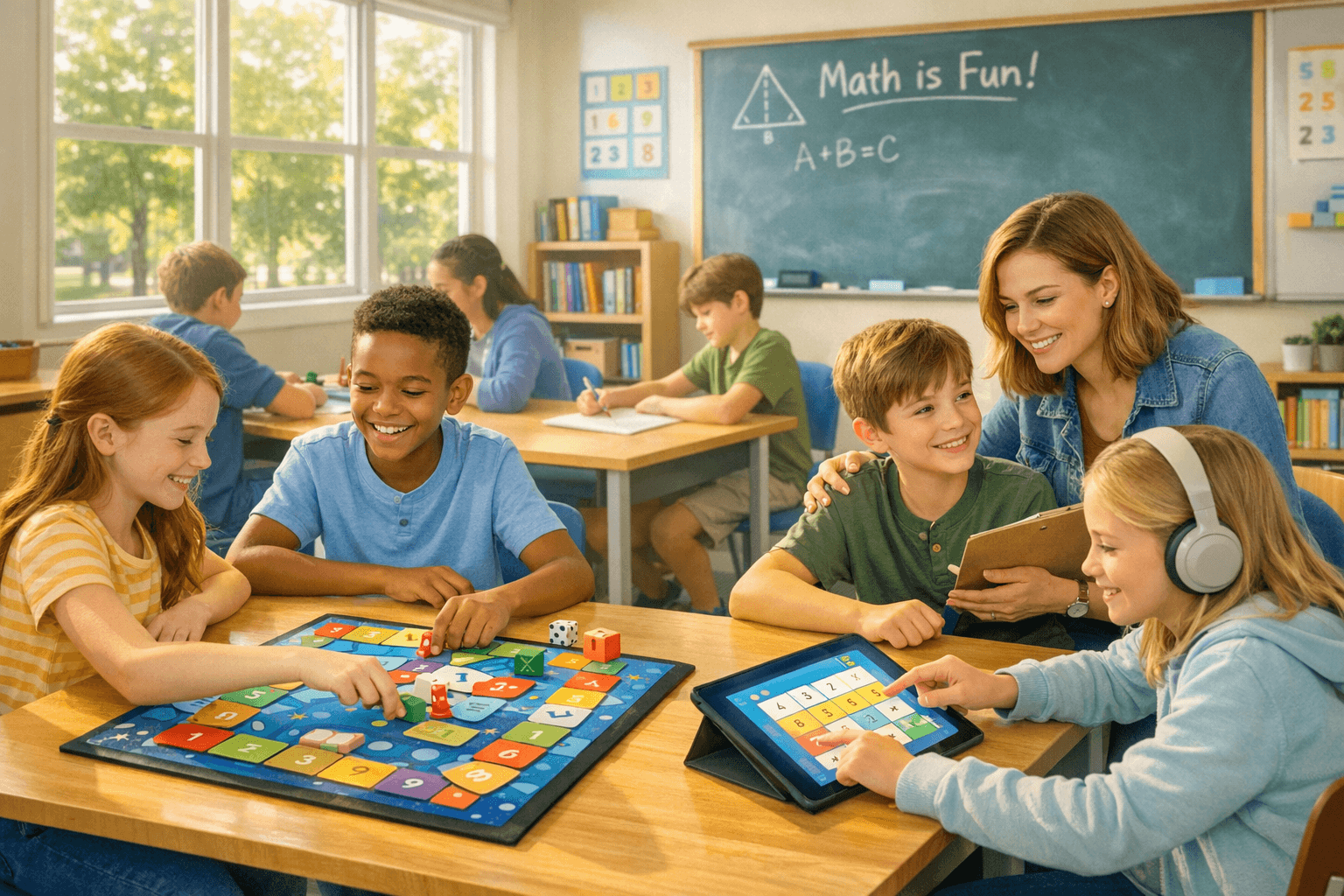
If your child says they "hate math", it’s often due to boredom, anxiety, or feeling disconnected from the subject. Middle school math gets harder, and many kids struggle with abstract concepts and repetitive drills. But it doesn’t have to stay this way. Here are five proven ways to help:
Gamify Math Practice: Platforms like Infinilearn turn math problems into fun challenges with instant feedback, reducing pressure and making learning enjoyable.
Turn Lessons Into Quests: Create levels, missions, and rewards to make math feel like an adventure instead of a chore.
Encourage Group Activities: Collaborative games and problem-solving reduce stress and make math more engaging.
Track Progress: Use tools to identify specific struggles and celebrate improvements, shifting focus from grades to growth.
Give Private Feedback: Immediate, one-on-one corrections help kids learn without fear of judgment, boosting confidence.
These strategies can break the cycle of frustration and help kids see math as a manageable challenge instead of a source of stress.
Teachers, Try This: Gamify Instruction to Reduce Math Anxiety and Improve Test Scores
Why Middle School Students Dislike Math
Figuring out why your child suddenly dreads math is the key to helping them. The reasons often lie in traditional teaching methods, how students perceive themselves, and the rising difficulty of math concepts in middle school. From tedious drills to abstract problems that feel disconnected from real life, these factors can lead to anxiety and disengagement.
Repetitive Drills Lead to Boredom
Imagine being handed a worksheet with 25 nearly identical math problems. While practice is important, this kind of repetition quickly turns into busywork. As Jackson Best from Mathletics puts it:
"Repeated worksheets, routine practice, and predictable activities (even when important) can cause concepts to blur and enthusiasm to fade".
The problem isn’t just boredom - it’s also the pressure to equate speed with skill. Jo Boaler, a mathematics education professor at Stanford, explains:
"There is a common and damaging misconception in mathematics - the idea that strong math students are fast math students".
This rush to solve problems quickly can trigger anxiety, not understanding. In fact, about one-third of students experience extreme stress during timed tests, regardless of their math abilities. The result? A cycle of boredom and anxiety that makes math feel more like a chore than a learning opportunity.
Math Anxiety Hurts Performance
Math anxiety isn’t just being nervous before a test - it’s a deeper, physical reaction. Brain scans show that students with math anxiety activate areas linked to detecting threats and even physical pain just at the thought of doing math.
This response drains their mental energy, creating what Molly Jameson, an educational psychologist at the University of Northern Colorado, calls a "cognitive drain":
"It's an overreaction to math that consumes mental resources in their brains and prevents them from accessing the skills they need to solve the problem".
Even if a student knows how to solve an equation, anxiety can block that knowledge - like knowing your password but freezing up when you need to type it under pressure.
The statistics are concerning. Between 20% and 25% of children deal with math anxiety, and in a national survey, 67% of teachers identified it as a major issue for their students. Beyond grades, this anxiety often leads to a "fixed mindset", where students start believing they’re just not "math people." This mindset only deepens the problem, making it harder for them to engage.
Abstract Problems Feel Unrelated to Real Life
As middle school math shifts from hands-on tasks - like measuring ingredients - to abstract concepts like algebra or geometry, many students struggle to see the point. Without real-world connections, these problems can feel like random puzzles with no practical use.
Traditional teaching methods often rely on symbols and verbal explanations, which don’t work for everyone. Visual learners or those who need hands-on examples can feel left behind. For example, a student might easily understand fractions when dividing a pizza but get confused when asked to solve "3/4 ÷ 1/2 = ?" on a worksheet. The math hasn’t changed, but the context has disappeared.
This disconnect only adds to the boredom and anxiety. It’s no surprise that nearly 40% of 8th graders scored below basic proficiency on the most recent National Assessment of Educational Progress. The issue isn’t a lack of effort or intelligence - it’s that many students can’t find a meaningful reason to care about math when it feels so removed from their everyday lives.
Solution 1: Use Infinilearn's Game-Based Math Platform
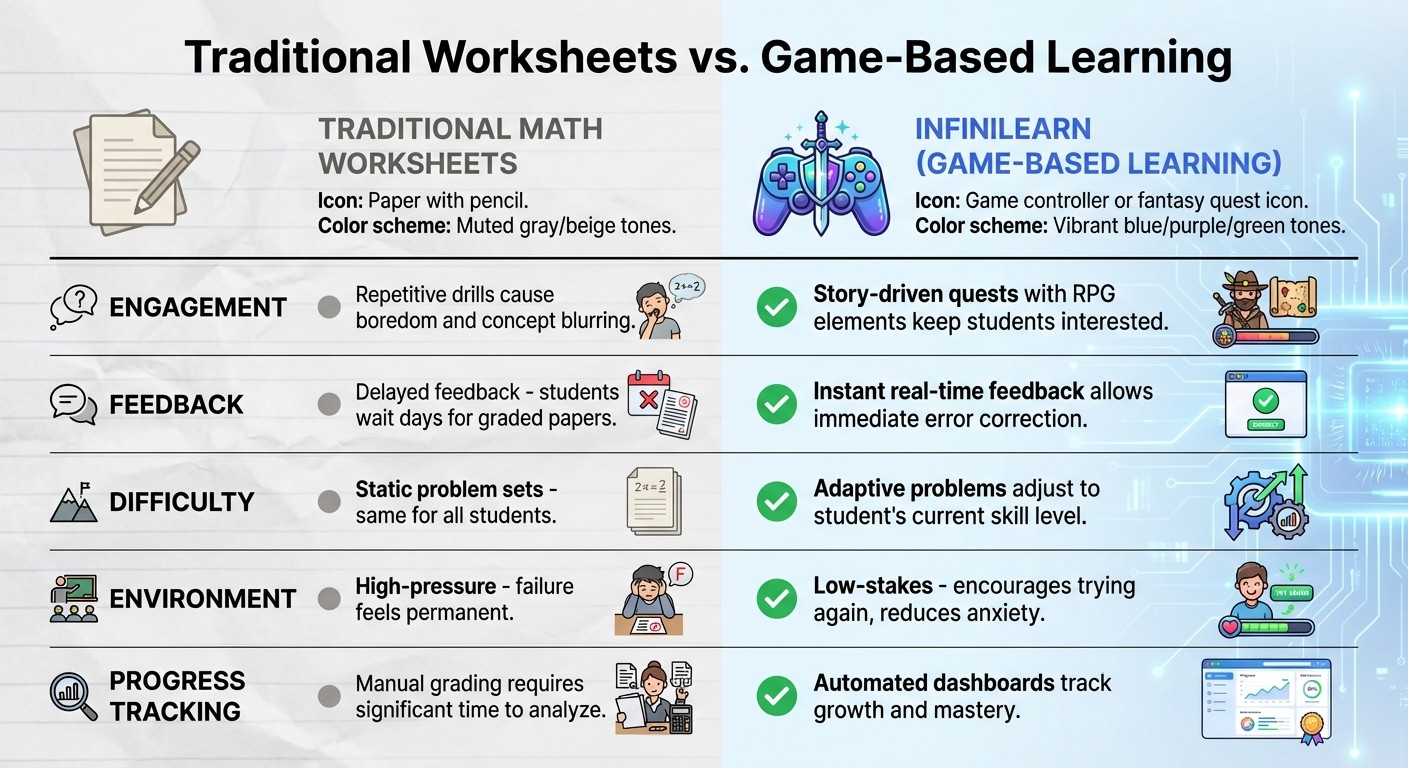
Traditional Worksheets vs Game-Based Math Learning Comparison
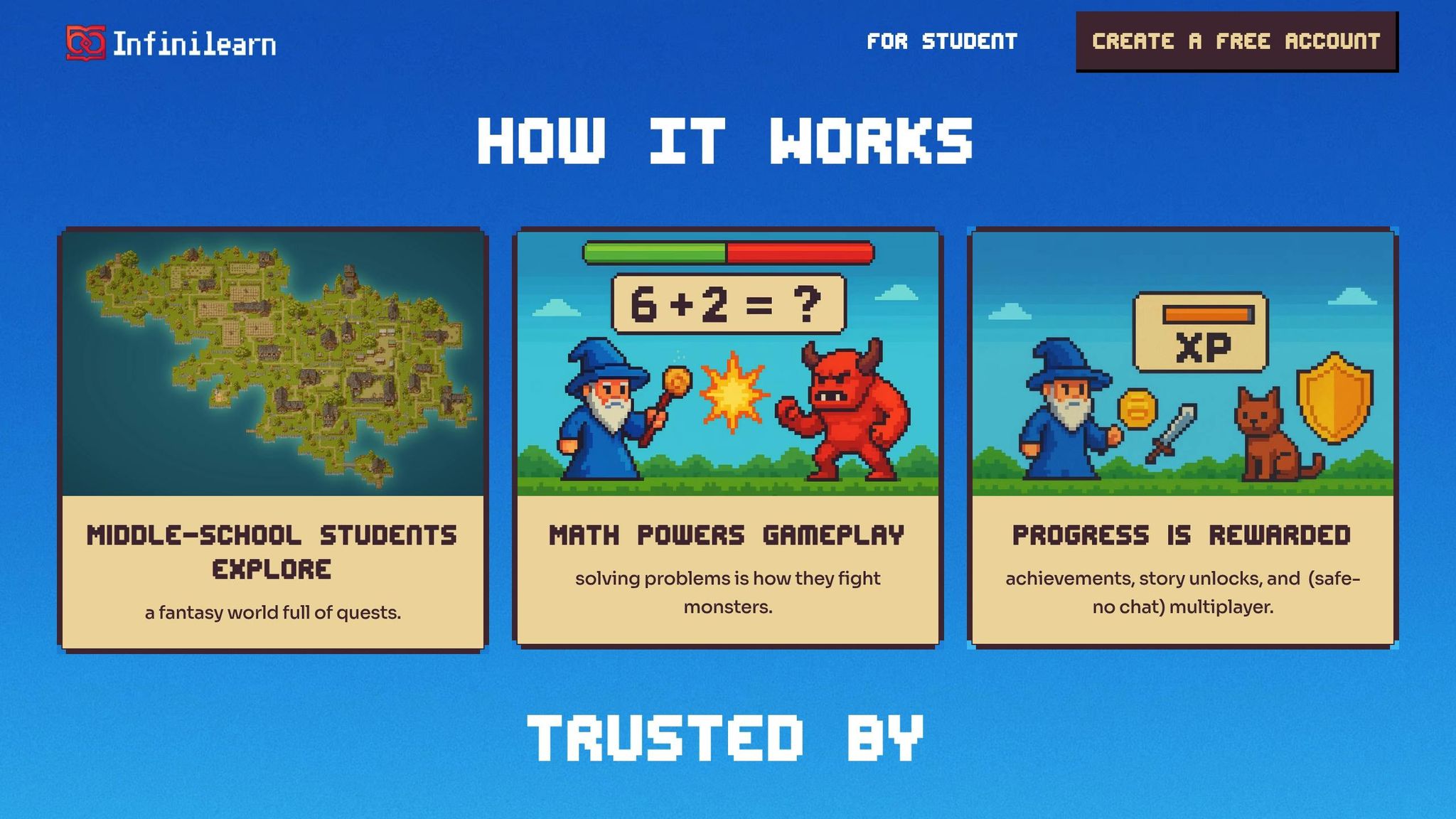
Imagine if math practice felt less like a chore and more like an adventure. That's exactly what Infinilearn aims to deliver. This game-based math platform turns routine exercises into exciting challenges, helping to ease math anxiety along the way. Instead of handing your child yet another worksheet, Infinilearn invites them into Numeria, a fantasy world where solving math problems isn't just practice - it's the key to defeating monsters and completing epic quests.
Infinilearn's approach is simple yet effective. Math challenges are woven into turn-based battles, where your child takes on the role of an Academy apprentice hunting for Seal Fragments. Each battle requires solving math problems to launch attacks. The platform adjusts the difficulty automatically based on their grade level and progress, ensuring they stay engaged without feeling overwhelmed. Unlike traditional methods, there are no public leaderboards or peer rankings - just a stress-free environment where mistakes are part of the journey, not something to fear. This setup helps reduce the pressure that often blocks effective learning in math.
How Infinilearn Makes Math More Engaging
Traditional math worksheets often feel like isolated drills, but Infinilearn flips the script by embedding math into a story-driven experience. Every problem has a purpose: solving equations isn’t just about getting the answer - it’s about calculating the damage needed to defeat a boss or advance the storyline. This creates a sense of purpose and excitement that standard worksheets just can’t match.
This method aligns with what Ted Stanford, an Associate Professor at New Mexico State University, says about the unique benefits of gamified learning:
"A game can draw somebody in - the same ideas may be laid out on a piece of paper or in a textbook, but they don't draw you in in the same way. You get instant feedback from a game... and it's private. You don't get judged by it".
The power of instant feedback is further emphasized by Kendall Black, a Marketing Specialist at Let's Go Learn:
"In a gamified setting, feedback is immediate, allowing students to learn from their errors in real-time. This quick feedback loop is invaluable in the context of mathematics, where understanding and correcting mistakes are part of the learning process".
In addition to the engaging gameplay, Infinilearn offers a progress tracking dashboard for parents and teachers. This feature provides a clear view of your child's strengths and areas for improvement - without the hassle of manual grading. Research supports the effectiveness of this approach, showing that students using adaptive game-based learning mastered 68% more math skills per month, and 91% of parents reported their children enjoyed using gamified math platforms.
Worksheets vs. Infinilearn: A Comparison
Here’s how Infinilearn stacks up against traditional math worksheets:
Feature | Traditional Math Worksheets | Infinilearn |
|---|---|---|
Engagement | Repetitive; can cause boredom and "blurring" of concepts | Story-driven quests with RPG elements keep students interested |
Feedback | Delayed; students wait for graded papers to see mistakes | Instant; real-time feedback allows immediate error correction |
Difficulty | Static problem sets | Adaptive; problems adjust to the student's current skill level |
Environment | High-pressure; failure feels permanent | Low-stakes; encourages trying again and reduces anxiety |
Progress Tracking | Manual; requires significant time to grade and analyze | Automated; dashboards that track growth and mastery |
Infinilearn isn’t just about making math more enjoyable - it’s about creating a space where kids can build confidence, lower anxiety, and truly grasp concepts rather than simply memorizing steps. This shift from drills to quests transforms math from a routine task into a meaningful and rewarding experience.
Solution 2: Create Quests and Levels for Math Lessons
Parents and teachers can make math lessons more engaging by turning them into exciting quests. Imagine transforming chapters into levels, lessons into missions, and tests into boss battles - suddenly, math feels more like an adventure than a chore.
Start by setting clear, goal-oriented "win" conditions for each session. Instead of saying, "Finish page 47", try something like, "Unlock Level 3 by mastering fractions with unlike denominators." This approach gives kids a sense of accomplishment and makes progress feel rewarding. Educator Jackson Best explains the concept well:
"Gamification involves adding elements such as goals, rules, rewards, and friendly challenges to learning experiences".
Daily practice can be broken into short, focused quests. Each session might include a quick review, a new challenge, and a small celebration of progress. This structure creates a rhythm that keeps kids motivated and makes learning feel personal and fun.
When designing these quests, aim for the "Goldilocks Zone" - tasks that are challenging but not overwhelming. Research suggests targeting an 80% success rate to strike the right balance. Start each session with a few easier problems to build confidence before introducing more difficult ones. To ease stress during quizzes, encourage your child to jot down key formulas or mnemonics (like PEMDAS) before diving in. This preparation helps create a smoother learning experience.
Tie math problems to your child's interests to make them more relatable. For example, use probability challenges for gaming fans, statistics for sports enthusiasts, or geometry for budding artists. This approach helps combat boredom and anxiety by connecting abstract concepts to real-world passions. As Richard Blankman from HMH notes:
"Math should be active and playful, not worksheets of sterile and monotonous problems".
Incorporating small rewards like stickers, points, or team challenges can also boost engagement. A visual progress tracker - such as a poster or chart - can highlight achievements and show that mistakes are part of the journey. Considering that 93% of Americans experience some level of math anxiety, shifting the focus from fearing mistakes to celebrating progress is crucial. Framing errors as "brain workouts" rather than failures helps kids see them as steps toward mastery, fostering a mindset of growth and resilience.
Solution 3: Try Collaborative Math Activities
Math doesn't have to be a solo endeavor. Group games and team challenges can completely change how middle schoolers engage with math, especially for students who thrive in social settings. Educator Donna Paul highlights this impact:
I've seen struggling students begin to participate more because a game leveled the playing field.
When students work as a team, the pressure to be perfect fades. Mistakes become shared learning opportunities rather than individual setbacks. Collaborative activities spread the emotional weight, making the experience more enjoyable and less intimidating.
Here are a few ideas to bring this collaborative spirit into the classroom. Start with mini whiteboard sessions - students can solve problems together without the permanence of pen and paper, encouraging group focus. Games like Yahtzee can strengthen probability and multiplication skills, while Set is perfect for honing pattern recognition. For fractions, try real-life scenarios: double a cookie recipe as a group or figure out how to divide three pizzas among eight people. These hands-on tasks help abstract math concepts feel more concrete and relatable.
Group activities also boost verbal learning, which can be a game-changer for many students. Matthew Pagirsky, PsyD, explains:
For kids who have better verbal abilities, just being able to talk out their strategy and give a good explanation of what they want to do and how they should solve it... can be really helpful.
When students explain their reasoning, debate solutions, and recalculate together, they’re deepening their understanding without even realizing it. These verbal exercises also set the stage for tackling more complex challenges.
To keep students engaged, choose activities that strike the right balance - not too easy, not too hard. Games like 24, where students use four numbers and basic operations to create an equation equaling 24, or Area Roll, where pairs roll dice to draw rectangles on graph paper, are excellent options. The goal is simple: make math feel like a team sport where everyone can contribute and grow.
Solution 4: Monitor Growth with Progress Tracking
Math challenges often stem from specific issues - like trouble with multiplication, confusion over fractions, or even test anxiety. Without clear data, parents and teachers are often left guessing. This is where progress tracking dashboards can make a meaningful impact.
Infinilearn’s progress tracking offers a comprehensive report that highlights your child’s specific struggles. Instead of waiting for graded tests, real-time feedback provides immediate insights into performance trends. For instance, if your child consistently struggles with timed activities but excels when time constraints are removed, it could signal a gap in automatic recall of basic facts. Research shows that mastering these fundamentals is a key predictor of success in advanced math.
These dashboards also ensure tasks remain appropriately challenging. They adjust difficulty based on the student’s performance, keeping engagement high. Plus, features like progress bars and certificates shift the focus from high-stakes testing to steady improvement. As Matthew Pagirsky, PsyD, explains:
Anxiety really can impact a lot of the things that are important for learning, like attention, memory, and processing speed.
The advantages of this approach become even clearer when compared to traditional grading methods.
How Progress Dashboards Improve Learning
Progress tracking dashboards offer a much-needed upgrade from traditional grading systems. While traditional methods often delay feedback for days or weeks, dashboards provide immediate, actionable insights as students work through problems. This allows for timely interventions before frustration sets in.
Feature | Traditional Grading | Progress Tracking Dashboards |
|---|---|---|
Feedback Timing | Delayed (days or weeks after a task) | Instant (real-time insights during activities) |
Personalized Support | Generic assignments for all students | Tailored support based on identified gaps |
Student Engagement | Low (repetitive drills) | High (gamified elements and rewards) |
Mindset Focus | Fixed (focus on grades or scores) | Growth-oriented (focus on effort and mastery) |
Difficulty Level | Static (same for the entire class) | Adaptive (adjusts to individual skill levels) |
Using the dashboard data, you can implement focused 15-minute daily sessions. This short, consistent practice is far more effective at building neural pathways than infrequent, lengthy study sessions. Reviewing errors with your child - distinguishing between logical mistakes and random guesses - helps reinforce the idea that mistakes are stepping stones to growth. As JetLearn aptly puts it, "Making mistakes is how brains grow stronger".
Solution 5: Provide Instant, Private Feedback
When kids struggle with math in front of their classmates, the fear of looking inadequate can be just as harmful as the mistake itself. Publicly correcting them can activate the brain's fear center - the same part that reacts to threats like snakes or spiders. That’s why giving feedback privately is so important for middle schoolers dealing with math anxiety.
Infinilearn’s platform addresses this by offering immediate, private feedback as students work through problems. This strategy helps break what neuropsychologist Matthew Pagirsky describes as the "vicious cycle":
You become sort of worried or heightened and then you get that vicious cycle going where you underperform because you're anxious. Then you think: 'Here's proof that I'm not good at this!' which reinforces the belief.
By allowing students to quickly correct their mistakes, this method stops errors from turning into a negative self-image. And there’s solid research to back it up.
In September 2024, Jonathan Scrivner conducted a study involving 127 eighth graders at a rural middle school. Over 45 days, students used a computer-based tool offering personalized mastery progressions with private feedback. The results? A statistically significant drop in math anxiety levels, showing that private feedback can effectively reduce fear in students.
Private feedback also helps preserve working memory. When students receive immediate corrections, they don’t waste mental energy worrying if they’re on the right track. Instead, they can focus on solving the problem, which lowers overall stress tied to math. As Edutopia explains:
A fear that the teacher may call their name at any moment causes some students to focus on the fear instead of the math.
The secret lies in making feedback both instant and actionable. Infinilearn’s system adjusts the difficulty of problems in real time, keeping students in the "Goldilocks Zone" - not so easy that it’s boring, but not so hard that it’s overwhelming. This mastery-based approach helps students work at their ideal level, while the private validation boosts their confidence.
Conclusion
Kids often dislike math due to monotonous drills, anxiety, and abstract concepts. The strategies discussed here address these issues head-on.
Take game-based platforms like Infinilearn, for example. Instead of relying on traditional worksheets, they transform math into an interactive journey filled with quests and challenges. This approach ties seamlessly to the idea of making math engaging through storytelling and adventure. Tools like level progression, collaborative tasks, progress tracking dashboards, and instant, private feedback keep students in the "Goldilocks Zone" - engaged but not overwhelmed by stress .
The numbers speak for themselves: around 20–25% of kids experience math anxiety, and a staggering 93% of Americans report math-related stress . Gamified, stress-free methods turn math into an exciting adventure rather than a dreaded task. As Jackson Best from Mathletics puts it:
Gamification works because it provides: Motivation through reward structures, Immediate feedback, Repeated practice without monotony, Opportunities for autonomy and mastery.
FAQs
How can making math fun help ease my child's anxiety about it?
Making math enjoyable and interactive can transform how children feel about the subject, especially those dealing with math anxiety. Adding game-like elements - like fun challenges, rewards, and opportunities for creative problem-solving - turns math into something that feels more like play than work. This shift not only boosts confidence but also helps ease the fear of making mistakes, fostering a more positive attitude toward learning.
Educational games and apps are excellent tools to reinforce this approach. They allow kids to practice math in a low-pressure, engaging environment. When learning becomes fun, children are more likely to stay motivated and build a deeper understanding of math concepts.
How can I make math lessons more relatable to real life for my child?
Making math part of everyday life can show kids its value and make it less frustrating. Start with examples they encounter often. For instance, have them calculate the cost of groceries, estimate travel times, or analyze sports stats. You could ask questions like, “What’s the total cost of $45.99 plus sales tax?” or “If three friends each take a slice of pizza, what fraction is left?” These real-world scenarios make math feel useful and even fun.
Another way to bring math to life is through hands-on activities. Let them plan a budget for a family outing, adjust ingredient measurements while cooking, or track plant growth in a garden using a basic spreadsheet. These tasks turn abstract ideas like percentages, ratios, and equations into practical skills they can see in action.
Interactive tools and games can also work wonders. Try virtual shopping challenges, sports-based math problems, or coding puzzles that match their interests. When math ties into things they enjoy and helps solve problems they care about, they’ll stay more motivated and confident.
How does personalized feedback help build a child's confidence in math?
Personalized feedback - focused, individual guidance that aligns with your child’s unique efforts and thought process - can play a powerful role in easing math anxiety and building confidence. Instead of emphasizing just the final answer, highlighting their approach to solving problems (like saying, "I love how you broke this into smaller steps - it’s a smart way to tackle it!") helps children realize that math skills are something they can improve with practice. This approach nurtures a growth mindset, encouraging them to view mistakes as opportunities to learn rather than reasons to give up.
One-on-one feedback also creates a judgment-free zone where kids feel comfortable asking questions and exploring solutions without the fear of being watched or judged by peers. This individualized support allows them to celebrate small victories, track their progress, and understand that errors are simply stepping stones in the learning process - not evidence of failure. Over time, this method builds their confidence and helps them approach math challenges with less fear and more determination.