
7 Signs Your Middle Schooler Needs Extra Math Practice
Math Education
Jan 16, 2026
Jan 16, 2026
Spot seven clear signs a middle schooler needs extra math practice and simple fixes—daily drills, visual tools, and confidence-building tips.

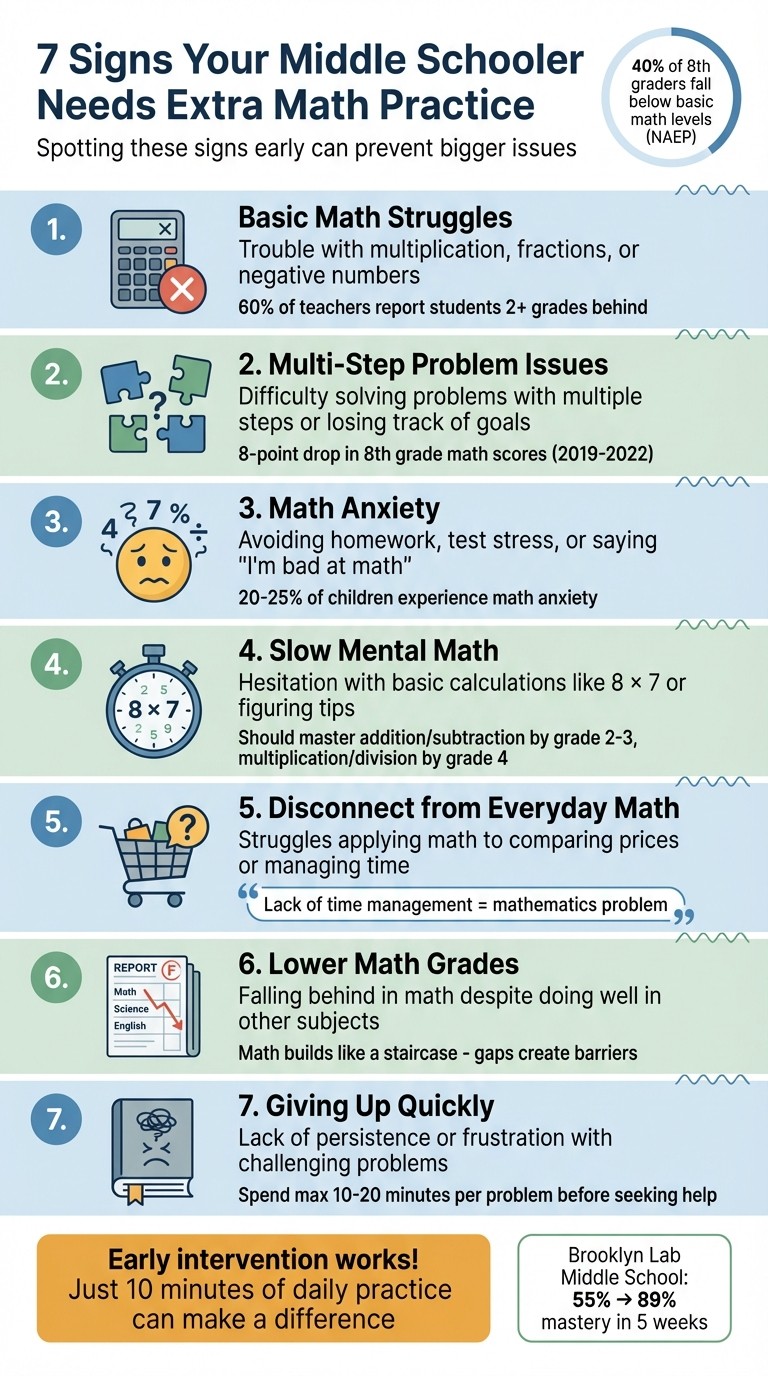
Middle school math can feel like a big leap. Struggles during these years often signal deeper issues that, if left unchecked, can lead to ongoing challenges. Here are 7 signs your child might need more math practice:
Basic Math Struggles: Trouble with multiplication, fractions, or negative numbers can make advanced topics harder.
Multi-Step Problem Issues: Difficulty solving problems with multiple steps or losing track of goals.
Math Anxiety: Avoiding math homework, test-related stress, or negative self-talk like “I’m bad at math.”
Slow Mental Math: Hesitation with basic calculations like 8 × 7 or figuring out tips.
Disconnect from Everyday Math: Struggles applying math to tasks like comparing prices or managing time.
Lower Math Grades: Falling behind in math despite doing well in other subjects.
Giving Up Quickly: Lack of persistence or frustration with challenging problems.
Spotting these signs early can help prevent bigger issues. Simple daily practice, hands-on tools, and encouraging a positive mindset can make a big difference in building confidence and skills.
7 Signs Your Middle Schooler Needs Extra Math Practice
Math Mindset: Transforming the Middle School Math Experience (REL Midwest)
1. Struggling with Basic Math Skills
Middle school math builds on a foundation of essential skills, and without a strong grasp of multiplication, fractions, or signed numbers, students can quickly find themselves overwhelmed. Michelle Russell, a math teacher at Florence High School, describes the challenge perfectly:
"These unmastered foundational skills keep students stuck in no man's land; they don't understand past concepts and they are not learning new ones either."
The numbers are sobering: nearly 40% of 8th graders fall below basic levels on the NAEP (National Assessment of Educational Progress), and over 60% of teachers report that their lowest-performing students are two or more grades behind. These gaps can snowball, making it harder for students to keep up as new topics build on what they’ve yet to master.
Finding Gaps in Basic Skills
To identify where students are struggling, review past tests for patterns in errors - whether it’s with fractions, negative numbers, or multiplication. A simple "no calculator" quiz can also shed light. Use colored paper to make it engaging, and include problems that test multiplication facts (up to 12), fraction operations, and combining positive and negative numbers. If students hesitate or consistently make mistakes, it’s a sign they may need extra help with these basics.
Another area to watch for is number sense - this includes understanding amounts, place value, and whether answers seem reasonable. For example, if a student struggles to determine whether 3/4 is larger than 2/3 or to estimate if an answer makes sense, they likely need focused practice to strengthen these skills.
Once you’ve pinpointed the gaps, the next step is implementing strategies to rebuild these critical foundations.
Ways to Strengthen Basic Skills
Devote just 10 minutes a day to practicing basic math facts using flashcards, apps, or verbal drills. Sarah D. Sparks, Assistant Editor at Education Week, highlights the importance of this habit:
"Even in an age of universal calculators, all students need to develop automatic, fluent recall of basic math facts."
Visual aids can also make a big difference. Tools like multiplication charts or number lines help students see patterns and relationships between numbers. To make practice more meaningful, tie it to real-life activities. For instance:
Have your child measure ingredients while cooking to work on fractions.
Ask them to calculate change at the store to reinforce decimals and subtraction.
Compare prices per pound at the grocery store to practice division and percentages.
Gamified learning tools and hands-on materials like buttons, beads, or dice can also transform practice into something fun and effective. These small steps can go a long way in building confidence and fluency in math.
2. Difficulty Solving Multi-Step Problems
After addressing foundational gaps, many students face an even bigger hurdle: tackling multi-step word problems. While they might manage single operations well enough, combining those operations in the context of a word problem often trips them up. Weak foundational skills make this process even tougher. As PBS explains:
"A student... cannot manage all the demands of a complex problem, such as a word problem, even though he or she may know component facts and procedures."
The numbers back this up. Eighth-grade math scores saw an 8-point drop in 2022 compared to 2019, marking the largest decline ever recorded by the NAEP. Part of the issue lies in brain development. The prefrontal cortex - responsible for logic and planning - goes through significant changes between ages 10 and 14. But beyond biology, multi-step problems require more than just math skills. They demand reading comprehension, focus, and the ability to juggle various operations without losing sight of the main objective. These challenges often show up in specific, noticeable ways.
Signs of Problem-Solving Difficulties
Some students lose track of their goal mid-problem, starting with one objective but ending up solving for something entirely different. Others rush, skip steps, or fail to double-check their answers. Sequencing is another common issue - students may know the operations involved but can’t figure out the correct order to apply them.
Word problems also require translating phrases into math operations and filtering out unnecessary details. For instance, a problem like "Maria had 24 cookies and gave away some to 3 friends equally, leaving her with 9 cookies" can leave students unsure where to begin. Phrases like "gave away equally" might not immediately translate to division, and they may struggle to separate the key numbers (24, 3, 9) from the rest of the story. When faced with a page full of similar problems, the sheer volume of information can overwhelm some students, causing them to shut down entirely.
How to Improve Problem-Solving Skills
One effective approach is the "Three Reads" strategy. Have your child read the problem three times: first to understand the story, then to identify the question, and finally to circle the key facts. This method slows them down and helps them focus on understanding the problem before diving into calculations.
Visual tools can also make a big difference. Tape diagrams, number lines, and color-coded steps help clarify relationships and operations. Research shows that students who visually represent mathematical information before writing equations are much better at solving problems. For example, if a problem involves comparing prices or distances, a simple diagram can make the solution path clearer.
To reduce distractions, limit visual clutter. Cover other problems on the page with a blank sheet of paper so your child can focus on one problem at a time. Color-coding can also help - use different colors to represent different operations, like yellow for addition and blue for subtraction. A simple checklist can guide them: "Did I circle the question? Cross out extra information? Draw a picture? Does my answer make sense?"
Lastly, encourage your child to talk through their thought process. Ask them to explain each step out loud before writing anything down. This verbalization helps them organize their thoughts and catch logical errors before they commit to a solution.
3. Avoiding Math or Showing Math Anxiety
When a child consistently avoids math homework or complains about stomachaches before tests, it’s often more than just procrastination. Studies indicate that 20% to 25% of children experience math anxiety. In fact, brain scans show that even the thought of a math task can activate areas of the brain linked to threat detection and physical pain. This reaction reflects a deeper anxiety that affects both emotions and behavior.
This heightened response drains working memory, creating a cycle where anxiety interferes with a student’s ability to apply what they already know. Educational psychologist Molly Jameson, PhD, explains:
"People with high math anxiety aren't necessarily lacking knowledge... It's an overreaction to math that takes up resources in their brains and prevents them from accessing the skills they need to solve the problem".
In essence, the anxiety acts as a mental block, preventing students from recalling formulas or solving problems they otherwise understand, which can spiral into a "vicious cycle" of panic and self-doubt.
Behaviors That Signal Math Avoidance
Certain behaviors can hint at math anxiety. Statements like "I’m terrible at this" or "I’m dumb at math" reveal a lack of confidence. Some students might avoid specifics when discussing time or measurements, opting for vague answers like "in a little while" instead of "in 15 minutes". Others may find excuses to skip school on test days, cry before exams, or get easily frustrated with homework. Physical symptoms, such as headaches or stomachaches that occur specifically before math class, can also be telling signs.
Math anxiety often peaks in middle school when the subject transitions from basic arithmetic to more abstract, multi-step reasoning. These new demands on working memory can intensify feelings of overwhelm.
Spotting these signs early is crucial. Once identified, the focus can shift to building confidence through supportive and gradual learning strategies.
How to Build Math Confidence
Math anxiety can be addressed with deliberate strategies that help students regain confidence and improve performance.
Start by modeling calmness and working through challenging problems together. Neuropsychologist Matthew Pagirsky, PsyD, suggests parents say, "I don’t know, let’s look it up together", when faced with a tough problem. Avoid framing math as a chore with comments like, "Let’s finish math so we can do something fun", as this reinforces negative associations.
Incorporate low-pressure, everyday math practice into routines. For example, calculate tips at restaurants, double recipes while cooking, or compare prices at the grocery store. These activities make math feel approachable and less intimidating. Limiting time spent on a single homework problem to 10–20 minutes can also help prevent frustration and burnout.
For test-taking, encourage your child to write down all memorized formulas at the start of the exam. This "brain dump" can ease working memory demands and reduce anxiety. Focus on praising effort and persistence rather than just outcomes. Tools like Infinilearn offer gamified, low-pressure practice that helps rebuild confidence, one step at a time.
4. Slow or Inaccurate Mental Math
If your child hesitates when calculating 8 × 7 or struggles to figure out a 15% tip without reaching for a calculator, it’s a sign that their mental math skills might need some work. By middle school, students are expected to have mastered addition and subtraction by the end of 2nd or 3rd grade, and multiplication and division by the end of 4th grade. When these skills aren't automatic, it can lead to challenges both in the classroom and in everyday life.
Pay attention to everyday difficulties - like making change, estimating grocery totals, or keeping score during a game. These could hint at weak mental math abilities. For some children, these struggles may even stem from dyscalculia, a learning disability affecting number-based operations, which impacts about 5% to 7% of elementary-aged kids. Without a solid foundation in mental math, even simple tasks can feel overwhelming, leaving less mental energy for tackling more complex problems.
Why Mental Math Speed Matters
Quickly recalling basic math facts isn’t just a convenience - it’s a way to free up mental energy for higher-level problem solving. A survey of 300 math educators by Education Week revealed that most see math fact fluency as "essential" for grasping more advanced concepts. For example, when students instinctively know that 6 × 8 = 48, they can focus their attention on understanding fractions, solving equations, or working through geometry proofs.
Without this fluency, even simple problems can feel like a slog. As Rocket Math explains:
"Fluency with multiplication facts is SO indispensable to further math computation, fractions, and pre-algebra that you can't wait until they have mastered addition and subtraction".
The goal is for students to recall basic math facts as effortlessly as they write a number. Any hesitation is a signal that more practice is needed.
Ways to Improve Mental Math
Strengthening mental math skills doesn’t require hours of drilling - it’s about consistent, bite-sized practice. Just 10 minutes a day can make a noticeable difference. Use tools like flashcards, math-focused games, or even real-life scenarios to keep practice engaging. Activities like calculating discounts, doubling recipes, or estimating travel times can show kids that mental math has real-world value, not just classroom importance.
Another helpful technique is the decomposition strategy, where larger problems are broken into smaller, more manageable parts. For instance, solving 47 + 65 becomes easier by breaking it into 40 + 60 and 7 + 5, then combining the results. Platforms like Infinilearn also offer adaptive, game-based practice that builds speed and accuracy without overwhelming students.
Incorporating math into everyday routines not only sharpens skills but also demonstrates how essential mental math is in daily life.
5. Trouble Seeing How Math Applies to Daily Life
When your middle schooler struggles to figure out which can of beans offers the best value or how long a task might take, it’s more than just a small hiccup - it’s a sign of a deeper disconnect from practical math. Mark Ankucic, a writer at Mathletics, explains:
"a real lack of understanding of how to manage time is a sign there's a mathematics problem".
Without recognizing how math ties into their everyday life, students often lose interest and can develop "math avoidance", a tendency to shy away from using reasoning in daily situations.
This disconnect can have far-reaching effects. Math concepts build on one another, so missing these early, real-world connections can create a "hidden and huge impact" on future learning. To address this, the University of California at Berkeley introduced a "Foundations of Data Science" course that connected computational thinking to real-life applications. The course became the fastest-growing on campus, with over 1,000 students enrolling by its second year. When students see the relevance of math, they’re more likely to stay engaged.
Signs of Disconnection from Practical Math
Certain everyday struggles can reveal a gap between classroom math and real-world application. For example, does your child give vague answers when asked to estimate measurements, like saying something is "big" instead of specifying inches or feet? Do they avoid calculating change or find it hard to compare prices while shopping? These are red flags worth noticing.
Word problems often highlight this disconnect. The Regional Educational Laboratory Northeast & Islands points out:
"word problems can offer an opportunity for children to think about mathematics in context and consider how mathematics relates to their own lives".
If your child focuses solely on the numbers in a word problem without grasping the story or context, they’re missing the practical side of math. Poor time management is another common indicator - whether it’s chronic lateness or struggling to understand that "5 minutes" is a specific, measurable period.
Connecting Math to Everyday Situations
The key to bridging this gap is to integrate math into daily routines. At the grocery store, ask your child to calculate the cost of produce by multiplying the price per pound by the weight, or have them compare unit prices to determine the better deal. Cooking is another great opportunity - measuring ingredients introduces fractions, while setting timers reinforces time management.
For word problems, try the "Three Reads" strategy: first, read for the story's context; second, identify what needs to be solved; and third, focus on the relevant numbers. This method helps tie abstract math to real-life scenarios. You can also incorporate their interests - use sports stats to teach percentages and averages or play board games to explore probability.
The Institute of Education Sciences emphasizes:
"students who learn to visually represent the mathematical information in problems prior to writing an equation are more effective at problem solving".
Tools like double number lines and tape diagrams make abstract concepts more tangible. When math becomes part of everyday activities like shopping, cooking, or planning, it shifts from being an abstract subject to a practical skill. These small, real-life integrations not only clarify complex ideas but also equip students for future challenges.
6. Math Grades Lower Than Other Subjects
When a middle schooler consistently excels in subjects like English, science, and social studies but struggles to pass math, it’s a clear sign of math-specific challenges. This isn’t about their overall academic ability - it’s often tied to missing foundational math skills that need attention.
Math works like a staircase; each concept builds on the previous one. Dallan Hunt from Sylvan Learning puts it this way:
"Since the material of each new grade level builds on prior grades, when your child struggles with basic skills, it's difficult to expect them to master harder ones."
For instance, if a student never fully grasped fractions or multiplication in earlier grades, those gaps can feel like brick walls when they encounter algebra or geometry. Shockingly, nearly 40% of 8th graders in the U.S. fail to meet basic achievement levels in math, and performance has either flatlined or declined since 2015.
Recognizing Math-Specific Struggles
Math challenges often stand apart from general academic difficulties and need targeted strategies. Start by reviewing your child’s tests and homework. Are they making random mistakes, or are there recurring errors with specific types of problems? Patterns like these often point to deeper gaps.
For example, if your child still counts on their fingers for basic addition or struggles to recall multiplication tables, they’re likely spending too much mental energy on simple calculations, leaving little room for tackling more complex problems. Difficulty with word problems could signal either a math issue or a reading comprehension challenge. Additionally, around 5% to 8% of students have developmental dyscalculia - a learning disability that causes persistent struggles with numbers despite strong reading skills. Math anxiety is another factor, affecting about 25% of students and often leading to "freezing up" during tests, even when they understand the material.
Steps to Address Math Struggles
Once challenges are identified, focused interventions can make a big difference. Start by getting a formal diagnostic assessment to pinpoint specific gaps. Then, dedicate just 10 minutes per day to building automatic recall of essential math facts. Hunt advises:
"Often your child will experience their own adversity and challenges as well, and specifically with learning math. It is important, therefore, to understand your child's learning, and how to tell if there is a problem."
If your child struggles with abstract concepts, use hands-on tools like buttons or LEGO bricks to illustrate operations. Regularly check your school’s online grade portal to spot patterns - are low grades one-off occurrences or part of a trend?. Encourage your child to use advisory periods or homeroom time to ask questions and get organized. Finally, help them shift away from the “I’m not a math person” mindset. Celebrate their mistakes as part of the learning process and emphasize effort over natural ability.
7. Giving Up Quickly on Math Problems
If your middle schooler shuts their notebook after a quick glance or immediately asks for the answer, it could point to underlying issues like anxiety or missing foundational skills. Dallan Hunt from Sylvan Learning highlights a critical red flag:
"A negative attitude is often a clear sign of a problem. Your child may insist they don't like math and have no patience for it. They may even try to convince themselves and others that they aren't good at math."
Math anxiety is a common challenge that can cause students to freeze up during problem-solving, even when they understand the material. This stress clouds their ability to think clearly, leading to self-doubt before they even begin. These early signs often evolve into noticeable patterns of low persistence, which we’ll explore next.
What Low Persistence Looks Like
Low persistence often shows up as negative self-talk, such as saying, "I'm just not a math person." It can also include constantly seeking immediate help, leaving work incomplete, skipping steps, or avoiding homework altogether through distraction or procrastination. Experts recommend that students spend no more than 10 to 20 minutes on a single problem before asking for help, as prolonged frustration can further discourage them.
Building Persistence Through Practice
To help your child develop resilience, try targeted strategies that build persistence step by step. Start by breaking larger goals into smaller, manageable tasks. For example, instead of focusing on "getting better at math", encourage them to concentrate on mastering one skill or completing one assignment at a time. Breaking problems into smaller steps - like reading the problem carefully, identifying key details, and solving incrementally - can also make the process feel less overwhelming.
It’s important to normalize the struggle. Share personal stories about times when persistence paid off. As Understood.org explains:
"When kids struggle with math, it doesn't mean they're not smart or not trying hard enough. In fact, kids who have trouble with math are often trying their best."
Gamified learning platforms, like Infinilearn, can also be a game-changer. These tools create a low-pressure environment where mistakes are part of the learning process. By adjusting difficulty levels automatically, they ensure students stay challenged without feeling overwhelmed. Progress tracking features, like completed quests and unlocked content, allow kids to see their growth. When your middle schooler can visualize their improvement, they’re more likely to tackle tough problems with confidence and determination.
Putting Solutions into Action
Using Multiple Strategies Together
Improving math skills requires a mix of consistent practice, interactive tools, and relatable examples. Start with brief daily drills to reinforce basic math facts. These quick, focused sessions help keep skills sharp without overwhelming students or causing frustration.
Combine this routine with hands-on learning tools. Manipulatives like algebra tiles or base-10 blocks can help bridge the gap between abstract concepts and tangible understanding . By physically engaging with these tools, students often find math less intimidating. Additionally, tie math exercises to everyday scenarios - for instance, tracking sports statistics or comparing prices at the store . This approach not only makes learning more engaging but also connects math to real-life situations, making it more meaningful.
To address math anxiety, focus on praising effort, encouraging breaks, and nurturing a growth mindset . Stay involved by regularly checking your child's online grade system and maintaining open communication with their teacher. This ensures that strategies at home align with those being used in the classroom .
Sarah D. Sparks, Assistant Editor at Education Week, highlights the multifaceted nature of learning math:
"Doing math requires that students understand concepts and operations and their relations to each other; compute math procedures efficiently and correctly; apply strategies and formulas to problems correctly; and understand the reasons that underlie the solutions".
By blending these approaches, you create a solid foundation for exploring more advanced tools and techniques.
Using Tools like Infinilearn

Digital tools can take these strategies to the next level by offering personalized feedback and adapting to your child's unique learning needs. Platforms like Infinilearn complement hands-on methods by providing interactive and engaging practice opportunities.
Infinilearn immerses students in a game-like environment where they solve grade-specific math problems to battle monsters. Aligned with Common Core standards, the game automatically adjusts its difficulty, ensuring students remain challenged without feeling overwhelmed. Unlike traditional worksheets, mistakes are seamlessly integrated into the gameplay, helping students learn without the fear of embarrassment.
The platform also includes a progress tracking dashboard, giving you real-time insights into your child's achievements and areas for improvement. This feature allows you to pinpoint specific gaps - whether it's fractions or mental multiplication - and set clear, actionable goals. With these insights, you can have more productive conversations with teachers and help your child focus on targeted areas for growth.
Conclusion: Supporting Your Child's Math Success
Key Takeaways
Math builds upon itself, so when middle schoolers face challenges with foundational skills, it can snowball into bigger obstacles as they encounter more advanced material. Identifying these struggles early is crucial. The seven warning signs discussed - from difficulty with basic skills to quickly giving up - can point to deeper issues, including math anxiety, which impacts nearly 93% of American adults to some extent.
The good news? Early intervention can make a huge difference. For example, in February 2023, Brooklyn Lab Middle School in New York reported a jump in student math mastery from 55% to 89% in just five weeks by focusing on clear goals and regular progress checks. Combining consistent practice, hands-on tools, practical applications, and interactive platforms can help students overcome challenges and strengthen their math abilities. And don’t underestimate the power of a positive mindset - it’s just as important in maintaining growth.
Encouraging a Positive Math Mindset and Building Resilience
A child’s attitude toward math isn’t set in stone. Studies show that early number sense, even in kindergarten, can predict future success in subjects like Algebra I. Beyond targeted practice, nurturing a positive outlook ensures that progress made early on translates into long-term achievement. A growth mindset - seeing mistakes as chances to learn rather than setbacks - plays a big role in this.
Short practice sessions, about 10–20 minutes, can help build skills without overwhelming your child. Celebrate their effort and persistence, and don’t shy away from sharing your own math struggles - it helps normalize the learning process. Stay engaged, keep communication open with teachers, and explore fun, interactive tools to support their journey toward math confidence and resilience.
FAQs
How can I tell if my child is struggling with math anxiety?
Math anxiety can manifest in various ways. For example, kids might express doubts about their abilities with comments like, “I’m just bad at math” or “I’ll never get this.” They may also steer clear of math-related tasks, procrastinating on homework or skipping extra-credit opportunities. Physical symptoms such as stomachaches, headaches, or sweaty palms before math lessons or tests are common as well. You might even notice a drop in confidence or motivation - like hesitating to answer simple questions or getting easily frustrated when tackling problems.
To figure out if it’s anxiety rather than short-term frustration, watch for consistent patterns. Does your child seem stressed every time math comes up, even with topics they know well? Do their physical complaints vanish during non-math subjects? Pay attention to their body language during math activities - fidgeting, avoiding eye contact, or appearing tense can all be telling signs. Spotting these behaviors early can help you provide the right support to address their math struggles effectively.
How can I help my middle schooler see the connection between math and everyday life?
Helping your middle schooler see how math fits into everyday life not only makes learning more engaging but also builds their confidence. Start with everyday household activities: measure ingredients while cooking or baking and use recipes to practice fractions by doubling or halving them. Folding napkins into shapes can introduce geometry, while counting items like plates or pieces of fruit reinforces basic arithmetic.
Shopping trips are another hands-on way to practice math. Let your child calculate change when paying with cash (like figuring out how much you get back from $10 after spending $6.75). Encourage them to compare prices to understand unit rates and ratios. Even weighing produce and multiplying the price per pound by the weight can help them work on decimals and multiplication.
For a creative twist, try math-related activities tied to their interests. Sketch a simple floor plan of your home, measure rooms in feet, and calculate distances. Estimate travel times for a road trip or dive into sports stats, like calculating points per game. These practical examples show how math connects to real life, making it both enjoyable and meaningful for middle schoolers.
What are the best ways to help my middle schooler improve their mental math skills?
Improving mental math skills can be as simple as weaving math into everyday activities. For example, while shopping, ask your child to estimate the total cost of items in your cart. Let them count the change during transactions or figure out how much time is left before an event starts. These everyday tasks not only strengthen number sense but also boost their confidence with numbers.
Short, focused practice sessions are another great way to build math skills. Use flashcards or math apps to practice essentials like addition, subtraction, multiplication, and division. Set a timer for just 1–2 minutes to make it a quick, enjoyable challenge. Keeping these sessions brief - around 10–15 minutes - helps prevent frustration and keeps the experience positive.
You can also turn mental math into a game. Play number-based games like bingo, roll dice and add up the totals, or use board game money to practice making change. These playful activities make math fun and help your child sharpen their skills in a relaxed, enjoyable way.