Is Gaming Good for Learning? What Parents Should Know
Game-Based Learning
Jan 17, 2026
Jan 17, 2026
How educational games reduce math anxiety, boost engagement, and improve middle-school math skills—plus practical screen-time and parenting tips.
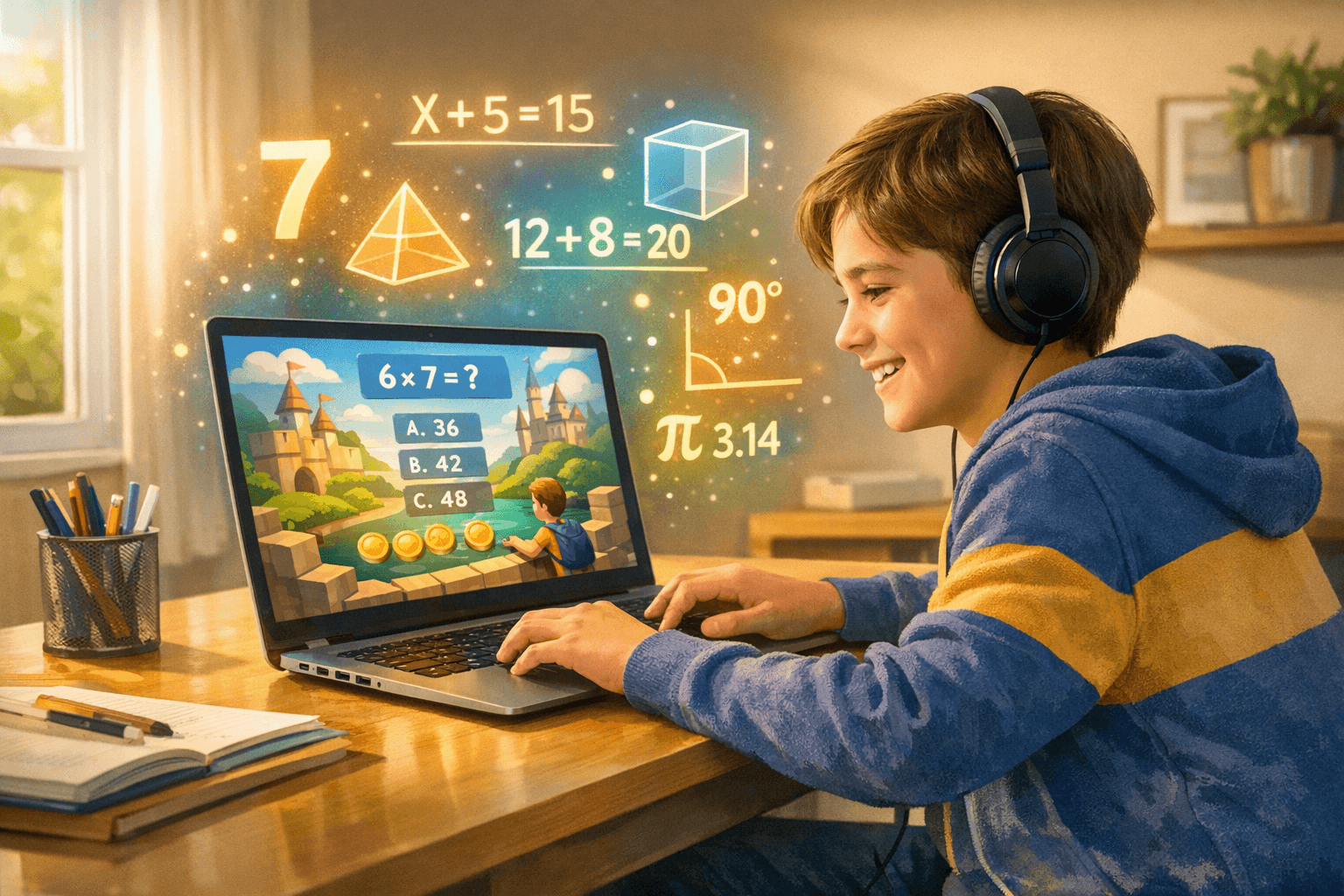
Yes, gaming can help kids learn math effectively. Research shows that educational games improve math skills, reduce anxiety, and boost engagement. For example:
Improved Math Skills: A meta-analysis found digital games improve STEM learning with an effect size of 0.667.
Reduced Anxiety: Games create a safe space for trial and error, helping students tackle math without fear of failure.
Increased Engagement: Students stay on-task 93% of the time during game-based learning, compared to 72% in conventional settings.
Games like Infinilearn combine learning with fun by transforming math into an interactive adventure. They provide instant feedback, align with Common Core standards, and allow for personalized pacing. However, screen time should be monitored, and games work best when paired with other teaching methods. Ultimately, gaming can make math more approachable and enjoyable for kids.
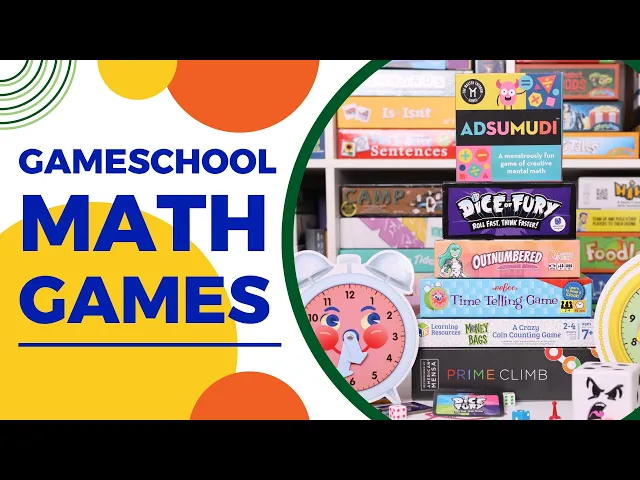
Gameschooling Math | Math Games for Your Homeschool
The Problem: Math Anxiety and Low Engagement in Middle School
In middle school, math struggles often arise not from a lack of ability but from unchecked anxiety and disengagement. Catching these issues early is critical. Let’s dive into how math anxiety develops and why traditional teaching methods might unintentionally make things worse.
What Is Math Anxiety?
Math anxiety is an overwhelming sense of fear or discomfort when faced with mathematical tasks. Around 17% of the U.S. population experiences this at high levels, and middle schoolers are especially prone to it.
It takes different forms, including test anxiety, classroom anxiety, and even anxiety around numbers themselves. Research has shown that anxiety disrupts the brain's ability to balance focus on tasks with its response to perceived threats. This disruption can impair working memory, which is essential for solving multi-step math problems. As researchers Silke Luttenberger, Sigrid Wimmer, and Manuela Paechter explain:
"Anxiety disrupts the balance between these two systems, causing the stimulus-driven system to become dominant, thus reducing the capacity to focus on task-relevant, instead of threat-related, information."
The 2012 Programme for International Student Assessment (PISA) study, which looked at students aged 15 to 16 across 34 countries, found troubling trends. About 33% of students reported feeling very tense when doing math homework, 31% felt nervous tackling math problems, and 59% worried about the difficulty of math classes. The study also revealed a clear link between anxiety and performance, with higher anxiety levels correlating to lower motivation and mastery (correlation coefficients ranged from r = -0.18 to r = -0.47).
Interestingly, 77% of students with math anxiety are actually average or above-average performers in math. As the University of Cambridge points out:
"Many children and adults experience feelings of anxiety, apprehension, tension or discomfort when confronted by a maths problem."
If left unaddressed, this anxiety can push students away from advanced math courses and STEM-related careers as early as middle school.
Why Conventional Methods Don't Always Work
Traditional teaching methods often fall short when it comes to addressing the symptoms of math anxiety. Passive repetition - like endless worksheets and routine practice - can actually make things worse. When anxiety clouds a student’s learning process, these repetitive approaches fail to meet individual needs. Over time, concepts become muddled, and enthusiasm fades. As Jackson Best from Mathletics puts it:
"Mathematics learning can lose momentum quickly. Repeated worksheets, routine practice, and predictable activities (even when important) can cause concepts to blur and enthusiasm to fade."
The core issue lies in the limitations of passive learning techniques. Traditional methods that focus on listening, note-taking, and rote memorization often struggle to engage students, especially when dealing with abstract math concepts that feel disconnected from everyday life.
One study compared traditional problem-solving exercises with gamified learning sequences. The results were striking: students using conventional methods improved their performance by just 5%, while those in the gamified group saw an 18% improvement. This difference underscores how traditional drills can intensify anxiety and fail to address the diverse needs of students.
Dr. Mehrnoosh Khoshnoodifar from Shahid Beheshti University of Medical Sciences highlights the challenge:
"Learning statistics is challenging for many learners... because of complexity and non-intuition of statistical concepts, lack of necessary mathematical knowledge or difficulty in dealing with the context of the problems and emotional issues, such as statistical anxiety, lack of self-efficacy and negative attitude towards statistics."
When students lose interest due to these conventional methods, it becomes harder for them to regain momentum - especially in cumulative subjects like math, where each new concept builds on the last. Over time, this disengagement can limit students' future opportunities in STEM fields before they even reach high school. Understanding these challenges sets the stage for exploring how gamified learning can reignite interest and improve math skills.
How Gaming Helps Students Learn Math
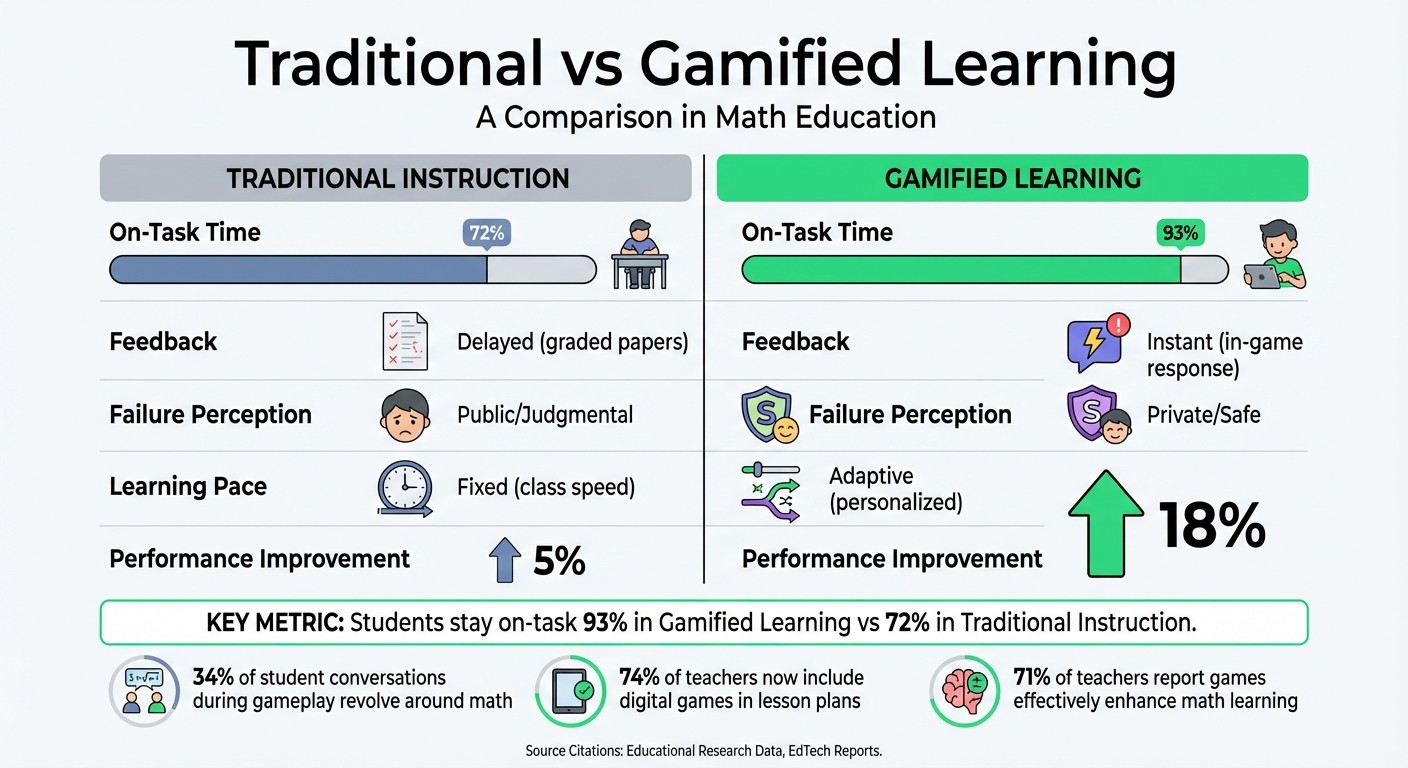
Traditional vs Gamified Learning: Key Performance Metrics for Math Education
When traditional teaching methods don't resonate, gamified learning offers a fresh approach to tackling math anxiety and disengagement. By turning math problems into interactive challenges, this method encourages students to engage with concepts in a way that feels less intimidating and more rewarding.
Beyond grabbing attention, educational games sharpen analytical thinking and problem-solving skills, replacing dull memorization with active participation.
Increasing Engagement and Motivation
Games are far more effective at capturing attention than traditional worksheets. Research shows that students stay on-task 93% of the time during game-based learning, compared to just 72% in conventional classroom settings.
A key reason for this is the instant feedback games provide. Ted Stanford, Associate Professor at New Mexico State University, explains:
"A game can draw somebody in - the same ideas may be laid out on a piece of paper or in a textbook, but they don't draw you in in the same way. You get instant feedback... and it's private. You don't get judged by it."
This immediate, private feedback creates a safe space for students to learn without the fear of public mistakes. Take Agrinautica from Math Snacks, for example. In this game, students create plants and creatures by forming mathematical expressions, discovering that multiple solutions can be correct.
Gaming also encourages collaboration. Studies reveal that about 34% of students' conversations during gameplay revolve around math, sparking discussions about strategies and solutions. This natural teamwork not only enhances engagement but also fosters deeper understanding and retention.
Building Retention and Problem-Solving Skills
Gamified learning shifts the focus from rote memorization to active problem-solving. As Barbara Chamberlin, Director of the Learning Games Lab at New Mexico State University, puts it:
"Our goal was not to get students to learn how to solve expressions - our goal was to help them think through solving problems in logical ways."
For instance, the game Curse Reverse integrates algebraic notation and variables into its mechanics, helping students see algebra as a practical tool rather than an abstract concept. The gameplay encourages breaking complex problems into smaller steps and selecting strategies based on difficulty.
Many games also use adaptive technology to tailor challenges to each student's abilities. This personalized approach helps build confidence as students progress at their own pace. Schools that regularly incorporate gamified platforms have reported significant improvements in standardized test scores.
Meeting Common Core Standards
Educational games aren't just engaging - they align seamlessly with Common Core standards. These games target critical areas where students often struggle, such as ratios, fractions, and decimals.
Math Snacks, a free platform funded by the National Science Foundation, is a prime example. Its games help middle school students develop a "concept image" of mathematical ideas, blending visual and logical understanding with real-world applications.
The impact of gamified learning is clear: 74% of teachers now include digital games in their lesson plans, and 71% report that these tools effectively enhance math learning. The key to their success lies in designing games that address specific learning objectives, complement traditional methods, and provide instant feedback for self-correction.
Platforms like Mastery Coding’s GamerMath™ take this a step further, using popular commercial games to teach math concepts. For example, Rocket League helps students explore ratios through strategy analysis, while Minecraft reinforces geometry by having players build structures with specific shapes and measurements.
Feature | Traditional Instruction | Gamified Learning |
|---|---|---|
On-Task Time | 72% | 93% |
Feedback | Delayed (graded papers) | Instant (in-game response) |
Failure Perception | Public/Judgmental | Private/Safe |
Learning Pace | Fixed (class speed) | Adaptive (personalized) |
Infinilearn: A Math Game for Grades 6-8
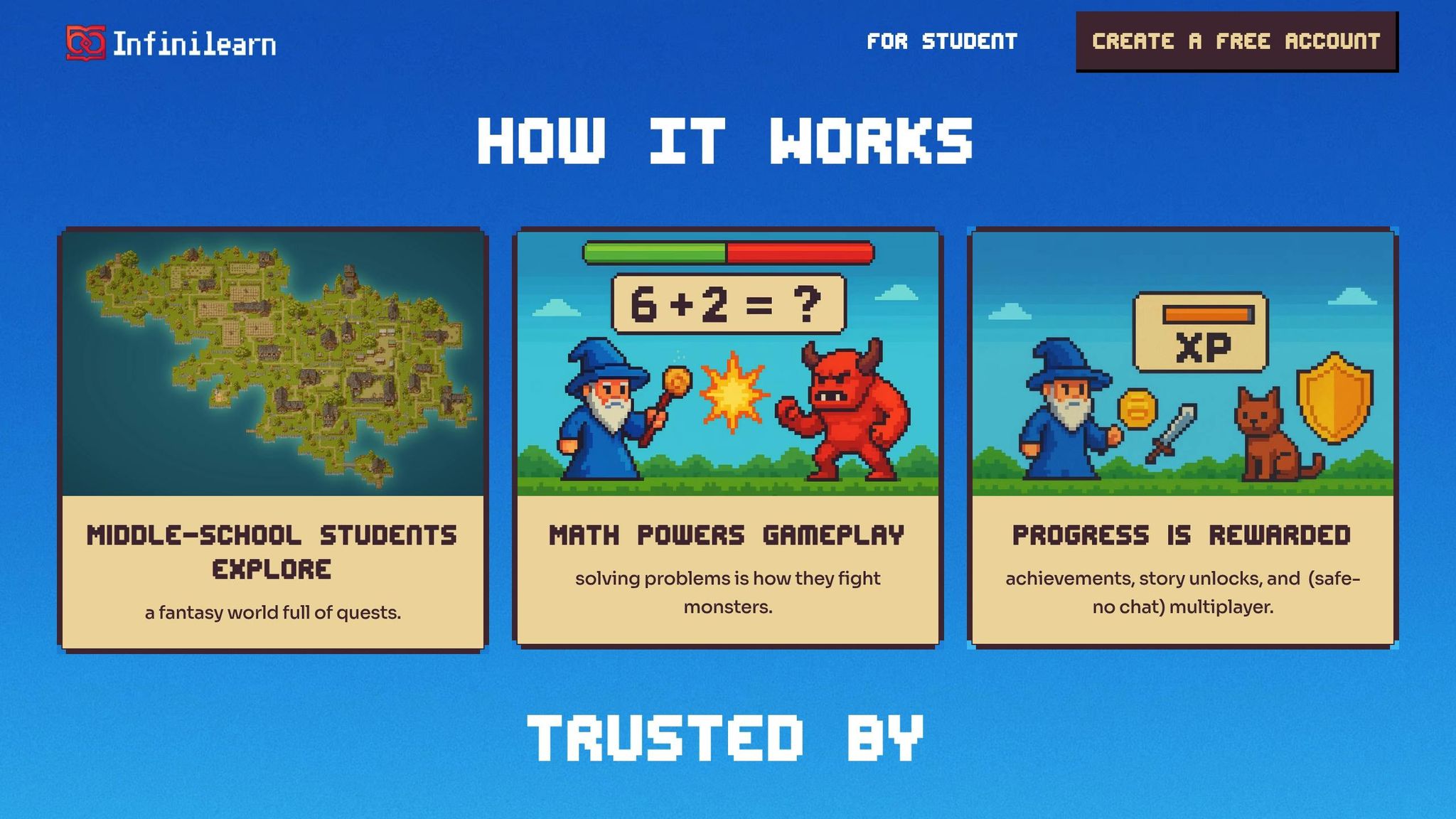
Infinilearn combines gamified learning with an exciting RPG experience tailored for middle school students. Set in the imaginative world of Numeria, the game turns math practice into a thrilling adventure. Students step into the role of Academy apprentices tasked with restoring the Arcane Seal by collecting Seal Fragments hidden across various zones. Here's a closer look at how Infinilearn transforms math into an engaging quest.
What Infinilearn Offers
Infinilearn incorporates turn-based battles where solving math problems is key to success. Its difficulty adjusts automatically to suit students in grades 6 through 8, ensuring the right level of challenge for each learner. A progress dashboard, designed to align with Common Core standards, allows parents and teachers to track performance effectively. To keep the focus on learning rather than competition, the game avoids public leaderboards, fostering a private and supportive environment.
How Infinilearn Helps Students Learn
The RPG storyline makes math feel approachable and fun. Studies highlight that interactive gameplay, when paired with narrative elements and character development, aligns seamlessly with Common Core Standards while making tricky math concepts easier to grasp. Infinilearn creates a "safe failure" environment, where students can learn from their mistakes without fear of judgment. Immediate feedback and the chance to retry problems help reduce math anxiety and build confidence and fluency. This design ensures students feel encouraged to keep learning, even when they stumble.
Pricing and Access
Infinilearn is designed to be accessible to all learners. The free tier includes core gameplay, making it a great starting point for students. For those looking for additional features, the premium subscription offers expanded progress tracking, grade-specific insights, and extra content. Whether for homeschooling or supplemental practice, Infinilearn provides an affordable way to make math learning interactive and enjoyable.
Possible Drawbacks and How to Handle Them
While gamified learning has its advantages, it's important for parents to be mindful of potential challenges and address them with care.
Managing Screen Time
Concerns about screen time are understandable, especially when 85% of U.S. teens reported playing video games in 2024, with 41% playing daily. The American Academy of Pediatrics suggests limiting video game use to 1–2 hours per day for older children. Instead of focusing solely on the time spent, prioritize the quality of the games your child engages with. Games that emphasize storytelling and collaboration often lead to better outcomes.
Dr. Douglas Gentile, a professor at Iowa State University, highlights the importance of setting boundaries:
"Data like this show that it's worth having rules and it's worth holding them firm because it has a powerful protective factor effect".
Rather than imposing strict limits that could lead to conflicts, try an approach called active mediation. Talk to your child about the games they play and how they feel about them. If the amount of time spent gaming feels excessive, consider the "25% Rule": instead of making drastic cuts, aim for gradual reductions. For example, find the midpoint between their current usage and your goal, and then repeat the process. This makes the adjustment more manageable. A common guideline is 1 hour per day during the school week and up to 2 hours on weekends.
Once you've set screen time boundaries, it’s essential to integrate them into a broader educational plan.
Using Games as Part of a Bigger Plan
Educational games are most effective when paired with other learning strategies. Scot Osterweil, Research Director at MIT Comparative Media Studies, explains:
"Games are a powerful learning tool when combined with other exploratory, hands-on activities and ongoing instruction from a teacher acting more as a coach than a lecturer".
Games should complement, not replace, direct human instruction. For example, a quick pre-game discussion and a post-game reflection can significantly enhance understanding and retention.
To create a balanced learning experience, combine digital learning with physical activities, reading, or hands-on projects. For instance, if your child is learning geometry through Infinilearn, you can reinforce those lessons by measuring objects around the house or constructing shapes with everyday items. This approach builds on the immersive, narrative-driven style of Infinilearn. In fact, nearly 50% of teachers report that struggling students benefit the most from game-based learning when it’s part of a larger educational framework.
Monitoring Your Child's Progress
Even with a balanced approach to screen time and learning methods, ongoing parental involvement is crucial. Dr. Sumru Bilge-Johnson, a child psychiatrist at Akron Children's, advises:
"Parents should know what their kids are playing, and who they're playing with. Parents can play, too. It's a chance for you to have conversations and to think together".
Playing alongside your child not only helps you understand the content but also allows you to identify potential struggles early on. Plus, it’s a great way to build trust and stay engaged.
Keep an eye out for signs that gaming might be interfering with important aspects of life, such as school performance, sleep, physical health, or relationships. These could indicate a shift from healthy use to problematic behavior. Tools like Infinilearn’s progress dashboard can help you track your child’s performance and pinpoint areas where they might need extra support. If you notice your child rushing through problems just to advance in the game, encourage them to focus on understanding the material rather than speed - this is especially important for kids who experience math anxiety.
How Parents Can Use Gaming Effectively
Once you've addressed potential concerns, you can incorporate gamified learning into your child's routine by clearly defining how, when, and why they play. This method not only reinforces math skills but also helps reduce frustration and build confidence.
Setting Up a Learning Routine
To make gaming sessions effective, structure them in a way that enhances learning. Break math homework into smaller, manageable sections and offer a small reward after each part. For instance, completing a set of problems could unlock hints for a final riddle or challenge. This approach keeps kids motivated without making homework feel overwhelming.
Gamified tools can also help improve fluency by focusing on speed and accuracy. Games naturally add variety and rewards, making practice feel less monotonous compared to traditional worksheets. To keep the experience engaging, ensure the challenges are just right - not too easy and not too hard. This balance, known as the "zone of proximal development", helps children stay interested without feeling frustrated.
Before each session, briefly review key math concepts to set the stage for better understanding. Research shows that this "pretraining" technique improves learning outcomes, with an average effect size of 0.8. For example, if the game focuses on ratios, take a moment to explain what a ratio is and provide a simple example. This quick review helps them grasp the material more effectively.
Monitoring Progress and Acknowledging Achievements
Many gamified platforms offer dashboards that break down performance by topic, making it easier to spot patterns. For example, your child might excel at fractions but struggle with negative numbers. These insights allow you to focus on areas that need extra attention rather than relying solely on a final score.
Celebrate progress in all forms. Instead of focusing only on correct answers, recognize "creative errors" or consistent effort as valuable steps in the learning process. For kids who find competition discouraging, track their improvements over time rather than comparing them to others. Platforms like Infinilearn support this by avoiding public leaderboards and emphasizing personal growth within a narrative framework, which helps boost confidence and reduce anxiety.
Encourage your child to explain their thought process during or after gameplay. This "self-explanation" technique not only reinforces what they've learned but also gives you a clearer sense of their understanding. Research shows this method has an average effect size of 0.5. A simple question like, "Why did you choose that strategy to solve the problem?" can provide valuable insights into their reasoning.
Pairing Gaming with Homeschool Lessons
You can extend the benefits of gamified learning by integrating it into other educational activities. Frame homeschool tasks as quests to maintain the game's engaging tone. For example, instead of saying "Solve these 10 equations", say, "Your mission is to solve these 10 equations to unlock the next chapter in your math journey."
After a gaming session, reinforce digital learning with hands-on activities. If your child has just completed a geometry level, ask them to measure objects around the house or create shapes using everyday items. This not only connects math to real-world applications but also strengthens the concepts they've just practiced in the game.
Antero Garcia, an Assistant Professor at Stanford Graduate School of Education, offers an insightful perspective:
"Think of games not as Band-Aids to fix what's broken in the classroom but as 'a pedagogical approach that might help people think differently about what's possible...'"
Use platforms like Infinilearn for repetitive practice that might otherwise feel tedious during traditional lessons. Save other teaching methods for introducing new concepts or tackling complex problems. This balanced approach ensures your child benefits from gamified learning while still covering all aspects of their education, helping to ease math anxiety and improve overall understanding.
Conclusion: Gaming as a Tool for Math Learning
Gamified learning tackles two significant hurdles in math education: anxiety and lack of engagement. Studies reveal that digital games can enhance learning outcomes compared to traditional methods, showing a mean effect size of 0.33. These platforms offer a low-pressure environment where mistakes are seen as part of the learning journey rather than setbacks.
When paired with traditional teaching methods, games deliver even better results. For instance, tools like Infinilearn shine when combined with hands-on activities, standard lessons, and practical applications. Its unique design - where math problems are integrated into turn-based battles in Numeria - provides students with instant feedback and the flexibility to learn at their own pace.
Parents can play a key role in leveraging gamified learning for math education. By establishing a consistent routine, tracking progress through user-friendly dashboards, and celebrating small milestones, you can help your child build confidence and develop a deeper understanding of math concepts. The aim isn’t to make learning feel like play but to make challenging tasks seem manageable. This balanced approach underscores the value of gaming as a powerful tool for learning math.
FAQs
How can parents manage screen time effectively while encouraging educational gaming?
To keep screen time in check, it's important to establish a daily routine for gaming. Experts suggest limiting total screen time - including educational games - to 1–2 hours per day. Treat educational gaming like any other scheduled activity. Pick a consistent time, such as after homework but before dinner, and use tools like timers or parental controls to stick to the limits. When you can, join your child during these gaming sessions to watch their progress and talk about strategies together.
Balancing screen time with offline activities is key. For instance, after playing a math game, ask your child to explain their approach or solve a similar problem on paper. By weaving gaming into a day that also includes reading, exercise, and time with family or friends, you can help your child enjoy the educational benefits of gaming while fostering healthy screen habits.
How does gamified learning help reduce math anxiety in students?
Gamified learning transforms math from a source of anxiety into an engaging and interactive experience. By turning tough math problems into enjoyable challenges, students are encouraged to stay interested and build confidence as they learn. One of the standout features of games is the instant feedback they provide, along with clear progress tracking. These elements help students view mistakes as valuable learning moments rather than failures, easing stress and promoting a sense of accomplishment.
Research highlights that educational games can positively influence emotional responses to math. They help reduce fear, boost persistence, and create a safe environment where students can practice without the weight of grades. By blending fun with education, gamified tools not only make math less intimidating but also nurture confidence and a mindset geared toward growth.
How does Infinilearn support Common Core standards in math education?
Infinilearn’s math-learning games are crafted to align with Common Core State Standards, focusing on essential math skills such as problem-solving, critical thinking, and numerical fluency - key components of these standards.
Although detailed curriculum information isn’t specified, the platform prioritizes creating engaging and interactive experiences. This approach ensures that the games not only support standardized educational benchmarks but also provide a fun way for kids to strengthen their math abilities. Parents can trust that Infinilearn is designed to complement widely recognized academic standards effectively.