8 Best Ways to Help Kids Practice Math Over Summer Break
Math Education
Jan 17, 2026
Jan 17, 2026
Prevent summer math loss with 8 engaging, play-based activities—games, manipulatives, graphing, timed drills, and DIY projects in 15–20 minutes daily.
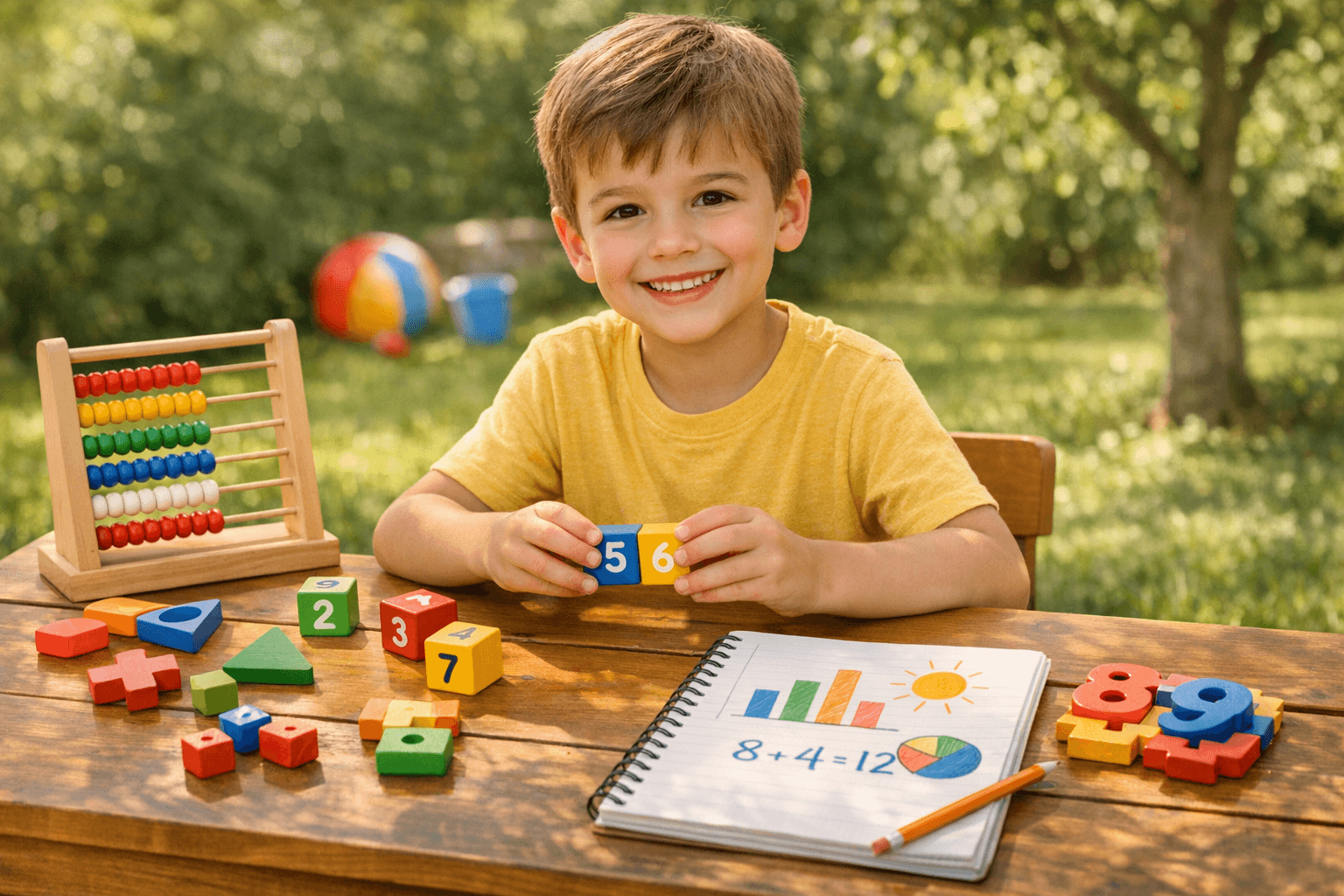
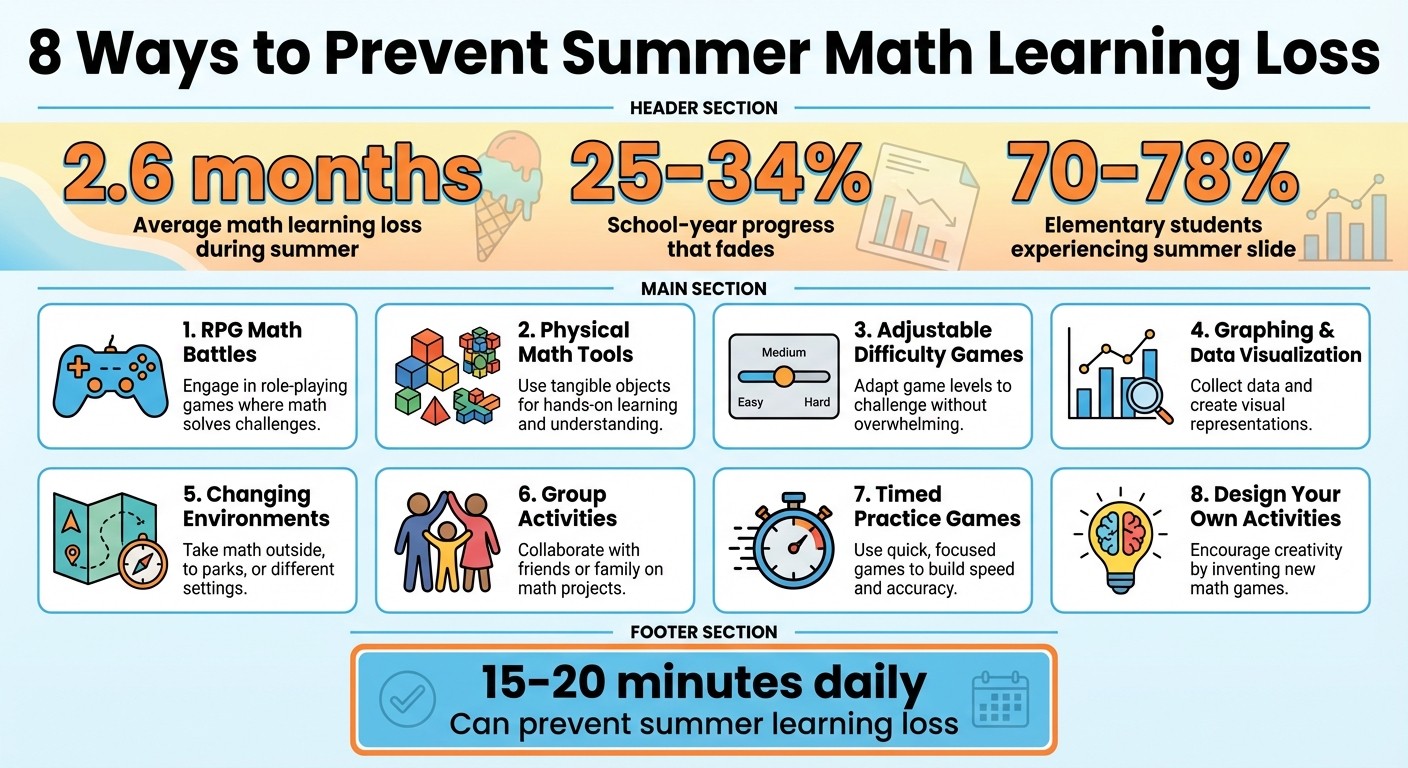
Summer break often causes kids to lose math skills, with students averaging a 2.6-month loss in math learning. Between 25% and 34% of their school-year progress fades, and 70% to 78% of elementary students experience a "summer slide." However, math practice doesn't have to feel like schoolwork. Fun, engaging activities can help kids retain and even improve their skills.
Here are 8 easy ways to keep math practice enjoyable and effective during summer:
Play Infinilearn's RPG Math Battles: Kids solve math problems in a game-like adventure, aligned with Common Core standards.
Use Physical Math Tools: Hands-on items like fraction tiles or measuring cups make math interactive and relatable.
Try Math Games with Adjustable Difficulty: Games adapt to skill levels, ensuring kids stay challenged without frustration.
Practice Graphing and Data Visualization: Use real-world data, like sports stats or bird counts, to make math practical.
Play Math Games with Changing Environments: Adventure-style games keep learning fresh and engaging.
Work on Math Problems with Friends or Family: Group activities like cooking or board games make math collaborative and fun.
Use Timed Practice Games: Short, focused challenges improve speed and fluency in basic math operations.
Design Your Own Math Activities: Let kids create projects tied to their interests, like tracking sports stats or scaling recipes.
These strategies combine play and learning, helping kids stay sharp without stress. Just 15–20 minutes a day can make a big difference, so they return to school ready to tackle new challenges.
Summer Math Learning Loss Statistics and Prevention Strategies
10 Fun Summer Vacation Math Activities for Elementary Students
1. Play Infinilearn's RPG Math Battles
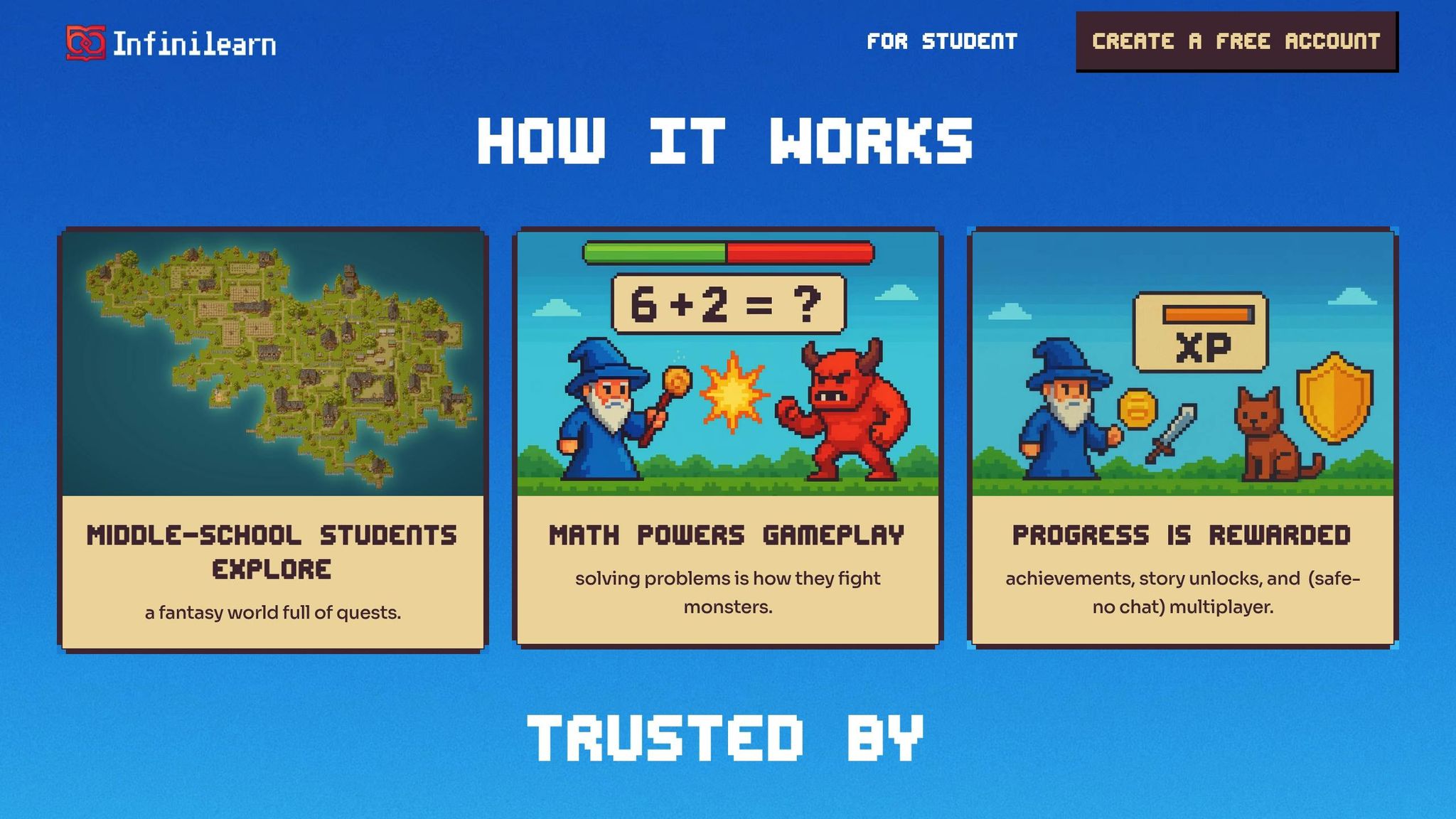
Infinilearn turns math practice into an exciting adventure, where middle school students battle monsters by solving math problems. Set in the magical world of Numeria, kids take on the role of academy apprentices on a mission to restore balance to the realm. They can choose avatars and explore this world through turn-based math challenges.
This unique mix of storytelling and problem-solving offers several key advantages:
Engaging Middle Schoolers
The RPG-style gameplay keeps students hooked by letting them earn spells and defeat monsters through math equations. It's a fun way to keep them motivated and coming back for more.
Common Core Alignment
The math problems are designed to match Common Core standards for 6th–8th grades. They cover essential topics like algebraic equations, proportions, and converting fractions to decimals. This ensures students are tackling age-appropriate material while reinforcing important skills, especially during breaks when learning loss can occur.
Tailored to Each Student's Level
The game adapts to each player's skill level based on their performance. Plus, parents and teachers have access to a progress dashboard, making it easy to spot improvements and identify areas where extra help might be needed.
Building Confidence, Not Anxiety
Infinilearn creates a low-pressure learning environment. Mistakes are treated as part of the learning process, and the absence of public leaderboards helps reduce stress, making math feel more approachable for kids.
2. Use Physical Math Tools and Manipulatives
Physical math tools, like fraction tiles, base 10 blocks, and measuring cups, offer a hands-on way to make math concepts more accessible. Unlike digital methods, these tactile tools provide a direct, interactive experience that helps simplify complex ideas. By engaging with these tools, students can dive into a variety of fun and meaningful math activities during their summer break.
Engagement Level for Middle Schoolers
Hands-on tools don’t just clarify math concepts - they make learning more engaging. Projects that involve creativity, like building a kite, adjusting a recipe, or designing a LEGO model, can teach key skills such as measuring, calculating perimeters and areas, and working with proportions. As Salimpoor notes, "The reason [using math as a secondary element] is my favorite is it helps you realize how math applies in the real world... it helps take math anxiety - a real phenomenon for many kids - out of the picture". These activities shift the focus away from repetitive drills, keeping students motivated and curious.
Alignment with Common Core Standards
The What Works Clearinghouse practice guide for grades 4 through 8 highlights the importance of visual and concrete tools, like manipulatives and area models, for understanding fraction operations. Belema Ibama-Johnson from REL Midwest emphasizes this as well, stating, "Teachers can use visual representations, such as number lines, manipulatives, and area models, to help students understand core concepts about computational procedures related to fractions and why they work". These tools help bridge the gap between hands-on learning and the abstract thinking required by Common Core standards.
Adaptability to Different Skill Levels
One of the best parts of using physical math tools is their flexibility. Beginners can practice simple tasks, like doubling a recipe with measuring cups, while more advanced learners can tackle challenges like calculating percentage discounts. This flexibility makes it easy for siblings or groups with varying skill levels to participate in the same activity while focusing on concepts tailored to their abilities.
Focus on Reducing Math Anxiety
Physical manipulatives can also ease math anxiety by acting as an external working memory. For example, using fraction tiles or drawing diagrams to solve word problems allows students to focus on problem-solving without the stress of keeping every detail in their heads. This approach not only builds confidence but also fosters a more enjoyable learning experience.
3. Try Math Games with Adjustable Difficulty
Math games with adjustable difficulty are a great way to combat summer learning loss while keeping students engaged. These games adapt to a student's skill level, allowing them to revisit earlier concepts before tackling more advanced ones. This creates a tailored learning experience that feels both rewarding and manageable.
Tailored Challenges for Different Skill Levels
When it comes to math practice, finding the right level of challenge is key. Games that adjust to a student's abilities help maintain their interest and confidence. As Connections Academy points out:
"The idea is to challenge them, but not to make the problems so hard that they get discouraged and disinterested in the activity".
For example, a simple card game like "Math War" can start with basic addition and then ramp up to multiplication or multi-step problems as the student progresses. For a practical twist, you might ask your middle schooler to adjust a recipe by doubling or tripling the ingredients. This task not only reinforces proportional thinking but also lays the groundwork for algebra concepts.
Making Math Fun for Middle Schoolers
Adjustable difficulty can turn math into an enjoyable activity rather than a dreaded chore. Linda Eisinger, a former Missouri Teacher of the Year, highlights this appeal:
"Children love ideas like this... They seem more fun, not like work".
Games like "24" or math-based board games provide a fun way to improve numerical fluency, without the pressure of traditional worksheets .
Building Confidence and Reducing Anxiety
Letting students set the difficulty level empowers them to find a balance that keeps them engaged. This approach minimizes the risk of cognitive overload by allowing learners to start with tasks they feel comfortable with. Starting small and gradually increasing the difficulty helps build confidence, enabling students to master concepts at their own pace .
Supporting Educational Standards
These games also align well with Common Core standards, progressing from basic operations to more complex problem-solving. Scaled activities can address key middle school topics like ratios, proportions, and algebraic thinking. Whether it's tweaking game rules or adjusting recipe measurements, these activities ensure students stay on track with grade-level expectations while filling in any learning gaps.
4. Practice Graphing and Data Visualization
Graphing and data visualization offer an engaging way to bring math to life for middle schoolers. Instead of sticking to abstract formulas, students can use graphs to make sense of real-world data - whether it’s tracking their basketball shooting percentages, counting local bird species, or managing a pretend $100 stock portfolio. This hands-on approach turns math into a practical tool for exploring everyday scenarios. By connecting abstract concepts to tangible activities, these methods align naturally with Common Core standards.
Alignment with Common Core Standards
Graphing and data visualization activities tie directly to several middle school math standards. For example, organizing birdwatching observations into graphs or tables helps students practice statistics and probability, such as analyzing frequencies and calculating probabilities. Tracking personal progress, like practicing an instrument, allows students to explore correlations between effort and results, supporting standards for functions and data modeling. Even simple science experiments can reinforce skills like using measurement units, calculating averages, and visualizing changes over time.
Engagement Level for Middle Schoolers
Connecting math to personal interests is a game-changer for engagement. Whether it’s tracking "minutes practiced" on a favorite hobby or calculating sports stats, these activities make numbers relatable. Neuroscientist Valorie Salimpoor explains it best:
"Take math and make it more like reading a storybook".
Incorporating regularly updated data - like weather trends, stock prices, or sports averages - adds an extra layer of excitement. Predicting outcomes from real-time data not only keeps students interested but also strengthens their understanding of math concepts, making summer learning more effective.
Adaptability to Different Skill Levels
Graphing activities are easy to adjust for students at various skill levels. For example, a birdwatching project can start with straightforward counting and simple bar graphs for beginners. As students grow more confident, they can tackle advanced tasks like calculating probabilities or identifying patterns. Those who find math challenging can receive extra guidance, while advanced learners can dive deeper into exploring complex relationships, such as the connection between practice time and performance.
Focus on Reducing Math Anxiety
Visualization tools like graphs can help ease math anxiety by shifting the focus from getting the "right answer" to understanding trends and patterns. Summer offers a relaxed setting where students can experiment with graphs without worrying about grades or judgment. Successfully creating and interpreting graphs not only builds confidence but also shows students that math is a valuable tool for uncovering insights, not just a series of obstacles. This approach helps break down the "I'm not a math person" mindset.
5. Play Math Games with Changing Environments
Math games set in ever-changing environments can make learning math more exciting and effective. These dynamic settings keep students intrigued, offering surprises and rewards that help reinforce math concepts. When students don’t know what challenge or reward lies ahead, their brains release dopamine, making the learning process more enjoyable and memorable. Neuroscientist Valorie Salimpoor captures this idea perfectly:
"Knowing that a desirable reward is coming, but not knowing when it will come or what it will be is the highest output".
This element of unpredictability creates opportunities for games to present challenges that fit the needs of a wide range of learners.
Engagement Level for Middle Schoolers
Middle school students are particularly drawn to adventure-style games. Activities like digital scavenger hunts or tracking a stock portfolio tap into their curiosity and keep them coming back for more. For example, monitoring the daily changes in a pretend stock portfolio or analyzing sports statistics can make math feel like a practical tool rather than just abstract numbers. This type of "predictive power" turns math into a way to understand and interact with the real world.
Adapting to Different Skill Levels
Dynamic games also adapt to students’ individual skill levels, ensuring that no one feels left behind - or bored. For instance, a scavenger hunt might start with basic addition but evolve into geometry problems, such as calculating the height of a tree based on its shadow. Digital games often use leveling systems to automatically adjust the difficulty, introducing more advanced concepts only after students have mastered earlier ones. This gradual progression keeps students motivated and challenged without overwhelming them.
Easing Math Anxiety
When math is woven into an adventure - like solving puzzles in a digital world or tackling real-life challenges at a grocery store - it becomes less intimidating. By focusing on solving practical problems rather than just getting the "right answer", students can build confidence and reduce math anxiety. Even simple activities, such as calculating restaurant bills or planning routes, can show how math applies to everyday life, making it feel more approachable and useful.
6. Work on Math Problems with Friends or Family
Making math a social activity can turn it into something fun and approachable. When middle schoolers team up with friends or family to tackle math problems, they tend to stay more engaged and feel less of the pressure that often comes with traditional math exercises. Plus, these shared moments naturally highlight how math fits into everyday life, creating a more inviting way to learn.
Alignment with Common Core Standards
Everyday activities like cooking and baking tie directly to Common Core's focus on "attending to precision", a key Standard for Mathematical Practice. For example, scaling a recipe - whether doubling it or halving it - teaches proportional reasoning, a skill that lays the groundwork for algebra. Similarly, analyzing sports stats or tracking bird counts in the backyard can reinforce concepts related to statistics, probability, and graphing. These activities aren't just enjoyable - they align with what students are expected to learn.
Engagement Level for Middle Schoolers
Middle schoolers are drawn to practical, real-world projects that feel relevant to their lives. Activities like calculating baseball on-base percentages, planning a summer vacation budget, or even running a small business - whether it's washing cars or pet sitting - can make math feel useful instead of abstract. Games like Monopoly, where kids act as the "banker", or Yahtzee, where they serve as the "scorekeeper", provide casual yet effective practice in mental math and reasoning.
Adaptability to Different Skill Levels
Family math activities can be adjusted to suit various skill levels. Take the license plate game, for instance: younger kids might focus on adding the digits, while older middle schoolers could use all four operations - addition, subtraction, multiplication, and division - to reach a target number like 24. In the kitchen, beginners can stick to basic counting and measuring, while more advanced learners can tackle unit conversions or recipe scaling. This flexibility allows siblings or friends at different levels to join in without anyone feeling left behind or overwhelmed.
Focus on Reducing Math Anxiety
When math becomes part of a hands-on project - like building a kite, planning a garden, or baking brownies - it shifts the focus from repetitive drills to solving real-world problems. This change helps ease anxiety because the emphasis is on completing the project, not just getting the "right" answer. Short "Number Talks", where families spend 5 to 15 minutes discussing different ways to solve a problem mentally, can also show kids that there’s more than one way to approach math. These discussions build confidence and demonstrate that math is a flexible tool for understanding the world, rather than a rigid set of rules.
7. Use Timed Practice Games for Speed
Timed practice games are a fantastic way for middle schoolers to sharpen their math skills in short, focused bursts. These challenges are particularly effective for improving fluency in addition, subtraction, multiplication, and division - perfect for combating the dreaded "summer slide".
Alignment with Common Core Standards
These activities are more than just fun; they align with Common Core standards, covering topics like algebra, geometry, ratios, and statistics. This ensures students practice precise calculations while staying on track academically. Neuroscientist Valorie Salimpoor emphasizes:
"Practice is an important part of math and is perhaps the best candidate for gamification and careful use of extrinsic rewards".
Engagement Level for Middle Schoolers
Timed games are most effective when they feel like an exciting challenge rather than a traditional test. Adding an element of unpredictability, like surprise rewards, can make these activities even more engaging while reinforcing learning. Keeping sessions to 15–20 minutes a day strikes the perfect balance - enough to build consistency without overwhelming students.
Adaptability to Different Skill Levels
Many modern apps are designed to adjust difficulty automatically, while others let students or teachers select skill levels manually. This adaptability ensures the games remain challenging but not frustrating, helping students enter a "flow" state where learning feels natural and rewarding. This approach also helps ease the pressure often associated with math practice.
Focus on Reducing Math Anxiety
Turning repetitive drills into engaging games can make speed-based practice less intimidating. Math anxiety often stems from an overloaded working memory rather than a lack of understanding. As Salimpoor explains:
"Sometimes kids experience math anxiety because they don't have good working memory, not because they don't understand the concepts".
Incorporating visual-spatial elements or allowing students to jot down notes during timed activities can ease mental strain, reduce stress, and make learning both enjoyable and productive. These small tweaks can transform math practice into a positive, confidence-building experience.
8. Design Your Own Math Activities
Encouraging middle schoolers to design their own math activities transforms learning into a fun and personalized experience. When students create activities tied to their interests - like tracking sports stats, designing Lego projects, or planning a small business - math suddenly feels like a practical tool rather than just another subject. Neuroscientist Valorie Salimpoor highlights this connection:
"If you do a task when you have intrinsic motivation it significantly increases your performance and what you learn".
Making Math Relatable for Middle Schoolers
The trick here is to weave math into something students already love. For instance, sports enthusiasts can analyze player statistics, while aspiring entrepreneurs can manage a mock budget for a dog-walking business. Art lovers might use the grid method to scale up their favorite drawings, practicing ratios and proportions without even realizing it. As Linda Eisinger, 2005 Missouri Teacher of the Year, points out:
"Children love ideas like this that are kind of quirky... They seem more fun, not like work".
Tailoring Activities to Different Skill Levels
Self-designed activities naturally adapt to each student's abilities. A beginner might create a scavenger hunt focused on identifying shapes, while a more advanced student could design puzzles involving algebra or geometry. Even in the kitchen, scaling a recipe offers flexibility: beginners can practice doubling ingredients, while those with stronger math skills might tackle multiplying by 1.5 or 2.5, diving into more complex fractions. This approach ensures everyone can start at their level and stretch their skills as far as they’re ready to go.
Building Confidence and Reducing Math Anxiety
Letting students take charge of their learning helps ease math anxiety. Activities like budgeting or mock investments make math feel purposeful and less intimidating, shifting the focus from rote memorization to creative problem-solving. As Salimpoor explains:
"We can do a boring task over and over and not remember it, but you can experience an emotional moment once and remember it forever".
Incorporating visuals, brainstorming ideas, or using hands-on tools can further reduce the mental strain and boost confidence. By designing their own math activities, students combine creativity with learning, paving the way for a more engaging and confident return to school.
Conclusion
Summer break doesn’t have to mean math skills fade away. The eight strategies highlighted here - from Infinilearn's RPG Math Battles to creating custom math activities - offer middle schoolers practical, engaging ways to stay sharp without the stress of traditional worksheets. Research consistently shows that summer learning loss is a real challenge. The silver lining? Just a little daily math practice can completely prevent this setback.
The science behind fun math activities shows they create lasting benefits. When kids tackle math through games, hands-on tools, or projects they genuinely enjoy, their brains release dopamine, which helps cement new information. As neuroscientist Salimpoor puts it:
"We can do a boring task over and over and not remember it, but you can experience an emotional moment once and remember it forever".
By blending math into hobbies, social interactions, and creative projects, you replace stress with curiosity and excitement.
Because math builds on itself, forgotten concepts can hold students back. Teachers often spend the first weeks of the school year reviewing old material instead of advancing to new topics. Linda Eisinger, 2005 Missouri Teacher of the Year, emphasizes this point:
"Math is so sequential. We tell parents that children just cannot forget everything we teach them during the year".
As summer approaches, focus on simple, consistent math moments. There’s no need to turn the break into a second school term. Instead, try short, daily activities like tracking sports stats, playing a quick math game, or measuring ingredients while cooking. These small efforts keep skills sharp and ensure your child heads back to school in September feeling confident and ready for the next challenge.
FAQs
What are some fun ways to help my child practice math during summer break?
Making math enjoyable is about weaving it into everyday life in a way that feels natural and fun. For example, while grocery shopping, you can ask your child to add up prices as you go and then compare their total to the receipt. If their calculation is close, celebrate with a small treat - maybe a $5 ice cream. Cooking together is another fantastic way to explore math. Measuring ingredients, working with fractions, and scaling recipes all sneak in math practice without it feeling like work.
Games are another great avenue to make math feel like play. There are plenty of apps with engaging math games that take just 15–20 minutes a day. For family bonding, classic board games like Monopoly, Yahtzee, or even card games can help kids practice counting, strategy, and probability, all while creating fun memories together.
Looking for something a bit more hands-on? Try real-world challenges. Give your child $20 and let them plan a picnic, figuring out how to stay under budget while covering all the essentials. Or, organize a backyard treasure hunt where each clue involves solving a quick math problem. These kinds of activities make math practical and exciting, turning what might feel like "learning" into a real adventure.
How can I help my child reduce math anxiety while practicing over summer break?
Reducing math anxiety during summer break is about turning math practice into something enjoyable and stress-free. The goal? To make math feel more like a game and less like homework. For instance, try playing board games that involve counting, budgeting, or recognizing patterns. These games sneak in math practice while creating fun moments with the family.
You can also weave quick, no-pressure math activities into everyday life. At the grocery store, ask your child to add up prices or calculate change. On a car ride, challenge them to find numbers on license plates. These small, practical exercises show how math connects to real-life situations, making it feel less intimidating.
Interactive apps and games are another great option. Many offer rewards and adjust difficulty based on your child’s progress. A simple 20-minute session each day can keep them engaged without overwhelming them. Plus, the positive feedback from these tools can boost their confidence and ease their fears about math.
How do math games support Common Core standards?
Many math games are tailored to fit Common Core State Standards, offering students an engaging way to strengthen essential math skills. These games often emphasize areas like problem-solving, number sense, and critical thinking - key elements of the standards.
Game developers usually design activities that align with grade-level expectations, ensuring students work on skills suited to their academic stage. Even if a game doesn’t explicitly mention Common Core alignment, many are built to support the concepts outlined in these standards, making them a helpful resource for summer learning.