
Dynamic Difficulty in Math Games: How It Works
Game-Based Learning
Feb 18, 2026
Feb 18, 2026
How math games use real-time performance tracking, subtle adjustments, and metrics like accuracy and speed to keep learners engaged and improve skills.
Dynamic Difficulty Adjustment (DDA) personalizes math games by tweaking challenges in real-time based on how well you’re doing. The aim? To keep you engaged without making tasks too easy or frustrating. Here’s the gist:
Real-time tracking: Systems monitor your performance - like accuracy, speed, and error patterns - to adjust the difficulty.
Gradual changes: Adjustments are subtle to ensure a smooth learning curve.
Key metrics: Accuracy, response time, and consistency help gauge progress.
Two main methods: Changes to problem complexity (e.g., harder math problems) and gameplay tweaks (e.g., time limits or hints).
The result? A balanced experience that keeps you motivated while improving your skills. Programs like Infinilearn use these methods effectively, blending math with fun gameplay to match your pace.
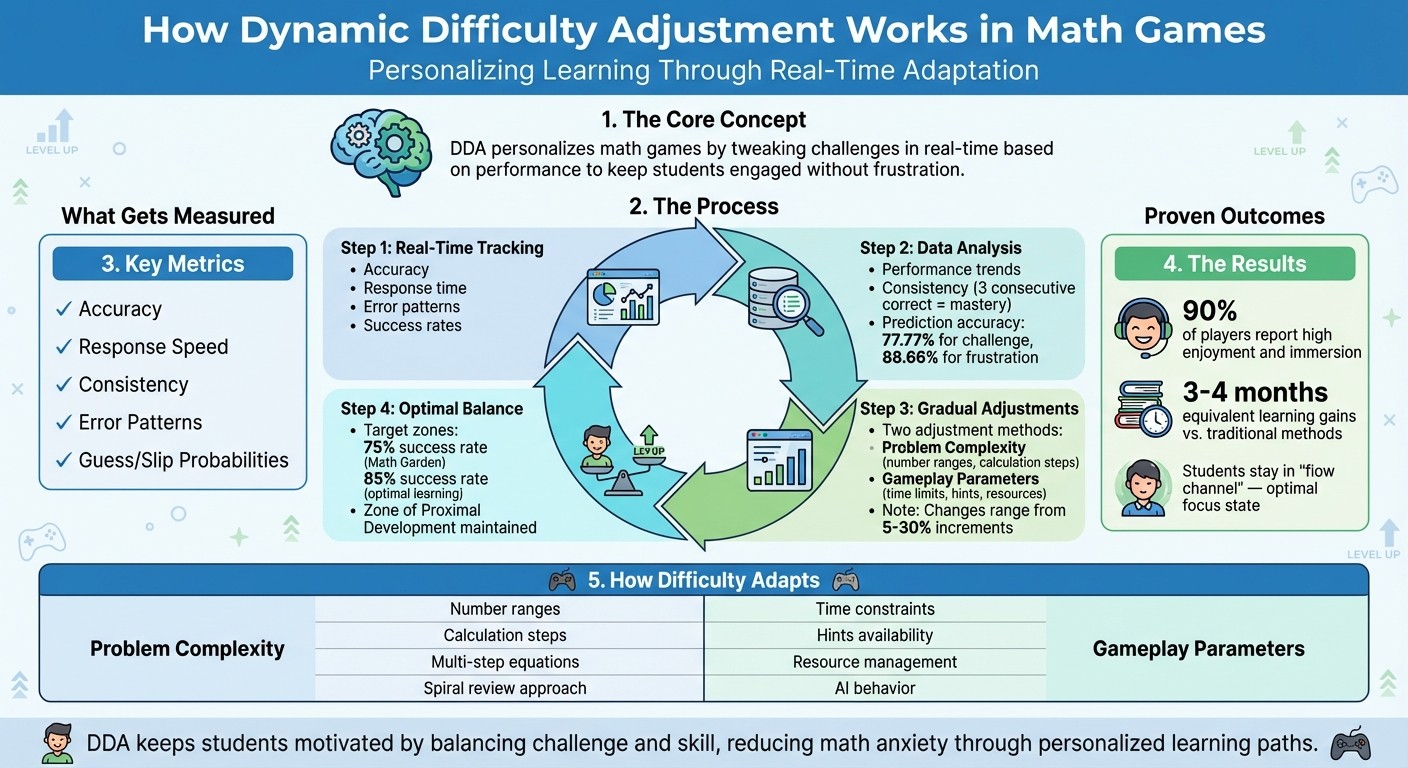
How Dynamic Difficulty Adjustment Works in Math Games
How adaptive gameplay can help children master arithmetic
How Dynamic Difficulty Adjustment Works
Dynamic difficulty adjustment (DDA) operates by continuously monitoring performance and fine-tuning challenges in real time. The idea is to balance tasks so they remain engaging - avoiding both boredom from being too easy and frustration from being too hard. Here's a closer look at how this process unfolds.
Real-Time Performance Tracking
DDA systems rely on challenge functions to assess difficulty using real-time data like success rates, completion times, and scores. They also consider key indicators such as accuracy, response time, and error patterns. For example, if a student consistently excels at a math skill, the system might introduce more advanced problems. On the flip side, if errors suggest they're struggling, the system adjusts by reinforcing core concepts and providing immediate feedback to keep them within their Zone of Proximal Development.
Some advanced systems even analyze in-game resources - like health, items, or currency - to predict potential challenges and minimize frustration before it happens. This approach blends reactive tracking (responding to immediate performance) with proactive tracking (anticipating future trends). These insights are then used to guide the system’s adjustments, which are designed to feel natural and unobtrusive.
Small and Gradual Adjustments
The secret to effective DDA lies in subtle changes. Game designer Chris Crawford explained it well: "Ideally, the progression is automatic; players start at the beginner's level and the advanced features are brought in as the computer recognizes proficient play". Many systems use techniques like fuzzy logic, which creates overlapping difficulty levels to ensure smooth transitions rather than abrupt shifts between "easy" and "hard".
For instance, one educational game adjusted enemy damage in battles by small increments - ranging from 5% to 30% per hit - making the increase in difficulty almost unnoticeable to players. These tweaks are often timed during natural breaks, like scene changes, to prevent users from gaming the system by deliberately underperforming. The goal is to maintain a seamless experience that keeps learners engaged without overwhelming them.
Studies highlight the effectiveness of this approach, showing it can predict challenge and frustration with 77.77% and 88.66% accuracy, respectively. By ensuring adjustments are gradual and consistent with previous difficulty levels, DDA supports a steady upward trajectory in performance - often referred to as a "positive monotonic curve". This steady progression helps learners stay motivated and in the flow of their tasks.
Key Metrics for Measuring Student Performance
DDA systems rely on dependable data to fine-tune their adjustments. They focus on metrics that reveal not only if a student is learning but also how they are learning. Two key metrics - accuracy and response speed - play a central role in evaluating performance.
Accuracy and Response Speed
The two primary metrics tracked are accuracy and response speed. Some systems combine these to discourage students from rushing through problems or overanalyzing simple ones. A great example is the Maths Garden system, which analyzed data from 3,648 elementary students between August 2008 and June 2009. During this period, the system processed over 3.5 million arithmetic problems while maintaining a target success rate of 75%. Researchers highlighted:
"In the scoring rule both accuracy and response time are accounted for"
Certain systems delve further by incorporating guess and slip probabilities. Using the Four-Parameter Logistic model, they estimate the chances of a student guessing correctly or making an error on an otherwise simple problem. This approach helps prevent misinterpreting lucky guesses as real understanding. To stay current with a student’s progress, many systems also use a discount factor, which prioritizes recent performance. As researchers from the University of Augsburg explained:
"By giving less weight to past evidence, we make the change in ability level more fluid and more reliant on recent outcomes"
Consistency and Error Patterns
Beyond accuracy and speed, metrics like consistency and error patterns provide deeper insights. Many platforms require students to achieve a "mastery streak" - usually three consecutive correct answers - before increasing the difficulty level. This ensures that progress isn’t based on luck.
A study conducted between 2016 and 2019 on the ASSISTments platform tracked 759 students from grades 3–12. It revealed that the difficulty of the third problem in a sequence was a strong indicator of long-term mastery. Seiyon M. Lee from the University of Florida emphasized:
"To achieve mastery in a skill, it is critical for a student to engage with the right amount of both opportunities and challenges"
Methods for Adapting Difficulty
Once performance data is collected, systems tweak challenge levels in two main ways: by altering the math problems themselves and by adjusting the surrounding game environment. These strategies work hand in hand to keep students motivated without making the experience overwhelming.
Adjusting Problem Complexity
The simplest way to adapt difficulty is by changing the numerical range and the complexity of calculations. For instance, if a student consistently excels at single-digit multiplication, the system might introduce two-digit numbers or multi-step equations. The aim is to maintain students in their "optimal challenge zone", where the material is tough enough to promote learning but not so hard that it becomes discouraging.
In April 2020, Prodigy Education's Prodigy Math Game implemented an adaptive algorithm designed to keep students within their Zone of Proximal Development. This system identified mastery levels in areas like multiplication and division, advancing students to more advanced content or revisiting foundational skills as needed. It also used a spiral review approach to reinforce prior knowledge while introducing new concepts. Sarah Tino, M.Ed., from Prodigy Education, explained:
"The goal is to find the sweet spot in skill mastery and development that challenges and engages each student".
Many adaptive systems use an error margin of 0.2, meaning the game only adjusts difficulty when a student’s performance dips below 0.8 or rises above 1.2. This ensures that changes are gradual, avoiding drastic reactions to isolated mistakes.
Modifying Gameplay Parameters
In addition to tweaking the content, adjustments to non-math elements of gameplay help maintain the right level of challenge. These include changes to time constraints, resource availability, and AI behavior. For example, in June 2024, researchers Nicholas Fisher and Arun K. Kulshreshth tested a custom first-person shooter called "Cattle Catchers from Outer Space." The game featured seven difficulty levels and dynamically adjusted elements like Aim Assist (by altering projectile hitbox sizes) and Reload Time based on a 40-second moving average of player performance.
These changes are most effective when implemented during "dead time", such as loading screens or level transitions, ensuring they don’t disrupt immersion. Systems may also respond to player performance by offering extra hints after multiple incorrect attempts or rewarding mastery with bonuses.
Parameter Type | Changes Made | Effect on Learning |
|---|---|---|
Numerical Complexity | Problem difficulty, number ranges, calculation steps | Keeps students in the Zone of Proximal Development |
Time Constraints | Response time limits, completion deadlines | Adjusts pace and pressure without altering math content |
Resource Management | Hints, power-ups, health packs | Offers support during struggles, phases out as mastery improves |
AI Behavior | NPC patterns, opponent tactics | Adds strategic depth and keeps players engaged |
Maintaining Engagement and Reducing Math Anxiety
Building on real-time adjustments, keeping students engaged while minimizing math anxiety is crucial for fostering progress in learning.
Balancing Challenge and Skill
Striking the right balance between challenge and skill is key to keeping students engaged. Games that are too easy can bore students, while overly difficult ones can frustrate them and lead to anxiety. Dynamic Difficulty Adjustment (DDA) systems address this by maintaining challenges in a sweet spot - problems that are demanding enough to encourage growth but still achievable. This balance ensures students remain immersed in the learning experience while building their skills.
Take the adaptive program Math Garden as an example. Its algorithm was designed to maintain a 75% success rate for all students, regardless of their skill level. This approach provides consistent positive feedback, making students feel capable and in control. According to Pekrun's Control-Value Theory, anxiety arises when students see a task as important but feel they lack the resources to succeed. By ensuring tasks are solvable, DDA enhances students’ sense of control, reducing the fear often associated with math.
Another useful benchmark is the 85% Rule, which suggests that maintaining an 85% success rate is ideal for balancing challenge and learning efficiency. This keeps students engaged without overwhelming them, allowing them to stay focused and motivated. When difficulty adjustments happen seamlessly - such as during transitions or loading screens - it ensures the experience feels natural, rather than as if the game is lowering its standards. This balance paves the way for effective feedback, which further motivates learners.
Positive Reinforcement and Feedback
Dynamic adjustments paired with immediate feedback help reinforce progress while avoiding the stigma of failure. By framing mistakes as learning opportunities, these systems encourage students to view errors constructively. Instead of simply marking an answer wrong and moving on, effective DDA systems provide instant feedback, helping students understand their mistakes and adjust their approach. This immediate correction loop strengthens comprehension and reduces frustration.
The most effective systems avoid punitive measures like losing lives, dropping points, or publicly displaying rank changes. A private environment where errors are free from social consequences encourages students to take risks and tackle challenging tasks. For instance, the learning platform Speech Blubs emphasizes this approach:
"Play-based learning fosters a growth mindset, where mistakes are seen as opportunities for learning rather than failures".
Positive reinforcement through badges, points, and achievements further boosts motivation. These rewards should highlight effort and persistence, not just correct answers. Progress markers that reflect improvement over time help students build confidence in their ability to succeed in math, even when individual problems feel tough. By combining non-punitive error handling with affirming feedback, these systems create a more positive relationship with math, reducing the anxiety that often accompanies traditional learning environments.
Dynamic Difficulty in Infinilearn: A Practical Example

Infinilearn demonstrates how dynamic difficulty can be applied effectively in middle school math education.
Adjusting to Individual Learning Levels
Infinilearn uses a real-time system that tailors the difficulty of math problems based on each student's progress. Targeted at grades 6–8 and aligned with Common Core standards, the platform ensures that problems remain both challenging and appropriate for the student's grade level. A progress dashboard tracks key metrics such as experience points (XP), skill mastery, and time spent on tasks. As noted in the Infinilearn FAQ:
"The game adapts to your current level and grows with you."
The system introduces new concepts only after students have mastered earlier ones. To maximize learning without causing fatigue, students are encouraged to engage with the game for 20–30 minutes daily. This adaptive approach is seamlessly integrated into the game’s narrative-driven challenges, creating a balanced and engaging learning environment.
Blending Math with Gameplay
Infinilearn integrates math directly into its role-playing game (RPG) mechanics. Within the fantasy world of Numeria, solving math problems becomes the key to powering monster battles. As the platform explains:
"Math powers gameplay: solving problems is how they fight monsters."
When students face a monster, they solve a math problem that adjusts in difficulty based on their recent performance. Success unlocks rewards like new story chapters, quests, and multiplayer options, making the experience immersive while steadily enhancing math skills.
Conclusion
Dynamic difficulty adjustment (DDA) brings a personalized touch to math games by modifying challenges in real time. This approach keeps students engaged by ensuring tasks remain within their Zone of Proximal Development.
These real-time adjustments do more than enhance the gaming experience - they lead to measurable learning improvements. Studies show that 90% of players report high levels of enjoyment and immersion when using DDA systems. Additionally, adaptive math programs have been linked to learning gains equivalent to 3–4 months of extra practice compared to traditional methods. Notably, students who start with lower math skills tend to benefit the most, highlighting how tailored difficulty can provide critical support to those who need it.
As Mohammad Zohaib from BMS College of Engineering puts it:
"Dynamic difficulty adjustment (DDA) is a method of automatically modifying a game's features, behaviors, and scenarios in real time, depending on the player's skill, so that the player... does not feel bored or frustrated".
By maintaining this balance between challenge and ability, DDA helps students achieve what researchers call the "flow channel" - a state of deep focus and motivation that drives continuous learning.
This concept isn't just theoretical - it’s already making a difference. For example, Infinilearn incorporates adaptive math challenges into its gameplay, ensuring that practice feels engaging and matches each student’s pace. This creates a stress-free environment where mistakes are part of the learning process, turning them into opportunities rather than obstacles. By meeting 6th to 8th graders where they are and advancing them at their own speed, DDA offers a personalized learning journey that keeps students motivated and eager to improve.
FAQs
How does a math game decide when to raise or lower difficulty?
Math games fine-tune their difficulty on the fly by evaluating how well a player is doing. They look at things like accuracy, scores, or how quickly problems are solved. If someone is doing great, the game might step it up with harder challenges or tougher opponents. On the other hand, if a player is having a tough time, the game can dial it back by simplifying tasks or making enemies less challenging. The goal is to strike a balance - keeping the game interesting and encouraging learning without overwhelming the player.
Can dynamic difficulty be tricked by guessing or going slow on purpose?
Dynamic difficulty systems can sometimes be influenced if players deliberately guess or slow their pace during gameplay. Since these systems rely on performance metrics to adjust difficulty, such actions can skew the system’s responses. While this might seem like an easy way to game the system, it can actually disrupt the intended learning or gaming experience by offering a distorted view of the player’s actual progress.
How do teachers or parents see progress if the game keeps changing?
Teachers and parents have access to real-time performance data and detailed reports to keep track of students' progress. These tools provide insights into math skills, pinpoint areas needing improvement, and showcase growth over time. Plus, as the game adjusts its difficulty levels dynamically, the reports reflect these changes, offering a clear picture of how students are advancing.