Cooperative vs. Competitive Math Games
Game-Based Learning
Feb 17, 2026
Feb 17, 2026
Compare cooperative and competitive math games for middle school: teamwork boosts confidence and problem-solving, competition improves short-term fluency.
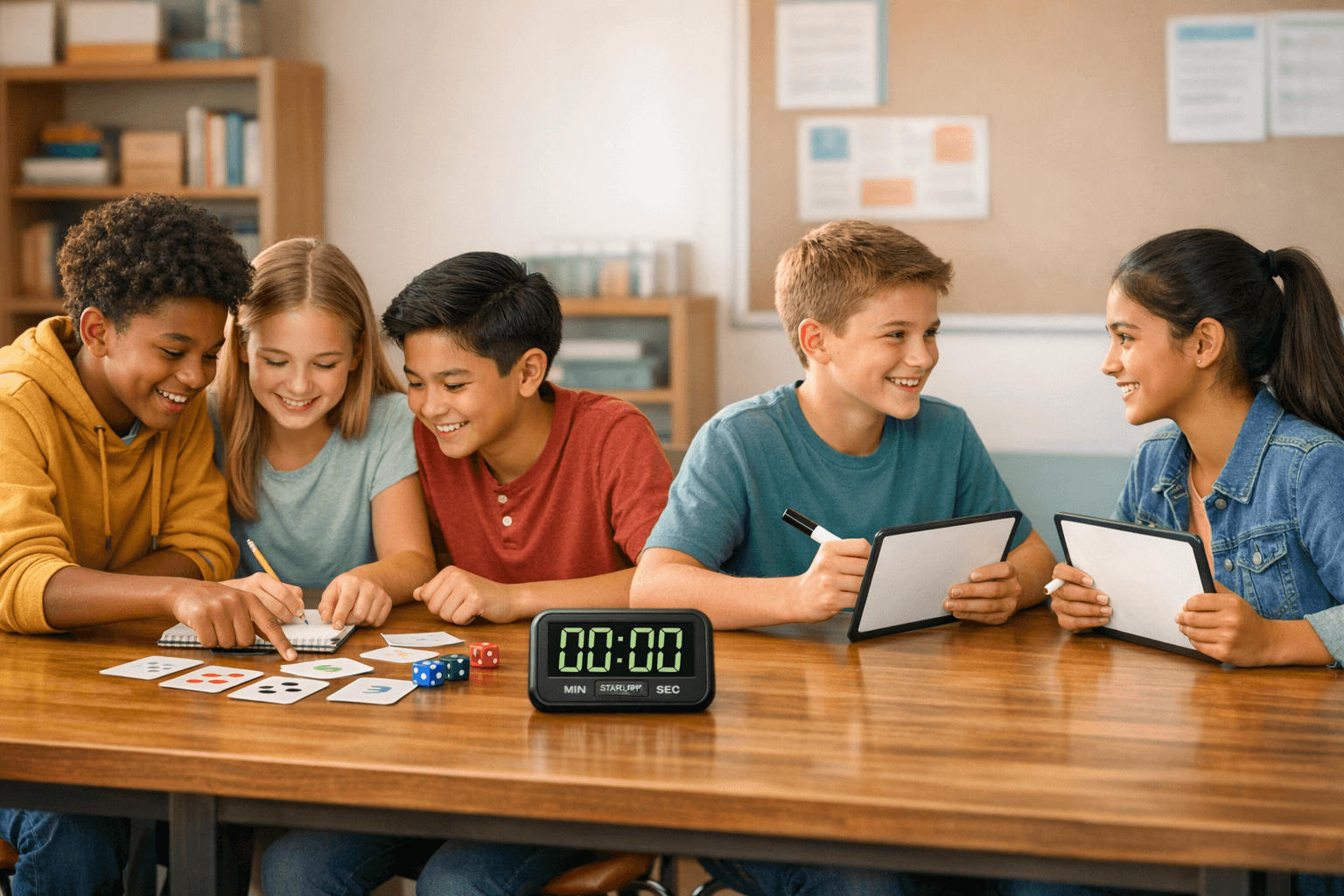
Cooperative and competitive math games impact how students learn, interact, and feel about math. Cooperative games focus on teamwork, where students solve problems together, reducing anxiety and building confidence. Competitive games emphasize individual performance, boosting short-term engagement but sometimes increasing stress.
Key Takeaways:
Cooperative Games: Team-based, promote shared problem-solving, reduce pressure, and improve attitudes toward math.
Competitive Games: Focus on individual achievement, enhance immediate performance, but may cause stress or discourage struggling students.
Research Insights: Cooperative approaches often lead to better problem-solving outcomes and long-term interest, while competitive games are effective for short-term fluency.
Quick Comparison:
Feature | Cooperative Math Games | Competitive Math Games |
|---|---|---|
Focus | Teamwork and shared goals | Individual performance and winning |
Stress Levels | Low-pressure, supportive environment | High-pressure, may increase anxiety |
Engagement | Sustains interest over time | Boosts short-term excitement |
Impact on Learning | Improves problem-solving and confidence | Enhances fluency, risks discouragement |
Both methods can be effective but suit different needs. Cooperative games are ideal for reducing anxiety and building confidence, while competitive games are better for quick skill practice.

Cooperative vs Competitive Math Games: Key Differences for Middle School Students
What Are Cooperative Math Games?
Cooperative math games shift the focus in classrooms from competition to teamwork. Instead of students vying for the top score, everyone works together toward a shared goal. The objective isn't about outperforming peers - it’s about achieving success as a group. Jonathan M. Cassie, Head of Senior School at Sewickley Academy, puts it this way:
"In a Cooperative game, the players form a team and play together to defeat the game itself".
This approach breaks away from the typical "winner vs. loser" mindset often seen in traditional math activities. Instead, victories and setbacks are shared, reshaping how students engage with both the material and each other. Teachers can even step into the role of the "opponent", presenting challenges - like a boss-level problem - that the entire class must tackle together. This collaborative structure sets the stage for exploring how these games function and their broader impact.
How Cooperative Math Games Work
The mechanics of cooperative math games revolve around team-based problem-solving and open dialogue. Students are encouraged to share ideas, discuss strategies, and come to a consensus before proceeding . Many of these games require partners to agree on a solution, promoting deeper conversations about mathematical reasoning and critical evaluation of each other’s logic.
Some teachers take this a step further by removing answer keys entirely, pushing students to rely on their own reasoning and to justify their approaches to their peers. Another effective method is "Think-Ink-Pair-Share", where students first reflect independently, then write down their ideas, and finally discuss them with a partner. This process ensures that everyone’s thoughts are heard and promotes stronger understanding.
Benefits of Collaboration for Middle School Math
The impact of cooperative math games goes well beyond improving math skills. These games create a supportive, low-stress environment where students feel safe to take risks and learn from their mistakes. Shametria Routt Banks, founder of The Routty Math Teacher, highlights this advantage:
"Cooperative games provide a low-pressure setting that helps alleviate [math anxiety]. Working together, students feel supported and empowered to take risks in their learning".
This collaborative approach also strengthens peer relationships and fosters a sense of shared engagement. Interestingly, students who participate in these games are more likely to want to play again and recommend them to others. This suggests that cooperative games not only enhance learning but also make math more enjoyable and socially rewarding for middle school students.
What Are Competitive Math Games?
Competitive math games shift the focus from teamwork to individual achievement, emphasizing personal performance over collaboration. In these games, students aim to outscore their peers, creating an environment centered on rankings, scores, and head-to-head challenges. While this approach can energize the classroom, it also introduces unique dynamics compared to cooperative methods.
In middle school settings, competitive math games are often used to practice arithmetic, improve fluency, or review previously covered material. Activities like these can spark enthusiasm and engagement, but they come with their own set of challenges.
How Competitive Math Games Work
These games are built on scoring systems, leaderboards, and individual accomplishments. Formats often include Math Jeopardy, timed challenges, or digital platforms that track and display individual performance. Features like time limits, instant feedback, and rankings create a high-energy atmosphere where speed and accuracy are key.
Research involving 58 urban middle school students found that competition during gameplay boosted learning outcomes. The desire to win can push students to refine their skills, fostering a mastery-oriented mindset.
However, this focus on winning can also shift attention away from the learning process itself. For example, a study of gifted 3rd and 4th graders found that just 15 minutes per day of competitive, computer-based math instruction over 10 days led to a marked preference for competition over cooperation. The Journal for the Education of the Gifted noted:
"Gifted students working competitively on math skills at the computer showed an increasing preference for more competition and less cooperation in their activities. Their attitudes towards working with others in social or academic settings reflected an increased interest in winning at the cost of cooperative behaviors".
Drawbacks of Competition
While competitive math games can increase short-term engagement, they also come with risks. The pressure to outperform classmates can heighten emotional stress and self-doubt, especially for students already dealing with math anxiety. Shametria Routt Banks, founder of The Routty Math Teacher, explains:
"The pressure to win and outperform their peers can create a fear of failure for some students, hindering their ability to enjoy the learning process".
This emphasis on winning can also lead to negative behaviors like teasing, taunting, or even sabotaging others' efforts. Students who struggle with certain concepts may feel left behind, as the focus on speed can discourage deeper, more thoughtful problem-solving.
Interestingly, research shows that cooperative approaches often lead to better problem-solving outcomes. Teams working together consistently outperform individuals in competitive settings across a range of tasks. While competition may generate excitement, it might not be the best approach for fostering long-term learning and skill development.
Cooperative vs. Competitive Math Games: Key Differences
Effects on Peer Learning
Peer learning takes on a different dynamic depending on whether students are working cooperatively or competitively. In cooperative games, students collaborate by sharing strategies and tackling problems as a team. This approach has been shown to enhance problem-solving skills significantly. For instance, a meta-analysis of 46 studies revealed that cooperative teams consistently outperformed individuals in competitive scenarios across all four problem-solving categories, with an effect size of 0.72 for math-related tasks.
Zhining Qin and colleagues at the University of Minnesota highlighted this trend, stating:
"Members of cooperative teams outperformed individuals competing with each other on all 4 types of problem solving".
On the other hand, competitive games focus on individual scores, which often limits peer-to-peer teaching opportunities. Research indicates that competitive environments reduce classroom interactions, thereby diminishing the natural learning that occurs when students explain concepts to one another. These differences in peer learning also influence student engagement and motivation during gameplay.
Effects on Engagement and Motivation
Both cooperative and competitive games can enhance engagement, but they do so in distinct ways. A November 2013 study led by Jan L. Plass at New York University examined 58 urban middle school students playing a math video game in individual, competitive, or cooperative modes. The findings revealed a fascinating contrast:
"In comparison to individual play, competition increased in-game learning, whereas collaboration decreased performance during the experimental play session... Additionally, collaboration resulted in stronger intentions to play the game again".
Cooperative games, by fostering a supportive atmosphere, make mistakes feel less intimidating. This can be especially beneficial for building confidence. Fengfeng Ke from Pennsylvania State University studied 125 fifth-graders in 2006 and found that cooperative gameplay was particularly effective in promoting positive attitudes toward math, regardless of gender or socioeconomic background. She concluded:
"Cooperative gameplaying was most effective for promoting positive maths attitudes regardless of students' individual differences".
The structure of a game, therefore, not only shapes peer interactions but also plays a critical role in sustaining motivation and interest over time.
Comparison Table: Cooperative vs. Competitive Math Games
Category | Cooperative Math Games | Competitive Math Games |
|---|---|---|
Peer Learning | High; emphasizes teamwork, shared problem-solving, and social interaction | Low; prioritizes individual performance and competition |
Engagement | Encourages sustained interest and repeated play in a supportive environment | High-pressure; boosts short-term interest but may cause stress |
Suitability for Middle School | High; fosters positive attitudes and social cohesion | Moderate; improves immediate performance but may widen gender or ability gaps |
Research Evidence | Strong support for better problem-solving outcomes (Effect size 0.72 for math) | Evidence of increased in-game learning but fewer social interactions |
How Infinilearn Supports Cooperative Learning
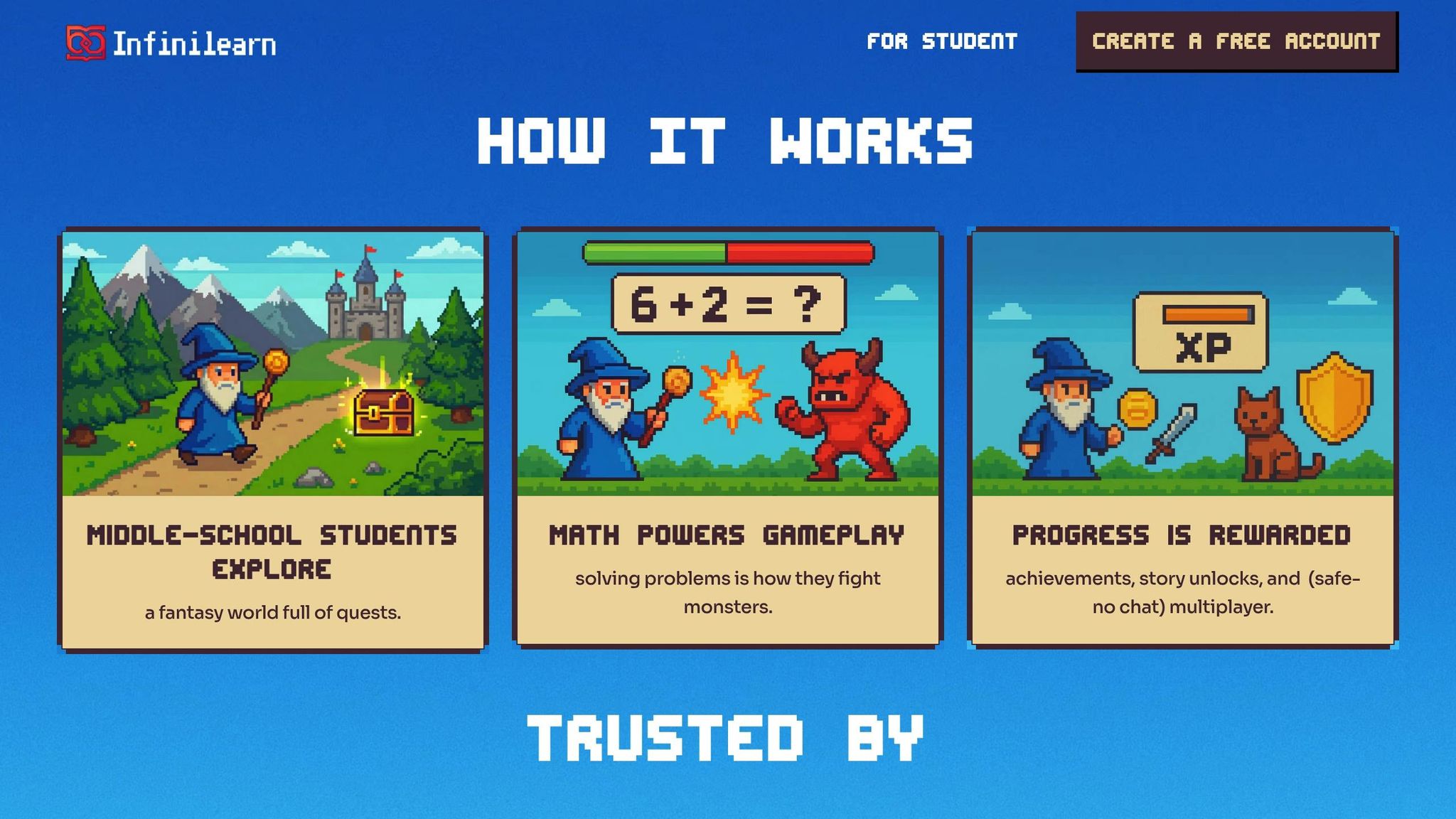
Infinilearn takes the benefits of cooperative math games and amplifies them, creating a platform that promotes teamwork and engagement for middle school students.
Multiplayer Collaboration in Numeria
Infinilearn's multiplayer mode transforms math practice into a shared adventure. Students team up in Numeria to battle monsters and complete quests, focusing on collaboration instead of individual competition. Players work together to defeat bosses and collect Seal Fragments, which naturally encourages communication about math strategies. During turn-based battles, students discuss and solve problems together, shifting the spotlight from personal scores to team achievements. This setup fosters peer-to-peer learning, where students help each other refine problem-solving skills. Essentially, the cooperative gameplay mirrors the same benefits seen in classroom group activities.
Common Core Alignment and Adaptive Gameplay
The game also tailors its cooperative experience by aligning with Common Core standards and using adaptive learning. Each student's math problems are adjusted to their grade level - whether 6th, 7th, or 8th grade - while they remain part of the same quest. For example, a 6th grader and an 8th grader can work side by side, each solving problems suited to their abilities. This ensures that every student can contribute meaningfully to the team's progress, regardless of their skill level. By blending personalized learning with teamwork, Infinilearn creates an environment where students improve both their individual math skills and their ability to collaborate effectively. The focus is on understanding and mastery, rather than just racing to the right answer.
Low-Pressure Learning Environment
Infinilearn eliminates competitive pressure by avoiding public leaderboards and rankings. Mistakes are part of the process, but they don't lead to public embarrassment or comparisons with classmates. This creates a safe space where students feel comfortable taking risks and sharing ideas, keeping the emphasis on group success. By embedding math challenges into a fantasy RPG storyline, where students protect Numeria and restore the Arcane Seal, the game reframes math practice as an exciting adventure. This approach reduces math anxiety by shifting the focus from performance pressure to collective achievement.
Additionally, the game includes a progress tracking dashboard for parents and teachers, offering insights into each student's growth without exposing them to peer comparison. This thoughtful design supports a low-pressure, cooperative learning environment that helps students build confidence while working together toward shared goals.
Conclusion
Cooperative and competitive math games each bring unique benefits to middle school classrooms. Competitive games can sharpen immediate performance and fluency, while cooperative games tend to nurture positive attitudes toward math, build problem-solving skills, and spark long-term interest.
The best approach depends on your students' needs. For those dealing with math anxiety or low confidence, cooperative games offer a supportive, low-pressure environment where mistakes become stepping stones for learning. Research shows that students in collaborative settings are more likely to want to play math games again compared to those in competitive environments. As Fengfeng Ke, Associate Professor at Florida State University, explains:
"Game-based learning in cooperative goal structure was most effective in promoting positive math attitudes".
Cooperative games also encourage peer-to-peer learning. Students collaborate, share strategies, and explain their thought processes, which fosters a focus on understanding rather than simply outperforming others.
This philosophy shapes Infinilearn’s cooperative model. Its multiplayer mode invites students to team up in quests to protect Numeria, with adaptive learning tailored to individual grade levels and no public leaderboards. By prioritizing teamwork, the design helps students build confidence and improve math skills while supporting one another.
The key takeaway is clear: cooperative game structures consistently excel at promoting problem-solving and a love for math. Keep an eye on how students respond - if frustration or disengagement surfaces, consider adjusting the format. The ultimate goal is to create a space where every student feels encouraged to learn, take risks, and develop a genuine interest in mathematics.
FAQs
When should teachers use cooperative vs. competitive math games?
Teachers can incorporate cooperative math games to encourage teamwork, foster positive social interactions, and create an engaging classroom atmosphere. These activities work particularly well for students who benefit from group collaboration, as they help lower anxiety and build confidence through shared efforts.
On the other hand, competitive math games are excellent for energizing students and driving motivation in a more challenge-oriented setting. They cater to those who thrive on competition, offering a sense of accomplishment while helping to sharpen their skills.
How can competition be motivating without increasing math anxiety?
Competition can inspire students and keep them motivated, especially when the focus is on personal improvement and mastering skills rather than just winning. By combining competition with opportunities for collaboration and presenting it as a way to push personal limits, students can remain engaged without feeling overwhelmed. Creating a supportive atmosphere that values effort and celebrates progress helps build resilience and motivation, turning competition into a constructive part of the learning process instead of a trigger for anxiety.
Can mixed-skill groups succeed in cooperative math games?
Yes, mixed-skill groups can thrive in cooperative math games when set up with care and intention. Studies indicate that working in diverse groups promotes interaction, allowing lower-ability students to benefit from peer support and exposure to different ways of thinking. Additionally, cooperative goals help create a more positive outlook on math for students across all skill levels. When thoughtfully designed, these groups can boost engagement, motivation, and learning for everyone involved.