Study: Collaborative RPGs Improve Math Engagement
Game-Based Learning
Feb 14, 2026
Feb 14, 2026
Team-based RPGs use teamwork, instant feedback, and storytelling to lower math anxiety, boost confidence, and improve middle school math outcomes.
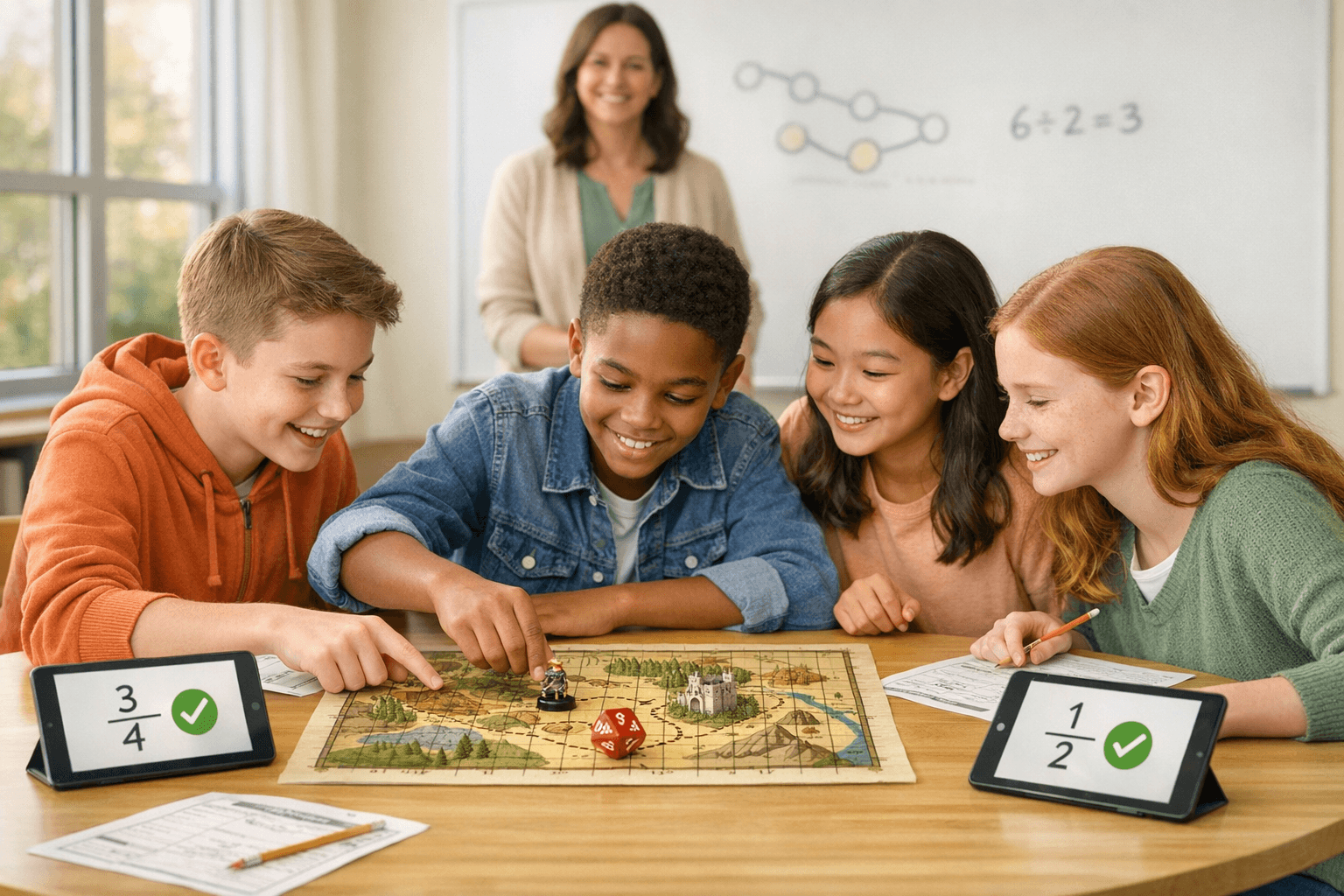
Collaborative role-playing games (RPGs) are proving to be a game-changer for middle school math education. By combining teamwork, instant feedback, and immersive storytelling, these games help students overcome math anxiety, boost confidence, and improve performance. Here’s why they work:
Teamwork builds motivation: Students take on roles like Mages or Warriors, contributing unique skills to solve math problems together. This shared responsibility increases engagement and reduces pressure.
Immediate feedback: Mistakes are corrected on the spot, helping students learn faster and stay motivated.
Lower math anxiety: Role-playing helps students set aside self-doubt, making math feel less intimidating.
For example, a study in Switzerland showed a 4.3% improvement in math attitudes after just seven weeks of collaborative RPGs. Similarly, gamified platforms in the U.S. led to an 18% performance boost compared to traditional methods. Programs like Infinilearn are building on this research, offering students a fun, team-based way to tackle math challenges while tracking progress for both teachers and parents.
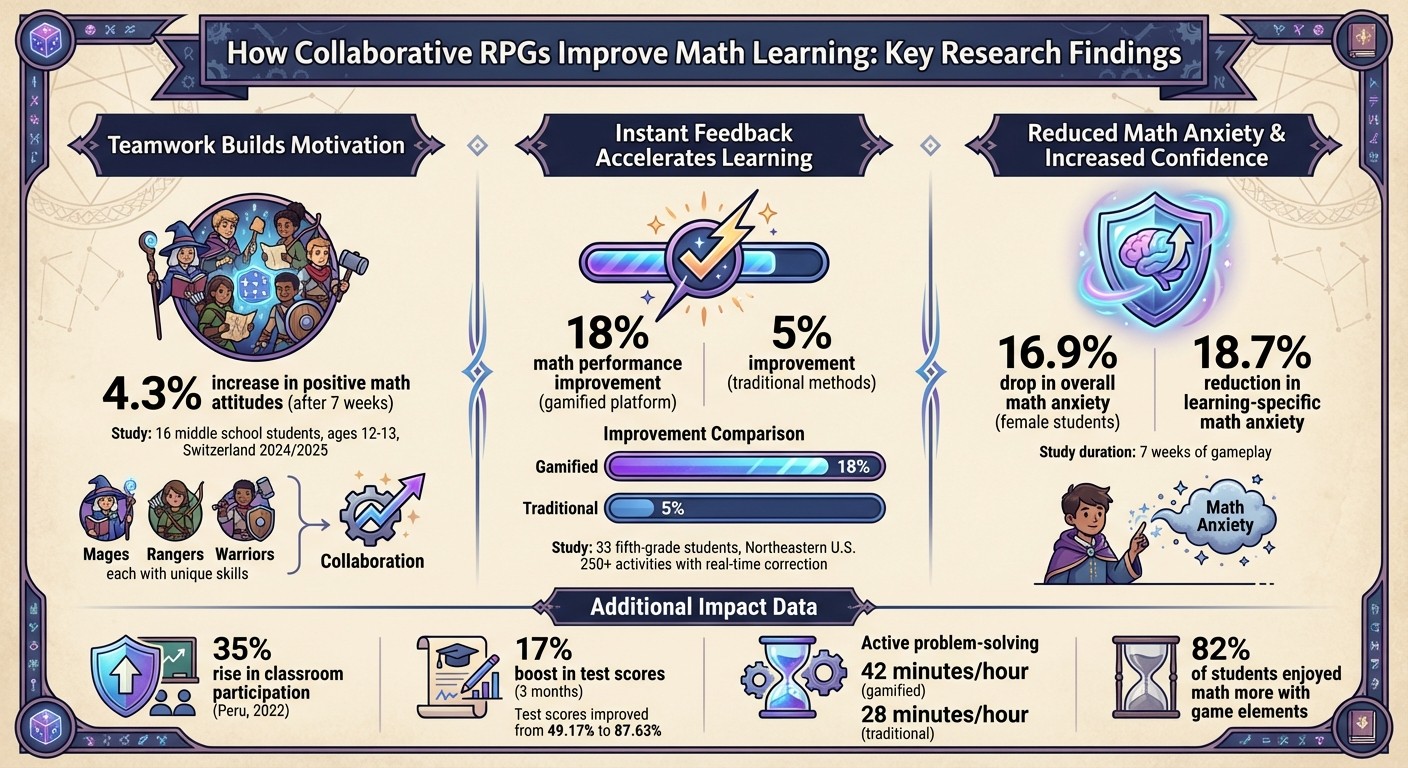
How Collaborative RPGs Improve Math Learning: Key Research Findings
Engaging maths education through games, technology and interdisciplinary learning
Study Results: How Collaborative RPGs Improve Math Engagement
Recent findings reveal how collaborative role-playing games (RPGs) can make math more engaging and improve learning outcomes for students.
Teamwork Increases Student Motivation
Middle school math often struggles to capture student interest, but collaborative RPGs offer a fresh solution by fostering teamwork and shared goals. A study conducted in Ticino, Switzerland, during the 2024/2025 school year observed 16 middle school students, aged 12–13, participating in an RPG called The Kingdom of Armathia. In this game, students took on roles like Mages, Rangers, and Warriors, each with distinct skills that contributed to the team's success. For instance, Mages simplified complex problems, while Rangers earned extra experience points for their team.
This role-based structure allowed every student to play an active part, leading to a 4.3% increase in the class's overall attitude toward math after just seven weeks. Additionally, features like Team Hit Points (THP), which track collective progress, reinforced the idea of shared responsibility and teamwork.
Instant Feedback Reinforces Math Concepts
One of the biggest challenges in traditional math teaching is the delay in feedback, which can make it harder for students to learn from their mistakes. Collaborative RPGs solve this by offering immediate feedback, helping students correct errors on the spot. A study involving 33 fifth-grade students in the Northeastern U.S. used a gamified platform with over 250 activities. One task, "Equivalents", required students to solve fraction and decimal problems while watching a progress bar fill toward 100%. Incorrect answers caused the bar to decrease, providing instant correction opportunities.
The results were striking: students using this gamified system improved their math performance by 18%, compared to just 5% improvement with traditional methods.
Rewards weren’t just motivators; they acted as real-time confirmation of effort and progress, making learning more engaging.
Reduced Math Anxiety and Increased Confidence
Collaborative RPGs also address emotional hurdles like math anxiety, which often holds students back. By stepping into character roles, students can temporarily set aside personal doubts, such as the belief that they’re "not a math person." In the Kingdom of Armathia study, female participants saw a 16.9% drop in overall math anxiety and an 18.7% reduction in anxiety specifically tied to learning math after seven weeks of gameplay.
Masiar Babazadeh, a researcher at the University of Applied Sciences and Arts of Southern Switzerland (SUPSI), noted:
The gamified context motivates students not only to practice exercises that might otherwise feel tedious in a traditional setting, but also to engage with complex challenges that students with low self-efficacy often avoid challenging tasks in traditional settings.
How Infinilearn Uses These Research Principles
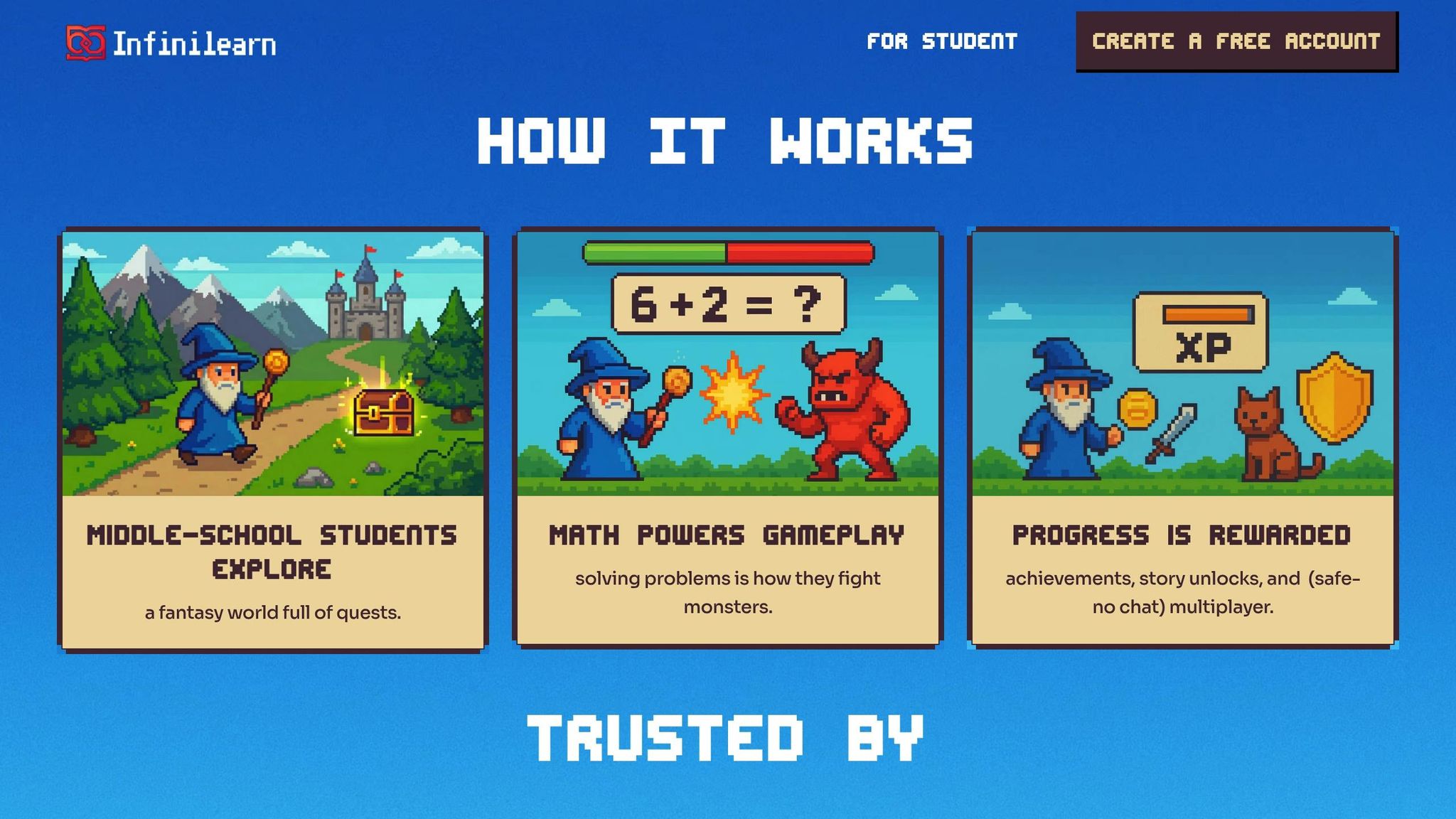
Drawing from studies that highlight how collaborative RPGs can enhance math engagement, Infinilearn incorporates these insights into its game design for middle school learners. Set in the immersive fantasy world of Numeria, the game invites 6th–8th grade students to become Academy apprentices. Their mission? To recover Seal Fragments and restore balance after the Arcane Seal is shattered. Math challenges are seamlessly woven into turn-based battles, where solving equations helps defeat monsters and advance the storyline.
Math-Powered Battles with Adaptive Difficulty
Each battle is tailored to the student's grade level, aligning with Common Core standards. When mistakes happen, the game provides instant feedback and extra practice opportunities. It also tracks areas where students struggle, adjusting future challenges to ensure they get the practice they need - without feeling overwhelmed.
Players can choose from five distinct classes, each offering a unique approach to gameplay. This setup ensures every student has a meaningful role to play, echoing findings from the Kingdom of Armathia study, which linked role-based activities to improved attitudes toward math.
Multiplayer Modes and Team-Based Gameplay
Infinilearn also emphasizes teamwork through its multiplayer features. Students can collaborate on battles and shared quests, exchanging strategies, comparing solutions, and supporting one another through tough problems. This cooperative element taps into research showing that social interaction can enhance learning outcomes. By steering away from public leaderboards and competitive rankings, the game reduces math-related anxiety and promotes a more positive outlook on the subject.
Progress Tracking Tools for Parents and Teachers
To further its educational value, Infinilearn includes real-time progress tracking tools for both parents and teachers. The dashboard provides insights into which Common Core standards have been mastered, highlights areas needing extra practice, and tracks time spent on different math topics. This allows adults to offer timely, targeted support instead of relying solely on periodic report cards.
For those with a premium subscription, additional features unlock, such as detailed grade progression and class-wide performance trends. Teachers can use this data to fine-tune their instruction, while parents can celebrate milestones and focus on areas needing improvement at home.
Using Collaborative RPGs in Middle School Math Instruction
Building a Supportive Learning Environment
Shifting the focus from individual scores to team success can have a powerful impact on how students approach math. When the emphasis is on working together rather than always being correct, students feel less pressure and are more likely to help one another tackle tough problems. Research backs this up: a 2024 study showed that sixth graders in collaborative environments made noticeable gains in math, regardless of where they started skill-wise.
In this setup, the teacher takes on the role of a facilitator rather than a traditional instructor. As Masiar Babazadeh puts it:
The teacher acts as a game master, guiding the narrative while minimizing direct intervention.
This "game master" approach gives students the freedom to explore math concepts on their own terms, turning the classroom into a space where curiosity and teamwork thrive. It’s a model that works well both in schools and at home, laying a strong foundation for practical math learning.
Steps for Classroom and Home Implementation
Start by setting clear and specific learning objectives. For example, decide which math topic - like fractions or multiplication - the game will focus on reinforcing. This clarity keeps everyone on track: educators and parents can guide effectively, while students stay engaged in the adventure.
Keep RPG groups small to maintain focus and make management easier. Try using creative methods, like character-based puzzles, to form random groups and encourage fresh collaboration.
At home, you can adapt strategies like "Think-Ink-Pair-Share." This involves having students first think about a problem on their own, jot down their solution, and then discuss it with a parent or sibling. This process not only helps them organize their thoughts but also strengthens their understanding through discussion.
Leverage digital tools to track progress and identify areas where students need extra help. For instance, platforms like Infinilearn align with Common Core standards and provide real-time updates on student achievements. Research involving nearly 800 students across six public schools found that embedding math challenges directly into game mechanics significantly boosts motivation compared to tacking on separate drills. Dorit Alt from Kinneret Academic College highlights the value of this approach:
The game is an important resource in teaching mathematics due to the activity, the practice, the feedback, and the enjoyment, and above all, it is a good ground for building new knowledge.
Conclusion
Research highlights how collaborative RPGs can reshape middle school math engagement. For instance, in 2022, a public secondary school in Lima, Peru, introduced an RPG-inspired adaptive learning method for sixth graders across three classrooms. Over just three months, the school reported a 35% rise in classroom participation and a 17% boost in test scores. Even more telling, 82% of the students said they enjoyed math more when game elements were part of the lessons.
Infinilearn has embraced this approach, crafting immersive math-based adventures that yield impressive results. Test scores soared from 49.17% to 87.63% following the introduction of RPG-based gameplay. Students in these gamified lessons actively solved problems for an average of 42 minutes per hour, compared to just 28 minutes in traditional classrooms.
This strategy directly addresses common struggles in middle school math. Evgenia Anagnostopoulou from the University of Sussex, after testing "The Red Circle" RPG with 148 participants in 2023, remarked:
The results suggest that the method is effective, with serious learning taking place. The participants reported that they had found the game to be fun and a useful way to learn maths.
These findings have shaped the design of Infinilearn, where math problems are seamlessly woven into RPG-style gameplay. Within the world of Numeria, students tackle grade-specific math challenges aligned with Common Core standards. They collaborate to uncover Seal Fragments through turn-based battles, all while enjoying a narrative-driven experience - free from the pressure of competitive rankings or public leaderboards.
The evidence offers a clear direction for educators and parents aiming to improve math engagement. By embedding math problems into an adventurous storyline, this approach transforms math from a chore into an exciting journey.
FAQs
How do collaborative RPGs reduce math anxiety?
Collaborative RPGs help ease math anxiety by creating a team-focused environment where students work together to tackle problems. This group dynamic lessens the stress of individual performance and promotes positive social interactions, making math feel more approachable. Through engaging storytelling and cooperative gameplay, these games also boost confidence and motivation, encouraging students to face math challenges with less fear and frustration.
What math topics work best in an RPG format?
Research indicates that concepts such as arithmetic (addition, subtraction, multiplication, division), fractions, ratios, proportions, and basic algebra are particularly suited for RPGs. These topics align seamlessly with middle school curricula and can be woven into exciting, story-based challenges. Games like Infinilearn incorporate interactive elements - think math-fueled battles and quests - to encourage problem-solving, strategic thinking, and the practical use of math skills in a fun, immersive way.
How can teachers track learning from RPG gameplay?
Teachers have the opportunity to observe students' learning in action by watching how they interact with and solve problems within the game. Studies indicate that teachers can take on the role of guides, carefully noting how students approach math challenges. Beyond observation, feedback plays a key role - both from students sharing their experiences and from teachers offering their insights. Expert reviews of the game's content further contribute to evaluating how well it supports understanding and keeps students engaged. Together, these approaches offer meaningful insights into students' progress during RPG-based learning.