Fun vs. Learning: Finding the Right Balance in Math Games
Game-Based Learning
Feb 16, 2026
Feb 16, 2026
Balancing fun and learning in math games is essential: embed math into gameplay, use adaptive difficulty, storytelling, and clear progress tracking.
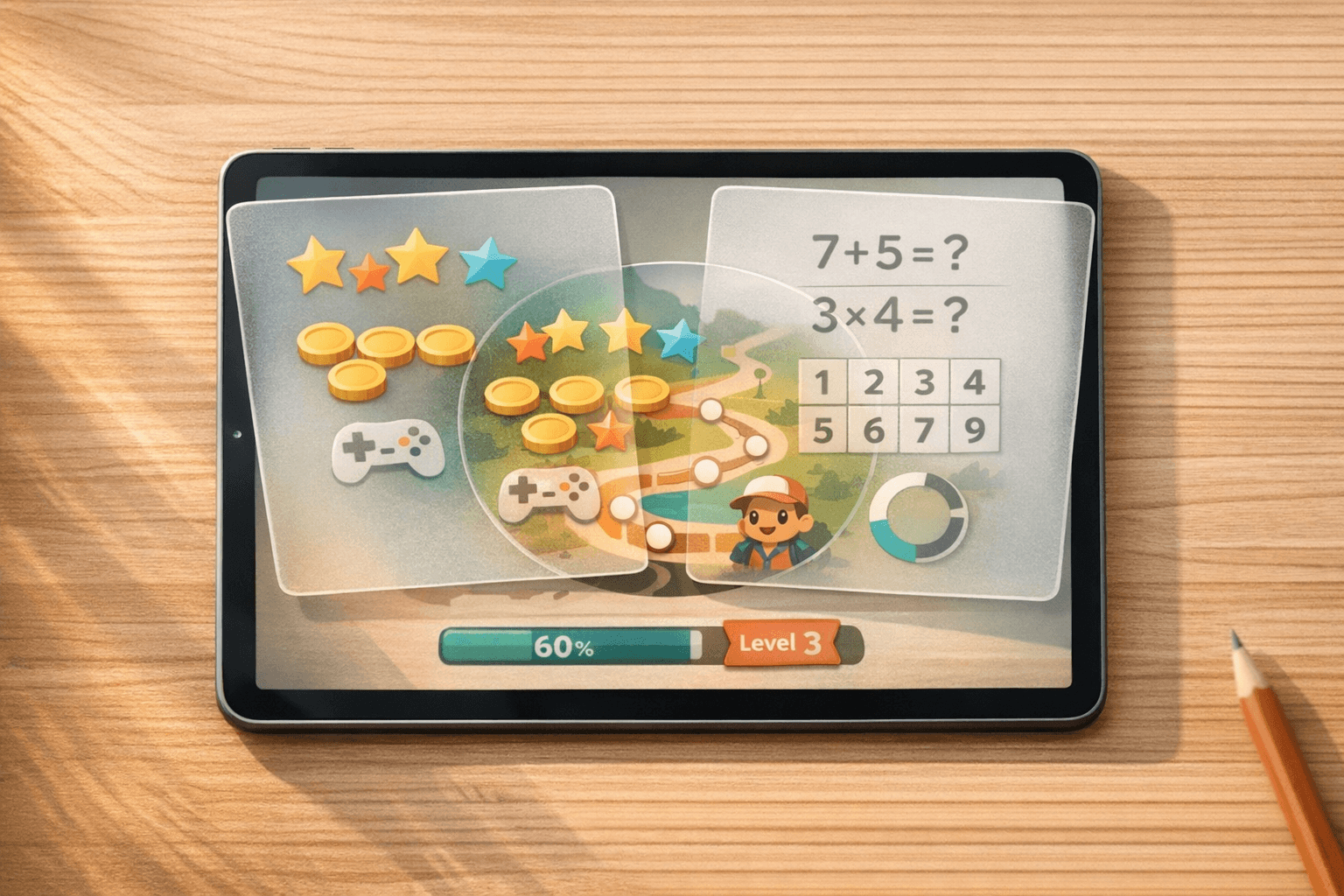
Math games work best when they balance fun with learning. Too much entertainment can hurt accuracy, while overly academic games risk losing student interest. The key is integrating math into gameplay so solving problems feels natural and rewarding.
Key takeaways:
Engagement matters: Features like visual feedback, storytelling, and rewards boost motivation.
Learning focus: Games aligned with educational standards help students build skills effectively.
Balance is critical: Games should neither overwhelm with flashy distractions nor bore with rigid drills.
Examples of success: Platforms like First in Math and Infinilearn show how to blend these elements, improving both engagement and academic outcomes.
Finding the right mix ensures students enjoy learning math while achieving real progress.
Balancing Fun vs Learning in Math Games: Key Factors and Outcomes
EVERY Math Teacher Should Know This Fun Game For The Classroom TARGET NUMBER
What Makes Math Games Fun
The difference between a student groaning at a worksheet and eagerly diving into a math problem often lies in how the problem is framed. Turning math into an adventure can change it from a chore into something students actually look forward to.
One key element is visual feedback systems, which keep students engaged by showing their progress in real time. Take the "strength meter" on the First in Math platform, for example. It tracks progress from 0% to 100%, moving forward with correct answers and slightly backward with mistakes. A study of 33 fifth-graders in January 2026 found that this feature encouraged strategic thinking instead of random guessing. Seeing their progress unfold builds confidence and keeps them motivated. Paired with interactive features, these visual cues help turn learning into a dynamic and enjoyable process.
How Fun Elements Increase Engagement
Interactive elements take math games to the next level by giving students a sense of control. Whether they're exploring game worlds, choosing challenges, or customizing characters, these choices create a feeling of agency. Research shows that this sense of control strengthens learning outcomes. On top of that, games that adjust difficulty based on performance ensure that advanced learners stay challenged while helping struggling students avoid frustration.
Storytelling also plays a big role in making math engaging. Instead of solving dry, abstract problems, students might use fractions to build a virtual structure or calculate coordinates to navigate a fantasy realm. By becoming math superheroes or embarking on epic quests, students form an emotional connection to the material, which keeps them invested in the learning process.
Competition and Rewards in Math Games
Digital rewards and competition add an extra layer of motivation. Stickers, badges, and points act as tangible markers of progress, validating effort and encouraging students to keep going. For instance, earning a bonus sticker for accurately estimating numerical equivalents gives students instant feedback that their skills are improving.
Both competition and collaboration enhance engagement in unique ways. A study published in the Journal of Educational Psychology by Jan L. Plass et al. found that competitive and collaborative modes both increased interest and enjoyment compared to solo play. Competition tends to drive better immediate performance and mastery-focused behavior, while collaboration keeps students playing longer and fosters a shared experience with classmates. The best math games offer options like leaderboards for competition and team-based challenges for collaboration, letting students choose what motivates them most.
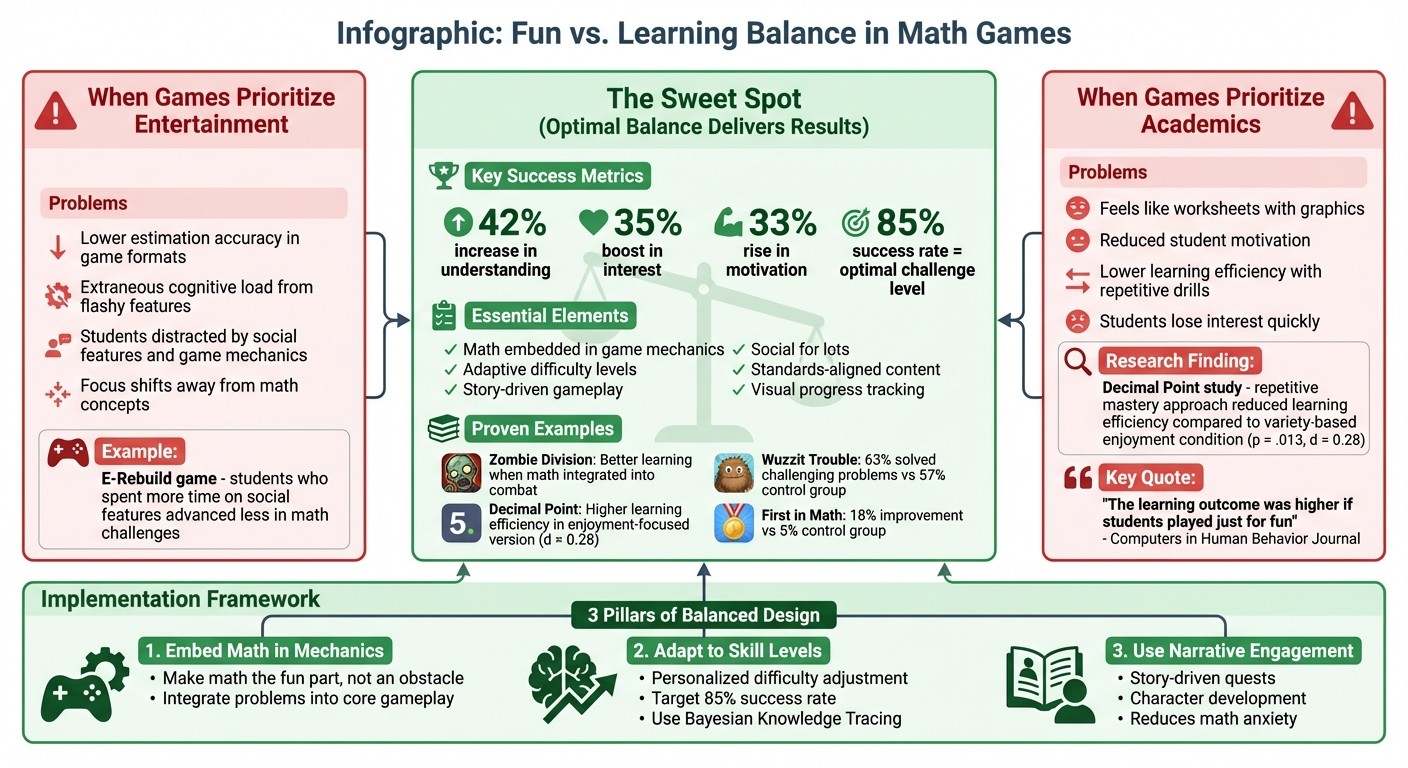
The results speak for themselves: gamified math applications have led to a 42% increase in understanding, a 35% boost in interest, and a 33% rise in motivation. By blending fun with learning, these games not only captivate students but also help them build lasting math skills through engaging challenges.
What Learning Means in Math Games
While fun is the hook that keeps students engaged, learning is the real payoff. Engaging gameplay may spark interest, but the value of math games lies in their ability to deliver meaningful academic growth. The key is ensuring these games align with educational standards and help develop skills that extend beyond the screen. Let’s dive into how aligning games with these standards turns playtime into a powerful learning experience.
Aligning Games with Educational Standards
The best math games don’t just entertain - they’re intentionally designed to meet specific educational benchmarks. For example, they often align with the Common Core State Standards (CCSS) or the National Council of Teachers of Mathematics (NCTM) standards, covering areas like "Number and Operations" or "Algebra".
Take ST Math as a case in point. A study by the MIND Research Institute, involving 10,860 students across 52 schools in Southern California between 2010 and 2014, found that the program improved basic number sense skills with an effect size of 0.14. This demonstrates how a well-aligned game can make a measurable difference in student outcomes.
But alignment isn’t just about content - it’s also about process. High-quality math games incorporate process standards that emphasize problem-solving, reasoning, communication, and representation. A review of 23 digital math games revealed that while most focused heavily on "Number and Operations", nearly all also supported NCTM Process Standards, promoting critical thinking alongside computational skills.
The First in Math platform provides another example. In one study, a group of fifth graders working on a standards-aligned "Equivalents" task showed an 18% improvement compared to just 5% in the control group.
"Alignment between intentions, content, and assessment may best illuminate results." - Computers & Education
Building Problem-Solving Skills Through Games
Beyond meeting standards, effective math games nurture problem-solving skills that students can apply in real-world scenarios. Instead of relying solely on rote memorization, these games encourage learners to understand why mathematical concepts work, making the learning experience richer and more meaningful.
Carnegie Mellon University’s Decimal Point game is a great example. Designed to address misconceptions about decimals, it offers 24 mini-games where students answer multiple-choice self-explanation questions after each round. Between 2015 and 2019, 624 fifth- and sixth-grade students participated in studies using this game. The results showed that students developed a deeper understanding of decimals and could apply their knowledge to new problems. Interestingly, female students - who often report higher levels of math anxiety - benefited even more, helping to close the gender gap in math performance.
"Middle school is when math anxiety emerges among female students and therefore a crucial time for addressing this issue." - Journal of Mathematics Education at Teachers College
Another standout example comes from Wuzzit Trouble, studied by researchers Holly Pope and Charmaine Mangram at Stanford University. In 2016, 59 third-graders played the game for 10 minutes, three times a week over four weeks. The results were striking: students in the gaming group significantly improved their "number sense" assessments, narrowing the gap with higher-performing peers. Remarkably, 63% of players solved a challenging, unconventional math problem, compared to just 57% of the high-performing control group.
"Students who are great memorizers and quick to answer tend to excel in traditional math environments... [Wuzzit Trouble] allows room for making mistakes and valuing the problem-solving process in a low-threat context." - Holly Pope and Charmaine Mangram, Doctoral Candidates, Stanford Graduate School of Education
The Problems with Focusing Only on Fun or Only on Learning
Balancing fun and learning is crucial when designing effective math games. Overemphasizing one at the expense of the other creates problems that can derail the educational experience. The issue isn’t about choosing between engagement and education - it’s about recognizing how an imbalance affects the outcome. Let’s break down what happens when the focus shifts too far in either direction.
When Too Much Fun Reduces Learning
When math games lean heavily on entertainment, they risk losing their educational value. For example, research by Simon Greipl from the Leibniz-Institut für Wissensmedien highlights this issue. His study revealed that while students found game-based number line estimation tasks more enjoyable than traditional methods, their estimation accuracy suffered significantly in the game format.
"More fun in a math-learning task was ultimately bought at the expense of lower reliability, namely lowered accuracy of estimations in the learning game." – Simon Greipl, Leibniz-Institut für Wissensmedien
The problem often lies in what's called extraneous cognitive load. Flashy features like intricate navigation, quests, and world-building can overwhelm a student’s working memory, leaving little capacity for actual math problem-solving. Without the right instructional support, students may focus more on the game mechanics than on the math concepts they’re supposed to learn.
Take the example of the 3D architecture game E-Rebuild. While middle school students enjoyed social interactions and chatting with peers during the game, these elements distracted them from completing math tasks. Those who spent less time on social features advanced more effectively through the game’s mathematical challenges.
When Too Much Learning Reduces Fun
On the flip side, games that overemphasize academics often lose the elements that make them engaging. If a game feels like a traditional worksheet with some graphics slapped on, students quickly lose interest and motivation.
A 2020 study at Carnegie Mellon University explored this issue with 159 fifth- and sixth-graders playing the Decimal Point game. In the "Learning Condition", students tracked their progress using mastery bars and repeatedly practiced the same mini-games to improve their decimal skills. However, this repetitive approach reduced learning efficiency compared to the "Enjoyment Condition", where students tackled a variety of challenges. Those in the enjoyment-focused group showed significantly higher learning efficiency (p = .013, d = 0.28).
Similarly, research involving 150 students aged 13 to 17 found that when they were explicitly told to "learn" from a game, their focus shifted to irrelevant tasks, and their overall learning outcomes declined. In contrast, students who played purely for fun achieved better results.
"The learning outcome was higher if students played just for fun." – Computers in Human Behavior Journal
Ultimately, striking a balance is key. Games that are too focused on fun can become distracting, while overly academic games risk turning into tedious drills. Both extremes undermine the potential for math games to be both engaging and educational.
How to Balance Fun and Learning in Math Games
Making math an enjoyable part of a game - not a chore - requires careful design. The trick is to weave math directly into the gameplay, so solving problems feels like a natural and rewarding part of the experience. Here's how this can be done effectively.
Embedding Math Problems into Game Mechanics
The best math games incorporate mathematical thinking directly into their mechanics. Instead of disrupting the flow with unrelated quizzes, the challenges should feel like an integral part of the game. For instance, imagine unlocking a door by solving a proportional reasoning puzzle rather than answering a pop-up question.
Take Zombie Division, a game created in 2011 by researchers M. P. Jacob Habgood and Shaaron Ainsworth. Designed for kids aged 7 to 11, the game required players to defeat skeletons by choosing weapons that matched divisors of the numbers displayed on the skeletons’ chests. For example, a skeleton with the number 15 could be defeated using a weapon marked with "3" or "5." This version of the game, where math was embedded in the combat mechanics, led to better learning outcomes compared to versions where math challenges were separated from gameplay.
"Mathematics is not about manipulating symbols, it is a way of thinking, and you can mainline that way of thinking into a person's head using a video game." – Keith Devlin, Mathematics Education Specialist
This approach avoids making math feel like an obstacle. Instead, it becomes the fun part of the game - whether it’s solving puzzles, navigating challenges, or strategizing attacks. By embedding math into the core mechanics, students engage more deeply with the concepts, and the game can naturally adjust to their learning level.
Adjusting Difficulty for Different Skill Levels
A game that adjusts its difficulty based on the player’s skill level keeps the experience engaging without becoming frustrating. Research suggests that learners perform best when they succeed about 85% of the time, striking a balance between challenge and accomplishment.
For example, a study of 234 secondary school students found that games with adaptive difficulty led to significantly better learning outcomes compared to static ones. Adaptive games tweak the difficulty based on the player’s performance - making tasks easier if the player struggles and harder when they succeed.
In 2020, Carnegie Mellon University studied how adaptive mechanics worked in the game Decimal Point. This game tracked mastery of five decimal-related skills (like addition and sorting) using Bayesian Knowledge Tracing. Players could see their progress on a dashboard, and the game recommended mini-games tailored to their weaker areas. This personalized approach helped students focus on what they needed most without feeling overwhelmed.
Fast-paced games can make even simple math problems feel harder, thanks to the added cognitive load of time pressure and competition. Effective games account for this by calibrating difficulty so that players aren’t bogged down by the mechanics while solving problems. Adding a strong narrative can further enhance engagement, making the challenges feel purposeful.
Using Stories and Characters to Engage Students
A great story can turn solving math problems into a meaningful adventure. When players are cast in roles like saving a magical world or restoring balance to a kingdom, math becomes a tool for completing their quest - not just a task to check off.
One study involving 27 college students found a strong link between narrative-driven gameplay and successful problem-solving. Researchers observed over 2,000 in-game actions, confirming that players engaged more deeply with math when it was tied to the game’s story. Challenges that appeared as part of the game world - like objects or characters - helped players stay immersed and motivated.
For instance, Infinilearn’s game set in Numeria builds its narrative around a shattered Arcane Seal. Players, acting as apprentices, must recover Seal Fragments to restore balance. Math problems are embedded in turn-based battles, where solving them correctly determines attack strength and progress. This approach transforms math practice into an exciting journey, far removed from the monotony of worksheets.
Narrative-driven games also help reduce math anxiety. Immersive stories and relatable characters create a positive emotional environment, encouraging students to take risks and learn from mistakes without fear. By tying math challenges to a meaningful story, these games strike a perfect balance between learning and fun.
Infinilearn: How One Game Balances Fun and Learning
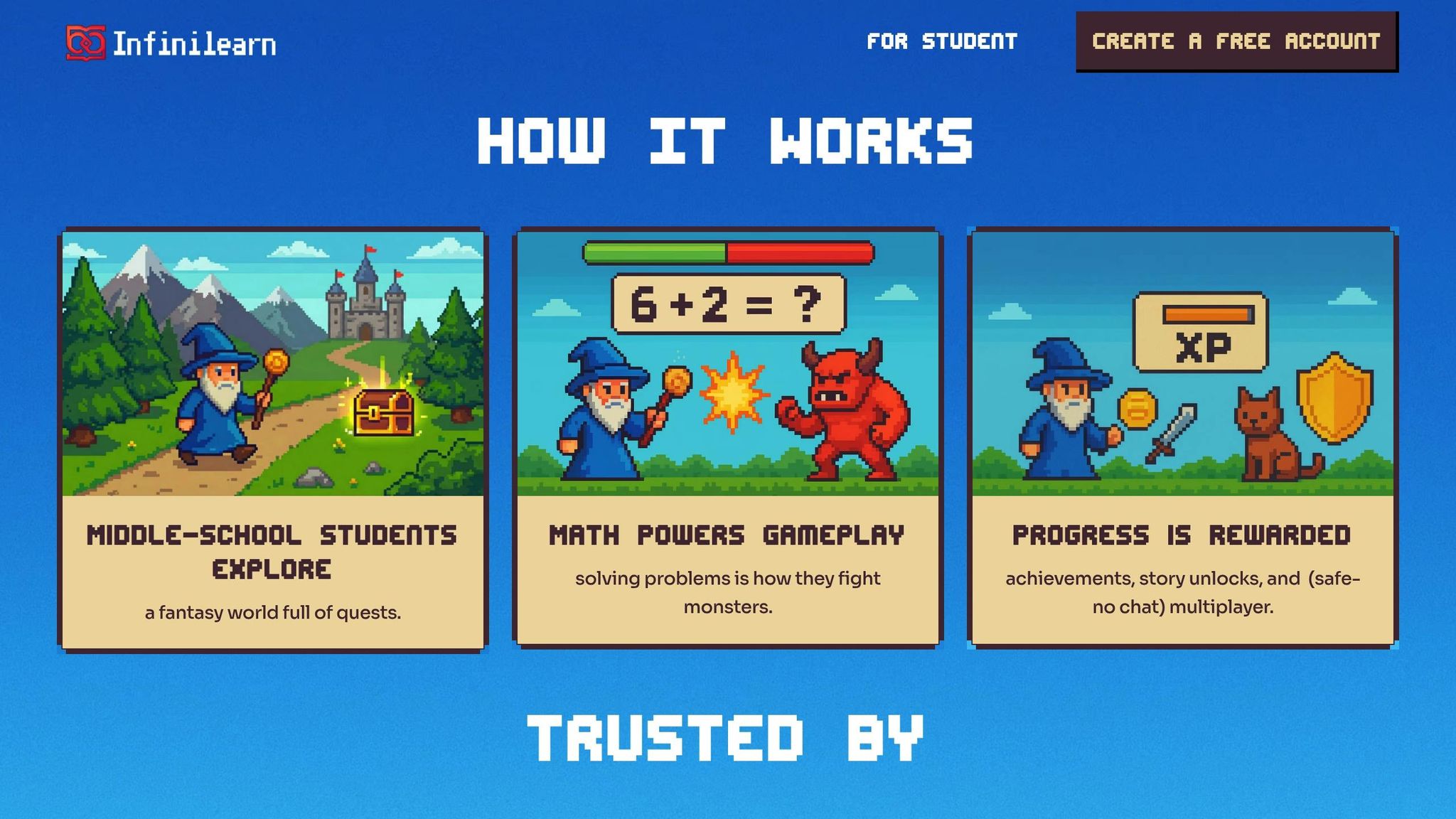
Infinilearn is a standout example of how to combine engaging gameplay with meaningful educational value.
Designed for middle school students in grades 6 through 8, Infinilearn transforms math practice into an immersive RPG adventure. Set in Numeria, a world where the Arcane Seal has been shattered, players step into the shoes of Academy apprentices. Their mission? To recover the Seal Fragments and restore balance to the realm.
What makes Infinilearn special is how deeply math is woven into the gameplay. According to the developers, "solving problems is how they fight monsters". Every turn-based battle ties the strength of a player’s attack to their ability to solve math challenges, placing learning at the heart of the adventure.
The game adapts to individual players, tailoring challenges to their skill levels. This ensures that tasks remain achievable but still rewarding. Aligned with Common Core standards for grades 6 through 8, Infinilearn covers topics like algebra and geometry, making it a comprehensive tool for math practice. Developer Adrian Martinez highlights, "The app will adapt to your personal level and support you throughout your learning journey". By striking a balance between entertainment and education, the game avoids the extremes of being too distracting or overly rigid.
Game Features That Keep Players Engaged
Infinilearn’s top-down RPG design includes quests, diverse zones to explore, challenging boss battles, and customizable characters, which encourage players to take ownership of their experience.
The game also supports safe multiplayer interactions, allowing students to collaborate or compete in a controlled environment. The developers recommend playing for 20–30 minutes daily to maintain steady progress without causing fatigue.
Currently, the game is available on Apple devices, with a web version in development. Players can choose between a free tier, which includes full RPG quests and basic progress tracking, or a premium membership for $9.99/month. The premium plan unlocks exclusive character cosmetics, early access to new features, and detailed progress reports.
Progress Tracking for Parents and Teachers
In addition to its engaging gameplay, Infinilearn provides tools for tracking academic progress, ensuring transparency for parents and educators.
The game includes a detailed dashboard that monitors XP, skill mastery, and practice time. It also sends automated notifications to parents and offers progress reports aligned with academic standards. This feature allows parents and teachers to see exactly how the game supports a student’s learning journey, proving that it’s more than just fun - it’s a tool for real educational growth.
Conclusion
Balancing fun and learning in math games is essential for helping students succeed. Research highlights that students' intrinsic motivation and a state of deep focus, often called "flow", are key drivers of learning outcomes. However, striking the right balance can be tricky. Games that prioritize entertainment too much may suffer from the "fun-accuracy trade-off", where excessive enjoyment undermines the reliability of learning tasks. On the flip side, games that are overly academic risk alienating students, particularly those who struggle with math anxiety.
The best math games combine fun and learning in a way that feels natural. For example, a 2020 study at Carnegie Mellon University tested the math game Decimal Point with 159 fifth and sixth graders. The study revealed that a version of the game focused on enjoyment led to higher learning efficiency compared to a control group. Students achieved similar test scores in fewer rounds, with effect sizes of d = 0.28 for posttests and d = 0.33 for delayed posttests. This shows that incorporating enjoyable elements into learning can actually speed up the process.
The secret lies in making sure that fun features are tightly connected to the learning goals, rather than being superficial distractions. Effective games adapt to each player's skill level, offer clear progress tracking through tools like open learner models, and integrate math challenges directly into the gameplay. As researcher Manuel Ninaus explains:
"Learning success in game-based learning approaches are driven by students' acceptance of the game as a learning tool and content-specific intrinsic motivation".
For parents and educators seeking balanced math games, Infinilearn is an excellent example of these principles in action. By embedding math challenges into RPG-style battles, tailoring tasks to individual skill levels, and offering transparent progress tracking, the game creates an engaging yet academically rigorous experience. This approach keeps students motivated while helping them build real mathematical skills, proving that fun and learning can go hand in hand.
FAQs
How can I tell if a math game is actually teaching skills?
To figure out if a math game is actually teaching useful skills, see if it helps improve reasoning and problem-solving instead of just encouraging memorization. Studies show that good math games boost both understanding of concepts and overall math ability, making the learning experience more impactful.
What are signs a game is too distracting to learn from?
Games can become a distraction from learning when players consistently bypass content, take advantage of game mechanics rather than focusing on the intended goals, or face lingering frustration. A term like "confrustion" - a mix of confusion and frustration - often points to cognitive overload, particularly when the game's entertainment value overshadows the clarity of its educational content. To truly aid learning, games need to strike a balance between being engaging and maintaining clear, focused educational objectives, reducing both unnecessary distractions and frustration.
How much daily play time is best for real progress?
Research indicates that spending 10 to 30 minutes a day playing math games can lead to meaningful improvements in learning. Even brief sessions, as short as 10 minutes, can make a noticeable difference. The secret lies in consistency - regular, focused practice strengthens skills over time.